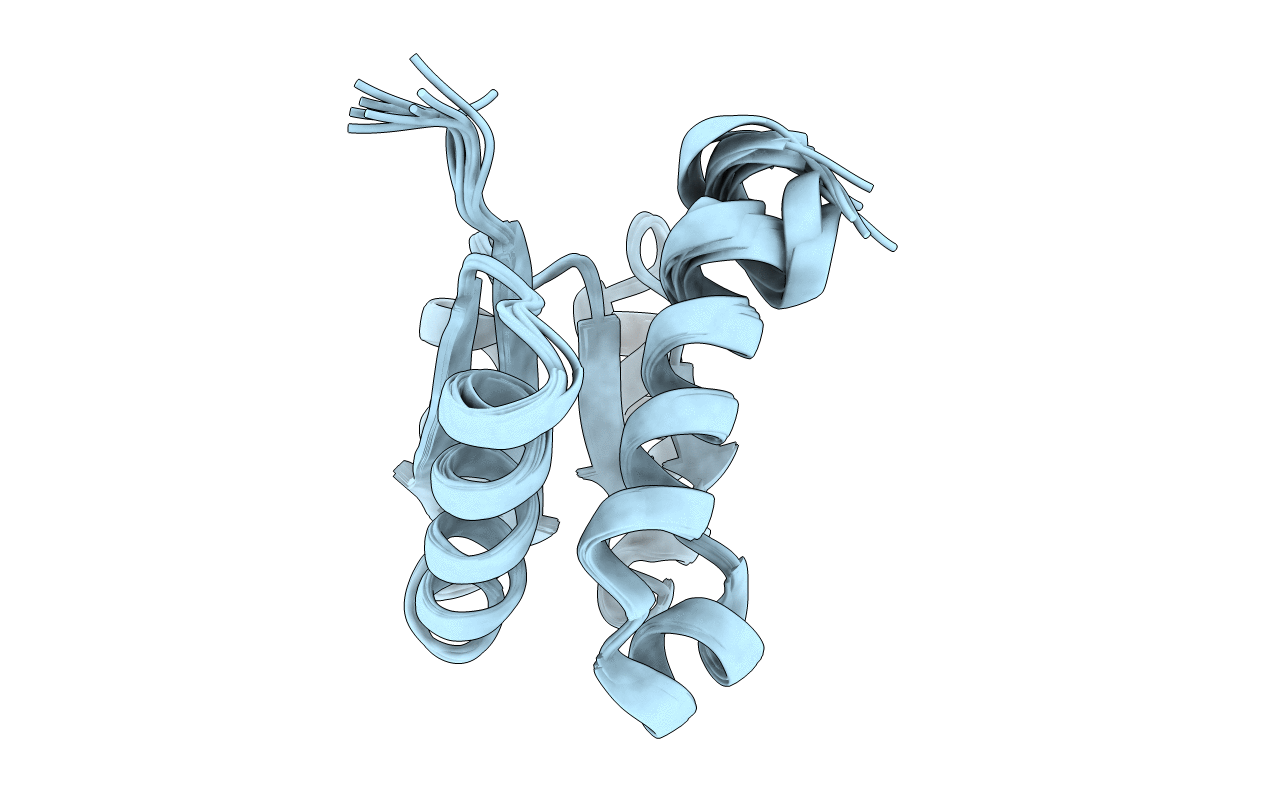
1H9C image
Deposition Date 2001-03-07
Release Date 2001-05-21
Last Version Date 2024-10-23
Entry Detail
PDB ID:
1H9C
Keywords:
Title:
NMR structure of cysteinyl-phosphorylated enzyme IIB of the N,N'-diacetylchitobiose specific phosphoenolpyruvate-dependent phosphotransferase system of Escherichia coli.
Biological Source:
Source Organism:
Host Organism:
Method Details:
Experimental Method:
Conformers Calculated:
33
Conformers Submitted:
9
Selection Criteria:
TARGET-FUNCTION, R-FACTOR, NUMBER OF VIOLATIONS

Macromolecular Entities
Structures with similar UniProt ID
Protein Blast
Polymer Type:polypeptide(L)
Molecule:PTS SYSTEM, CHITOBIOSE-SPECIFIC IIB COMPONENT
Chain IDs:A
Chain Length:106
Number of Molecules:1
Biological Source:ESCHERICHIA COLI
Modified Residue
Compound ID Chain ID Parent Comp ID Details 2D Image
CSP A CYS S-PHOSPHOCYSTEINE
Ligand Molecules
Primary Citation
NMR Structure of Cysteinyl-Phosphorylated Enzyme Iib of the N,N'-Diacetylchitobiose Specific Phosphoenolpyruvate-Dependentphosphotransferase System of Escherichia Coli
J.Mol.Biol. 308 993 1009 (2001)
PMID: 11352587 DOI: 10.1006/JMBI.2001.4623

Abstact

The determination by NMR of the solution structure of the phosphorylated enzyme IIB (P-IIB(Chb)) of the N,N'-diacetylchitobiose-specific phosphoenolpyruvate-dependent phosphotransferase system of Escherichia coli is presented. Most of the backbone and side-chain resonances were assigned using a variety of mostly heteronuclear NMR experiments. The remaining resonances were assigned with the help of the structure calculations.NOE-derived distance restraints were used in distance geometry calculations followed by molecular dynamics and simulated annealing protocols. In addition, combinations of ambiguous restraints were used to resolve ambiguities in the NOE assignments. By combining sets of ambiguous and unambiguous restraints into new ambiguous restraints, an error function was constructed that was less sensitive to information loss caused by assignment uncertainties. The final set of structures had a pairwise rmsd of 0.59 A and 1.16 A for the heavy atoms of the backbone and side-chains, respectively. Comparing the P-IIB(Chb) solution structure with the previously determined NMR and X-ray structures of the wild-type and the Cys10Ser mutant shows that significant differences between the structures are limited to the active-site region. The phosphoryl group at the active-site cysteine residue is surrounded by a loop formed by residues 10 through 16. NOE and chemical shift data suggest that the phosphoryl group makes hydrogen bonds with the backbone amide protons of residues 12 and 15. The binding mode of the phosphoryl group is very similar to that of the protein tyrosine phosphatases. The differences observed are in accordance with the presumption that IIB(Chb) has to be more resistant to hydrolysis than the protein tyrosine phosphatases. We propose a proton relay network by which a transfer occurs between the cysteine SH proton and the solvent via the hydroxyl group of Thr16.

Legend

Protein

Chemical

Disease

Primary Citation of related structures
Feedback Form
Name
Email
Institute
Feedback