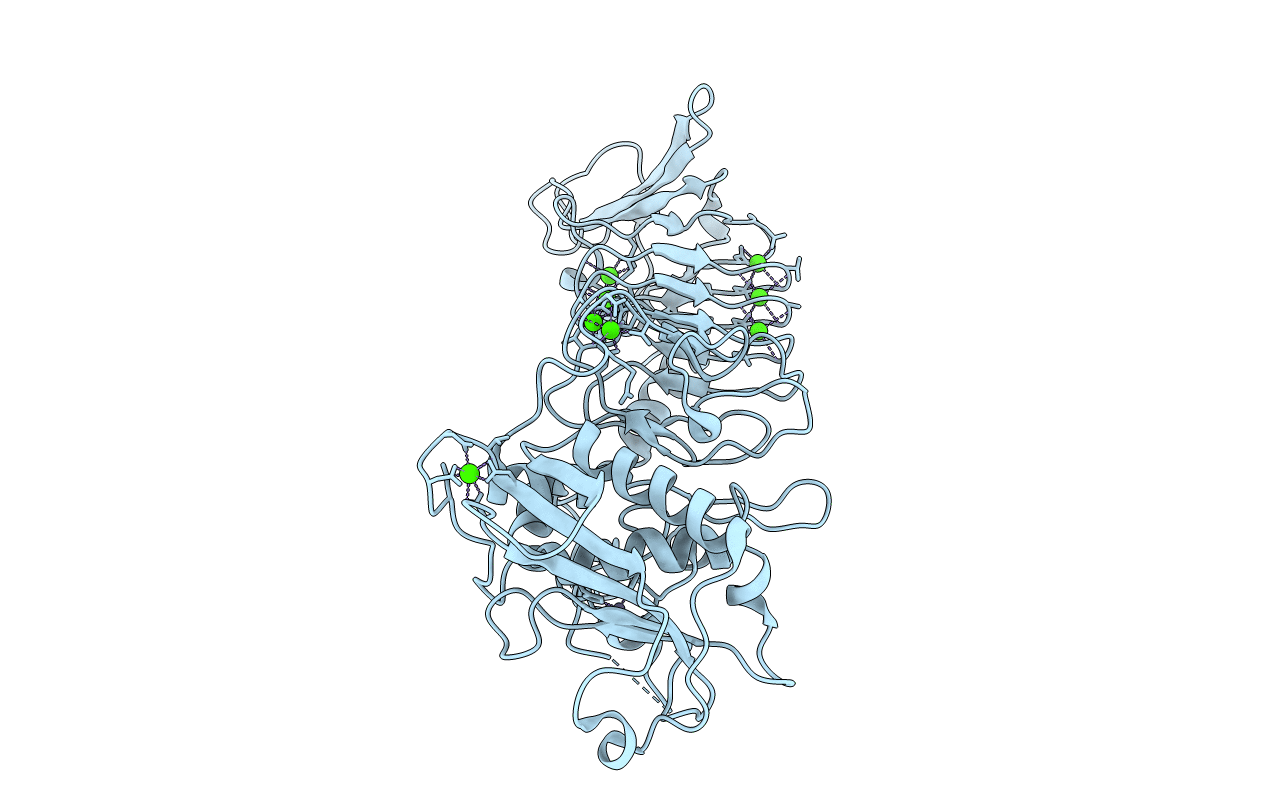
1H71 image
Deposition Date 2001-07-02
Release Date 2003-02-13
Last Version Date 2023-12-13
Entry Detail
PDB ID:
1H71
Keywords:
Title:
Psychrophilic Protease from Pseudoalteromonas 'TAC II 18'
Biological Source:
Source Organism:
Method Details:
Experimental Method:
Resolution:
2.10 Å
R-Value Free:
0.22
R-Value Work:
0.16
Space Group:
P 21 21 21

Macromolecular Entities
Structures with similar UniProt ID
Protein Blast
Polymer Type:polypeptide(L)
Molecule:SERRALYSIN
Gene (Uniprot):PAPRA
Chain IDs:A (auth: P)
Chain Length:463
Number of Molecules:1
Biological Source:PSEUDOMONAS SP. TAC II 18
Primary Citation
Crystal Structures of a Psychrophilic Metalloprotease Reveal New Insights Into Catalysis by Cold-Adapted Proteases
Proteins: Struct.,Funct., Genet. 50 636 ? (2003)
PMID: 12577270 DOI: 10.1002/PROT.10264

Abstact

Enzymes from psychrophilic organisms differ from their mesophilic counterparts in having a lower thermostability and a higher specific activity at low and moderate temperatures. It is in general accepted that psychrophilic enzymes are more flexible to allow easy accommodation and transformation of the substrates at low energy costs. Here, we report the structures of two crystal forms of the alkaline protease from an Antarctic Pseudomonas species (PAP), solved to 2.1- and 1.96-A resolution, respectively. Comparative studies of PAP structures with mesophilic counterparts show that the overall structures are similar but that the conformation of the substrate-free active site in PAP resembles that of the substrate-bound region of the mesophilic homolog, with both an active-site tyrosine and a substrate-binding loop displaying a conformation as in the substrate-bound form of the mesophilic proteases. Further, a region in the catalytic domain of PAP undergoes a conformational change with a loop movement as large as 13 A, induced by the binding of an extra calcium ion. Finally, the active site is more accessible due to deletions occurring in surrounding loop regions.

Legend

Protein

Chemical

Disease

Primary Citation of related structures
Feedback Form
Name
Email
Institute
Feedback