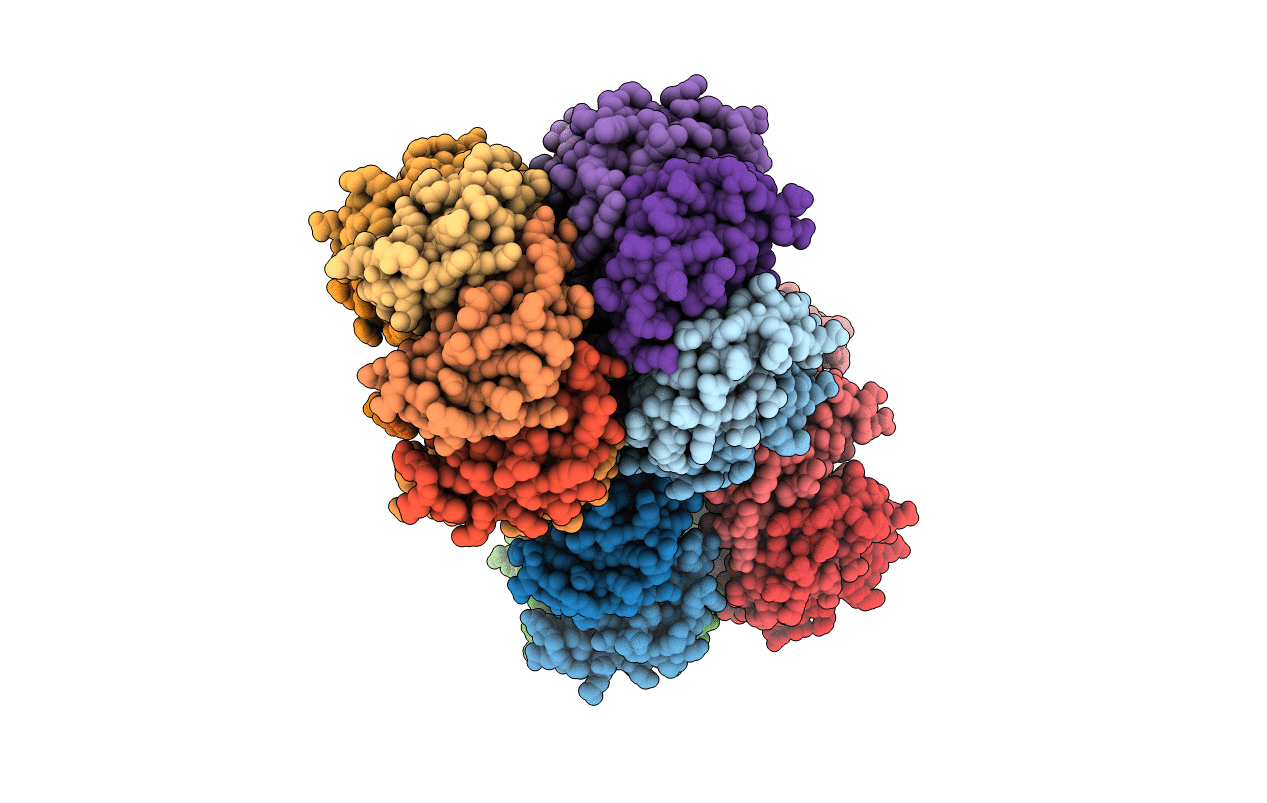
1H64 image
Deposition Date 2001-06-05
Release Date 2002-12-19
Last Version Date 2024-05-01
Entry Detail
PDB ID:
1H64
Keywords:
Title:
CRYSTAL STRUCTURE OF THE SM-RELATED PROTEIN OF P. ABYSSI: THE BIOLOGICAL UNIT IS A HEPTAMER
Biological Source:
Source Organism:
Host Organism:
Method Details:
Experimental Method:
Resolution:
1.90 Å
R-Value Free:
0.28
R-Value Work:
0.23
R-Value Observed:
0.23
Space Group:
P 1

Macromolecular Entities
Structures with similar UniProt ID
Protein Blast
Polymer Type:polypeptide(L)
Molecule:SNRNP SM-LIKE PROTEIN
Gene (Uniprot):PAB8160
Chain IDs:A (auth: 1), B (auth: 2), C (auth: A), D (auth: B), E (auth: C), F (auth: D), G (auth: E), H (auth: F), I (auth: G), J (auth: H), K (auth: I), L (auth: J), M (auth: K), N (auth: L), O (auth: M), P (auth: N), Q (auth: O), R (auth: P), S (auth: Q), T (auth: R), U (auth: S), V (auth: T), W (auth: U), X (auth: V), Y (auth: W), Z (auth: X), AA (auth: Y), BA (auth: Z)
Chain Length:75
Number of Molecules:28
Biological Source:PYROCOCCUS ABYSSI
Primary Citation
Crystal Structures of the Pyrococcus Abyssi Sm Core and its Complex with RNA.Common Features of RNA Binding in Archaea and Eukarya
J.Biol.Chem. 278 1239 ? (2003)
PMID: 12409299 DOI: 10.1074/JBC.M207685200

Abstact

The Sm proteins are conserved in all three domains of life and are always associated with U-rich RNA sequences. Their proposed function is to mediate RNA-RNA interactions. We present here the crystal structures of Pyrococcus abyssi Sm protein (PA-Sm1) and its complex with a uridine heptamer. The overall structure of the protein complex, a heptameric ring with a central cavity, is similar to that proposed for the eukaryotic Sm core complex and found for other archaeal Sm proteins. RNA molecules bind to the protein at two different sites. They interact specifically inside the ring with three highly conserved residues, defining the uridine-binding pocket. In addition, nucleotides also interact on the surface formed by the N-terminal alpha-helix as well as a conserved aromatic residue in beta-strand 2 of the PA-Sm1 protein. The mutation of this conserved aromatic residue shows the importance of this second site for the discrimination between RNA sequences. Given the high structural homology between archaeal and eukaryotic Sm proteins, the PA-Sm1.RNA complex provides a model for how the small nuclear RNA contacts the Sm proteins in the Sm core. In addition, it suggests how Sm proteins might exert their function as modulators of RNA-RNA interactions.

Legend

Protein

Chemical

Disease

Primary Citation of related structures
Feedback Form
Name
Email
Institute
Feedback