1GYG image
Deposition Date 2002-04-23
Release Date 2002-06-13
Last Version Date 2024-05-01
Entry Detail
PDB ID:
1GYG
Keywords:
Title:
R32 CLOSED FORM OF ALPHA-TOXIN FROM CLOSTRIDIUM PERFRINGENS STRAIN CER89L43
Biological Source:
Source Organism:
Method Details:
Experimental Method:
Resolution:
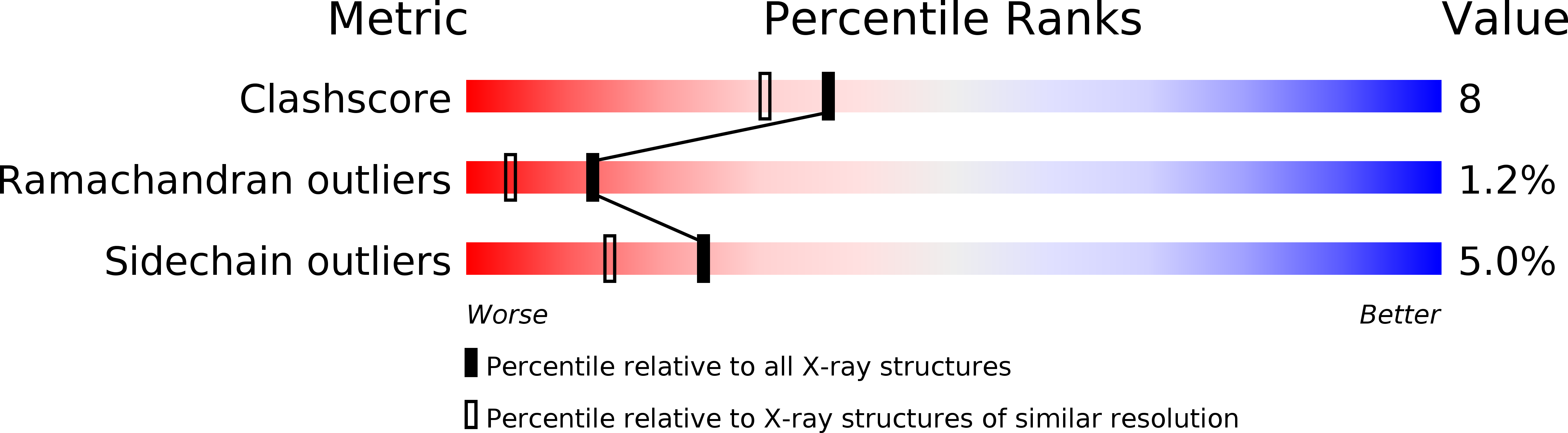
1.90 Å
R-Value Free:
0.25
R-Value Work:
0.20
R-Value Observed:
0.20
Space Group:
H 3 2
Macromolecular Entities
Structures with similar UniProt ID
Protein Blast
Polymer Type:polypeptide(L)
Molecule:PHOSPHOLIPASE C
Chain IDs:A, B
Chain Length:370
Number of Molecules:2
Biological Source:CLOSTRIDIUM PERFRINGENS
Ligand Molecules
Primary Citation
Crystal Structure of the C. Perfringens Alpha-Toxin with the Active Site Closed by a Flexible Loop Region
J.Mol.Biol. 319 275 ? (2002)
PMID: 12051905 DOI: 10.1016/S0022-2836(02)00290-5

Abstact

Clostridium perfringens biotype A strains are the causative agents of gas-gangrene in man and are also implicated as etiological agents in sudden death syndrome in young domestic livestock. The main virulence factor produced by these strains is a zinc-dependent, phosphatidylcholine-preferring phospholipase C (alpha-toxin). The crystal structure of alpha-toxin, at pH 7.5, with the active site open and therefore accessible to substrate has previously been reported, as has calcium-binding to the C-terminal domain of the enzyme at pH 4.7. Here we focus on conformation changes in the N-terminal domain of alpha-toxin in crystals grown at acidic pH. These changes result in both the obscuring of the toxin active site and the loss of one of three zinc ions from it. Additionally, this "closed" form contains a small alpha helix, not present in the open structure, which hydrogen bonds to both the N and C-terminal domains. In conjunction with the previously reported findings that alpha-toxin can exist in active and inactive forms and that Thr74Ile and Phe69Cys substitutions markedly reduced the haemolytic activity of the enzyme, our work suggests that these loop conformations play a critical role in the activity of the toxin.

Legend

Protein

Chemical

Disease

Primary Citation of related structures
Feedback Form
Name
Email
Institute
Feedback