1GU6 image
Deposition Date 2002-01-24
Release Date 2002-03-08
Last Version Date 2024-10-16
Entry Detail
PDB ID:
1GU6
Keywords:
Title:
Structure of the Periplasmic Cytochrome c Nitrite Reductase from Escherichia coli
Biological Source:
Source Organism:
ESCHERICHIA COLI (Taxon ID: 562)
Method Details:
Experimental Method:
Resolution:
2.50 Å
R-Value Free:
0.24
R-Value Work:
0.20
R-Value Observed:
0.20
Space Group:
P 21 21 21
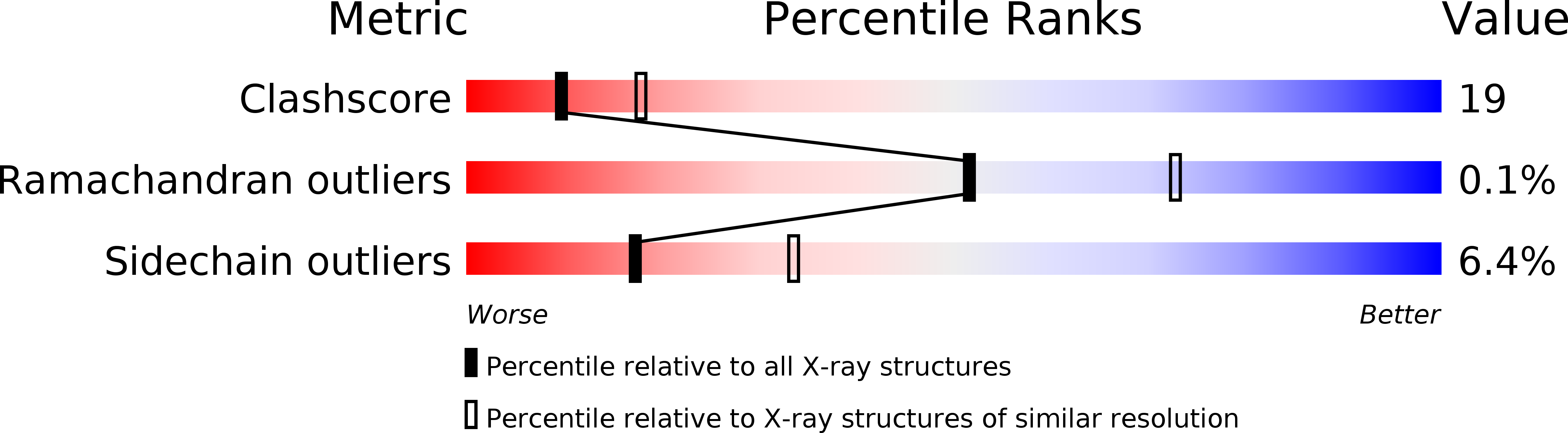
Macromolecular Entities
Structures with similar UniProt ID
Protein Blast
Polymer Type:polypeptide(L)
Molecule:CYTOCHROME C552
Chain IDs:A, B (auth: C), C (auth: E), D (auth: G)
Chain Length:452
Number of Molecules:4
Biological Source:ESCHERICHIA COLI
Primary Citation
Structure and Spectroscopy of the Periplasmic Cytochrome C Nitrite Reductase from Escherichia Coli
Biochemistry 41 2921 ? (2002)
PMID: 11863430 DOI: 10.1021/BI015765D

Abstact

The crystal structure and spectroscopic properties of the periplasmic penta-heme cytochrome c nitrite reductase (NrfA) of Escherichia coli are presented. The structure is the first for a member of the NrfA subgroup that utilize a soluble penta-heme cytochrome, NrfB, as a redox partner. Comparison to the structures of Wolinella succinogenes NrfA and Sulfospirillum deleyianum NrfA, which accept electrons from a membrane-anchored tetra-heme cytochrome (NrfH), reveals notable differences in the protein surface around heme 2, which may be the docking site for the redox partner. The structure shows that four of the NrfA hemes (hemes 2-5) have bis-histidine axial heme-Fe ligation. The catalytic heme-Fe (heme 1) has a lysine distal ligand and an oxygen atom proximal ligand. Analysis of NrfA in solution by magnetic circular dichroism (MCD) suggested that the oxygen ligand arose from water. Electron paramagnetic resonance (EPR) spectra were collected from electrochemically poised NrfA samples. Broad perpendicular mode signals at g similar 10.8 and 3.5, characteristic of weakly spin-coupled S = 5/2, S = 1/2 paramagnets, titrated with E(m) = -107 mV. A possible origin for these are the active site Lys-OH(2) coordinated heme (heme 1) and a nearby bis-His coordinated heme (heme 3). A rhombic heme Fe(III) EPR signal at g(z) = 2.91, g(y) = 2.3, g(x) = 1.5 titrated with E(m) = -37 mV and is likely to arise from bis-His coordinated heme (heme 2) in which the interplanar angle of the imidazole rings is 21.2. The final two bis-His coordinated hemes (hemes 4 and 5) have imidazole interplanar angles of 64.4 and 71.8. Either, or both, of these hemes could give rise to a "Large g max" EPR signal at g(z)() = 3.17 that titrated at potentials between -250 and -400 mV. Previous spectroscopic studies on NrfA from a number of bacterial species are considered in the light of the structure-based spectro-potentiometric analysis presented for the E. coli NrfA.

Legend

Protein

Chemical

Disease

Primary Citation of related structures
Feedback Form
Name
Email
Institute
Feedback