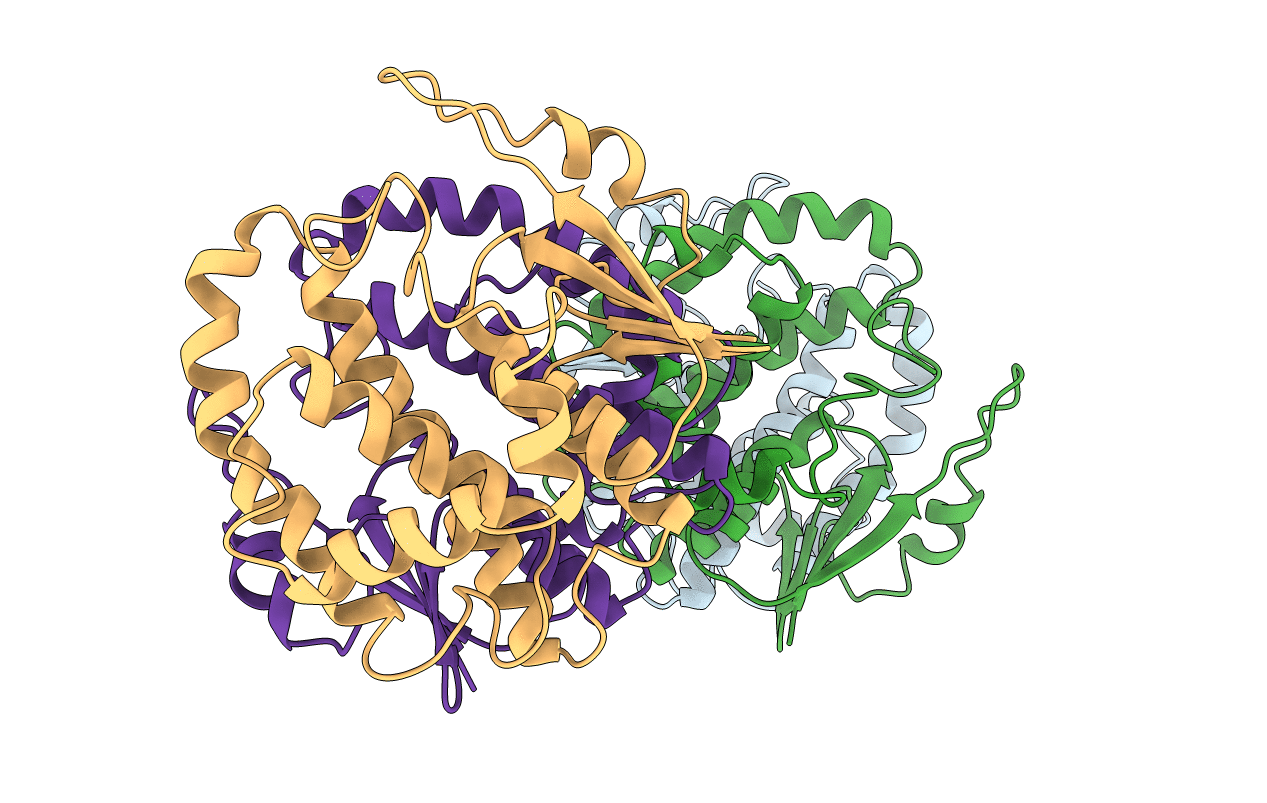
1GTU image
Deposition Date 1998-06-11
Release Date 1999-02-02
Last Version Date 2024-05-22
Entry Detail
PDB ID:
1GTU
Keywords:
Title:
LIGAND-FREE HUMAN GLUTATHIONE S-TRANSFERASE M1A-1A
Biological Source:
Source Organism:
Homo sapiens (Taxon ID: 9606)
Method Details:
Experimental Method:
Resolution:
2.68 Å
R-Value Free:
0.24
R-Value Work:
0.21
R-Value Observed:
0.21
Space Group:
P 21 21 21

Macromolecular Entities
Structures with similar UniProt ID
Protein Blast
Polymer Type:polypeptide(L)
Molecule:GLUTATHIONE S-TRANSFERASE
Gene (Uniprot):GSTM1
Chain IDs:A, B, C, D
Chain Length:217
Number of Molecules:4
Biological Source:Homo sapiens
Primary Citation
Functions of His107 in the catalytic mechanism of human glutathione S-transferase hGSTM1a-1a.
Biochemistry 38 1193 1202 (1999)
PMID: 9930979 DOI: 10.1021/bi982164m

Abstact

Domain interchange analyses and site-directed mutagenesis indicate that the His107 residue of the human subunit hGSTM1 has a pronounced influence on catalysis of nucleophilic aromatic substitution reactions, and a H107S substitution accounts for the marked differences in the properties of the homologous hGSTM1-1 (His107) and hGSTM4-4 (Ser107) glutathione S-transferases. Reciprocal replacement of His107 and Ser107 in chimeric enzymes results in reciprocal conversion of catalytic properties. With 1-chloro-2, 4-dinitrobenzene as a substrate, the His107 residue primarily influences the pH dependence of catalysis by lowering the apparent pKa of kcat/Km from 7.8 for the Ser107-containing enzymes to 6.3 for the His107-containing enzymes. There is a parallel shift in the pKa for thiolate anion formation of enzyme-bound GSH. Y6F mutations have no effect on the pKa for these enzymes. Crystal structures of hGSTM1a-1a indicate that the imidazole ring of His107 is oriented toward the substrate binding cleft approximately 6 A from the GSH thiol group. Thus, His107 has the potential to act as a general base in proton transfer mediated through an active site water molecule or directly following a modest conformational change, to promote thiolate anion formation. All wild-type enzymes and H107S chimera have nearly identical equilibrium constants for formation of enzyme-GSH complexes (Kd values of 1-2 x 10(-)6 M); however, KmGSH and Ki values for S-methylglutathione inhibition determined by steady-state kinetics are nearly 100-fold higher. The functions of His107 of hGSTM1a-1a are unexpected in view of a substantial body of previous evidence that excluded participation of histidine residues in the catalytic mechanisms of other glutathione S-transferases. Consequences of His107 involvement in catalysis are also substrate-dependent; in contrast to 1-chloro-2,4-dinitrobenzene, for the nucleophilic addition reaction of GSH to ethacrynic acid, the H107S substitution has no effect on catalysis presumably because product release is rate-limiting.

Legend

Protein

Chemical

Disease

Primary Citation of related structures
Feedback Form
Name
Email
Institute
Feedback