1GQR image
Deposition Date 2001-12-04
Release Date 2002-03-15
Last Version Date 2024-10-23
Entry Detail
PDB ID:
1GQR
Keywords:
Title:
ACETYLCHOLINESTERASE (E.C. 3.1.1.7) COMPLEXED WITH RIVASTIGMINE
Biological Source:
Source Organism:
Method Details:
Experimental Method:
Resolution:
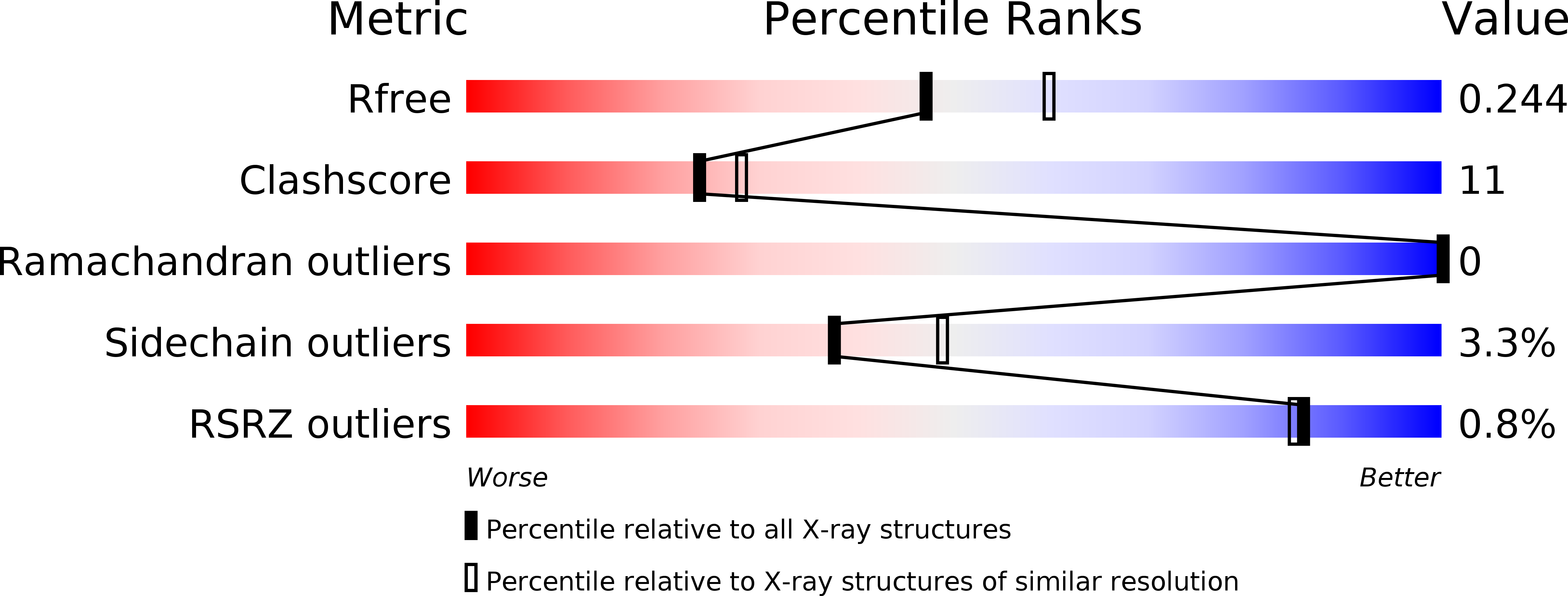
2.20 Å
R-Value Free:
0.23
R-Value Work:
0.19
R-Value Observed:
0.19
Space Group:
P 31 2 1
Macromolecular Entities
Structures with similar UniProt ID
Protein Blast
Polymer Type:polypeptide(L)
Molecule:ACETYLCHOLINESTERASE
Gene (Uniprot):ache
Chain IDs:A
Chain Length:532
Number of Molecules:1
Biological Source:TORPEDO CALIFORNICA
Modified Residue
Compound ID Chain ID Parent Comp ID Details 2D Image
ASN A ASN GLYCOSYLATION SITE
Primary Citation
Kinetic and Structural Studies on the Interaction of Cholinesterases with the Anti-Alzheimer Drug Rivastigmine
Biochemistry 41 3555 ? (2002)
PMID: 11888271 DOI: 10.1021/BI020016X

Abstact

Rivastigmine, a carbamate inhibitor of acetylcholinesterase, is already in use for treatment of Alzheimer's disease under the trade name of Exelon. Rivastigmine carbamylates Torpedo californica acetylcholinesterase very slowly (k(i) = 2.0 M(-1) min(-1)), whereas the bimolecular rate constant for inhibition of human acetylcholinesterase is >1600-fold higher (k(i) = 3300 M(-1) min(-1)). For human butyrylcholinesterase and for Drosophila melanogaster acetylcholinesterase, carbamylation is even more rapid (k(i) = 9 x 10(4) and 5 x 10(5) M(-1) min(-1), respectively). Spontaneous reactivation of all four conjugates is very slow, with <10% reactivation being observed for the Torpedo enzyme after 48 h. The crystal structure of the conjugate of rivastigmine with Torpedo acetylcholinesterase was determined to 2.2 A resolution. It revealed that the carbamyl moiety is covalently linked to the active-site serine, with the leaving group, (-)-S-3-[1-(dimethylamino)ethyl]phenol, being retained in the "anionic" site. A significant movement of the active-site histidine (H440) away from its normal hydrogen-bonded partner, E327, was observed, resulting in disruption of the catalytic triad. This movement may provide an explanation for the unusually slow kinetics of reactivation.

Legend

Protein

Chemical

Disease

Feedback Form
Name
Email
Institute
Feedback