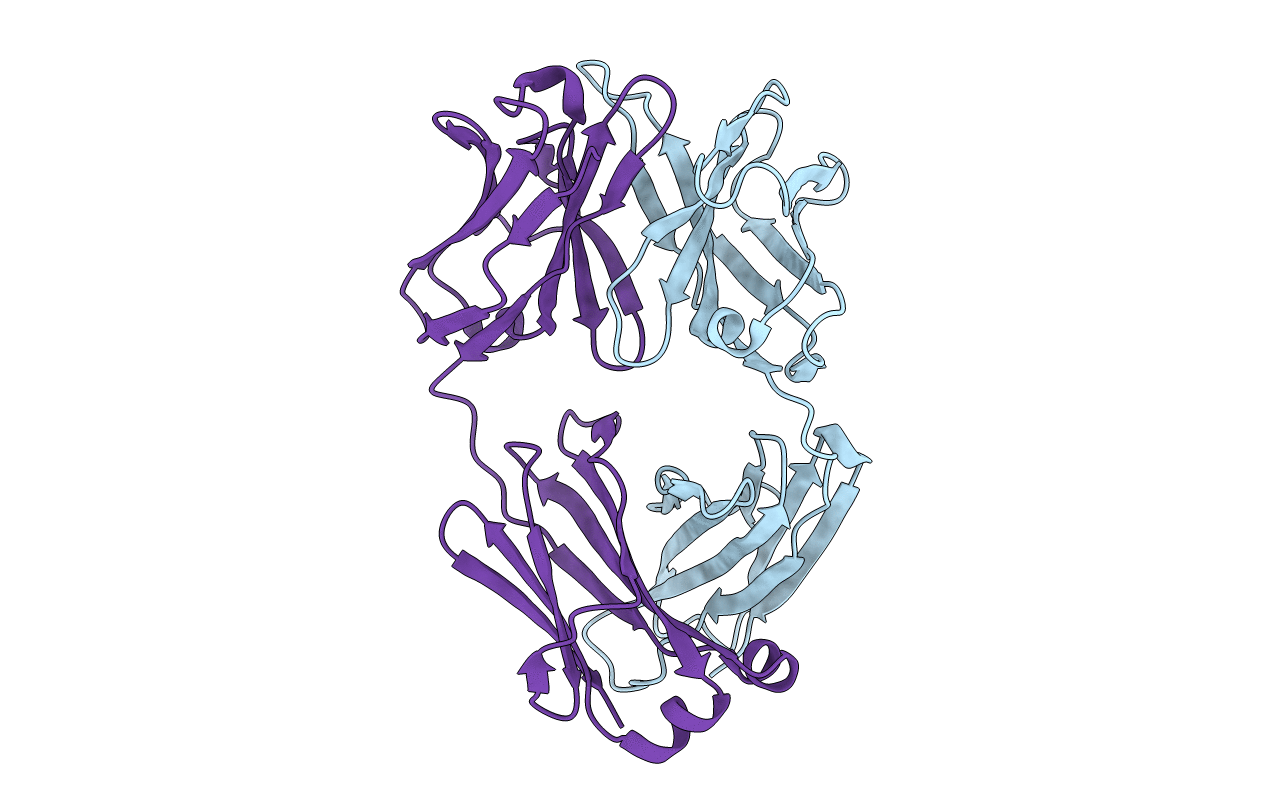
1GIG image
Deposition Date 1993-01-20
Release Date 1994-04-30
Last Version Date 2024-11-06
Entry Detail
PDB ID:
1GIG
Keywords:
Title:
REFINED THREE-DIMENSIONAL STRUCTURE OF THE FAB FRAGMENT OF A MURINE IGG1, LAMBDA ANTIBODY
Biological Source:
Source Organism:
Mus musculus (Taxon ID: 10090)
Method Details:
Experimental Method:
Resolution:
2.30 Å
R-Value Observed:
0.19
Space Group:
P 31 2 1

Macromolecular Entities
Structures with similar UniProt ID
Protein Blast
Polymer Type:polypeptide(L)
Molecule:IGG1-KAPPA HC19 FAB (HEAVY CHAIN)
Chain IDs:B (auth: H)
Chain Length:221
Number of Molecules:1
Biological Source:Mus musculus
Polymer Type:polypeptide(L)
Molecule:IGG1-KAPPA HC19 FAB (LIGHT CHAIN)
Chain IDs:A (auth: L)
Chain Length:210
Number of Molecules:1
Biological Source:Mus musculus
Primary Citation
Refined three-dimensional structure of the Fab fragment of a murine IgGl,lambda antibody.
Acta Crystallogr.,Sect.D 50 768 777 (1994)
PMID: 15299376 DOI: 10.1107/S0907444994001903

Abstact

We report the cDNA sequence determination and the crystal structure of the Fab fragment of a murine IgG1,lambda antibody (HC19), specific for an influenza virus hemagglutinin. The HC19 Fab-fragment structure has been refined; the crystallographic R-factor is 19.5% at 2.3 A resolution. We have compared the conformation of HC19 complementarity determining regions (CDRs) with those of CDR loops of Fab structures available from the Protein Data Bank. These loops were chosen based on the identity of key residues, following the canonical-structure approach; four CDRs have a main-chain conformation very similar to the canonical structure that had been identified. HC19 L1 CDR adopts a conformation clearly distinct from all L1 CDRs that belong to a chain of a different class or origin; this is determined by the nature of a few residues at positions in the sequence different from those of key residues in other light chains. This canonical structure should be representative of most murine lambda-class light chains, as inferred from the very high sequence homologies of these polypeptides.

Legend

Protein

Chemical

Disease

Primary Citation of related structures
Feedback Form
Name
Email
Institute
Feedback