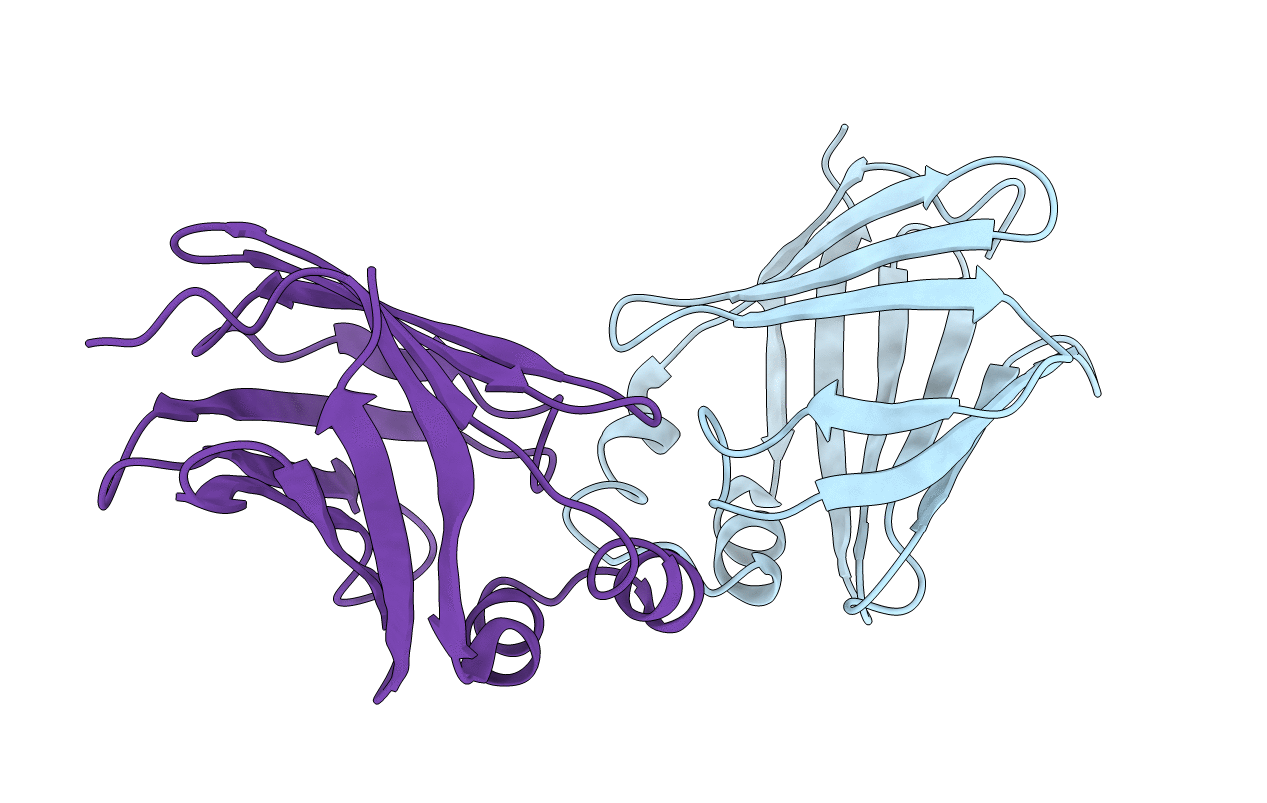
1GGL image
Deposition Date 2000-08-23
Release Date 2001-03-07
Last Version Date 2023-08-09
Entry Detail
PDB ID:
1GGL
Title:
HUMAN CELLULAR RETINOL BINDING PROTEIN III
Biological Source:
Source Organism:
Homo sapiens (Taxon ID: 9606)
Method Details:
Experimental Method:
Resolution:
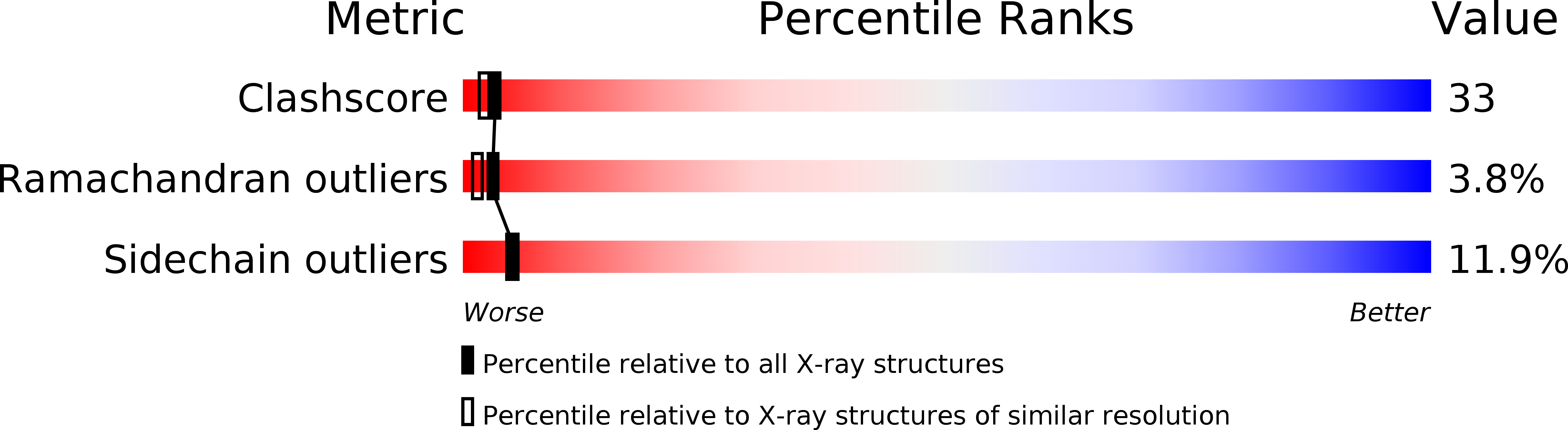
2.31 Å
R-Value Free:
0.28
R-Value Work:
0.22
Space Group:
P 21 21 21
Macromolecular Entities
Structures with similar UniProt ID
Protein Blast
Polymer Type:polypeptide(L)
Molecule:PROTEIN (CELLULAR RETINOL-BINDING PROTEIN III)
Gene (Uniprot):RBP5
Chain IDs:A, B
Chain Length:134
Number of Molecules:2
Biological Source:Homo sapiens
Primary Citation
Identification, retinoid binding, and x-ray analysis of a human retinol-binding protein.
Proc.Natl.Acad.Sci.USA 98 3710 3715 (2001)
PMID: 11274389 DOI: 10.1073/pnas.061455898

Abstact

Two cellular retinol-binding proteins (CRBP I and II) with distinct tissue distributions and retinoid-binding properties have been recognized thus far in mammals. Here, we report the identification of a human retinol-binding protein resembling type I (55.6% identity) and type II (49.6% identity) CRBPs, but with a unique H residue in the retinoid-binding site and a distinctively different tissue distribution. Additionally, this binding protein (CRBP III) exhibits a remarkable sequence identity (62.2%) with the recently identified iota-crystallin/CRBP of the diurnal gecko Lygodactylus picturatus [Werten, P. J. L., Roll, B., van Alten, D. M. F. & de Jong, W. W. (2000) Proc. Natl. Acad. Sci. USA 97, 3282-3287 (First Published March 21, 2000; 10.1073/pnas.050500597)]. CRBP III and all-trans-retinol form a complex (K(d) approximately 60 nM), the absorption spectrum of which is characterized by the peculiar fine structure typical of the spectra of holo-CRBP I and II. As revealed by a 2.3-A x-ray molecular model of apo-CRBP III, the amino acid residues that line the retinol-binding site in CRBP I and II are positioned nearly identically in the structure of CRBP III. At variance with the human CRBP I and II mRNAs, which are most abundant in ovary and intestine, respectively, the CRBP III mRNA is expressed at the highest levels in kidney and liver thus suggesting a prominent role for human CRBP III as an intracellular mediator of retinol metabolism in these tissues.

Legend

Protein

Chemical

Disease

Primary Citation of related structures
Feedback Form
Name
Email
Institute
Feedback