1GDU image
Deposition Date 2000-09-29
Release Date 2001-02-07
Last Version Date 2024-10-30
Entry Detail
PDB ID:
1GDU
Keywords:
Title:
FUSARIUM OXYSPORUM TRYPSIN AT ATOMIC RESOLUTION
Biological Source:
Source Organism:
Method Details:
Experimental Method:
Resolution:
1.07 Å
R-Value Work:
0.10
R-Value Observed:
0.10
Space Group:
P 1
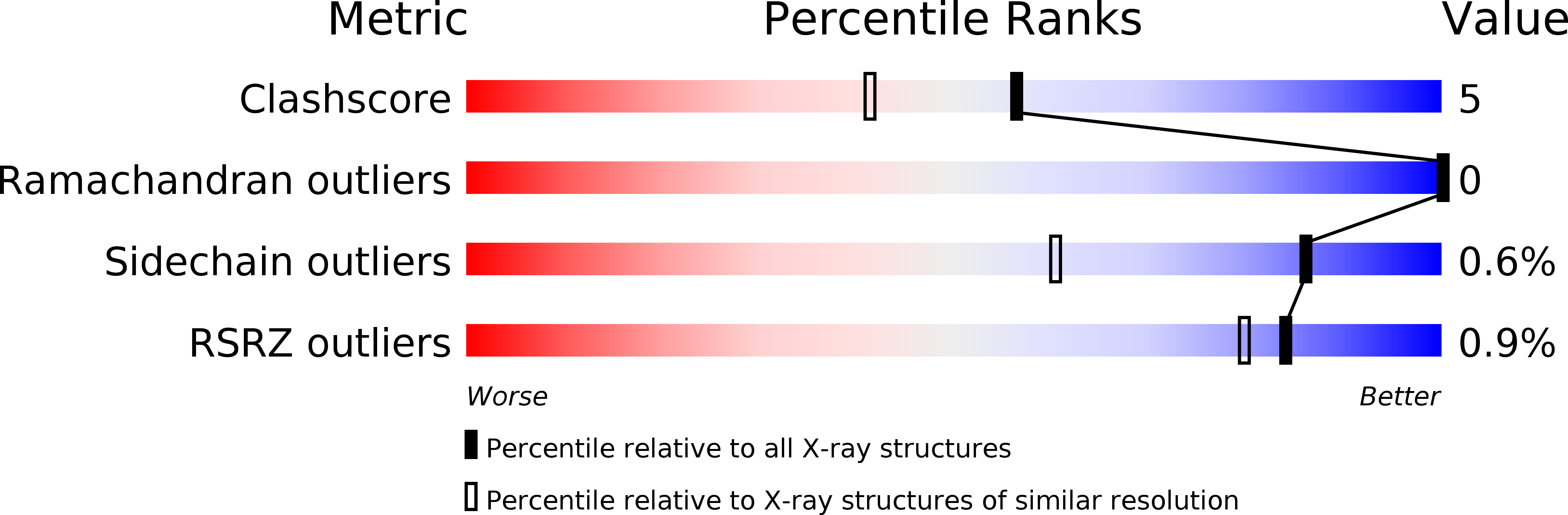
Macromolecular Entities
Structures with similar UniProt ID
Protein Blast
Polymer Type:polypeptide(L)
Molecule:TRYPSIN
Chain IDs:A
Chain Length:224
Number of Molecules:1
Biological Source:Fusarium oxysporum
Ligand Molecules
Primary Citation
Fusarium oxysporum trypsin at atomic resolution at 100 and 283 K: a study of ligand binding.
Acta Crystallogr.,Sect.D 57 8 19 (2001)
PMID: 11134922 DOI: 10.1107/S0907444900014116

Abstact

The X-ray structure of F. oxysporum trypsin has been determined at atomic resolution, revealing electron density in the binding site which was interpreted as a peptide bound in the sites S1, S2 and S3. The structure, which was initially determined at 1.07 A resolution and 283 K, has an Arg in the S1 specificity pocket. The study was extended to 0.81 A resolution at 100 K using crystals soaked in Arg, Lys and Gln to study in greater detail the binding at the S1 site. The electron density in the binding site was compared between the different structures and analysed in terms of partially occupied and overlapping components of peptide, solvent water and possibly other chemical moieties. Arg-soaked crystals reveal a density more detailed but similar to the original structure, with the Arg side chain visible in the S1 pocket and residual peptide density in the S2 and S3 sites. The density in the active site is complex and not fully interpreted. Lys at high concentrations displaces Arg in the S1 pocket, while some main-chain density remains in sites S2 and S3. Gln has been shown not to bind. The free peptide in the S1-S3 sites binds in a similar way to the binding loop of BPTI or the inhibitory domain of the Alzheimer's beta-protein precursor, with some differences in the S1 site.

Legend

Protein

Chemical

Disease

Primary Citation of related structures
Feedback Form
Name
Email
Institute
Feedback