1GCO image
Deposition Date 2000-08-07
Release Date 2001-02-28
Last Version Date 2023-12-27
Entry Detail
PDB ID:
1GCO
Keywords:
Title:
CRYSTAL STRUCTURE OF GLUCOSE DEHYDROGENASE COMPLEXED WITH NAD+
Biological Source:
Source Organism(s):
Expression System(s):
Method Details:
Experimental Method:
Resolution:
1.70 Å
R-Value Free:
0.19
R-Value Work:
0.17
R-Value Observed:
0.17
Space Group:
C 1 2 1
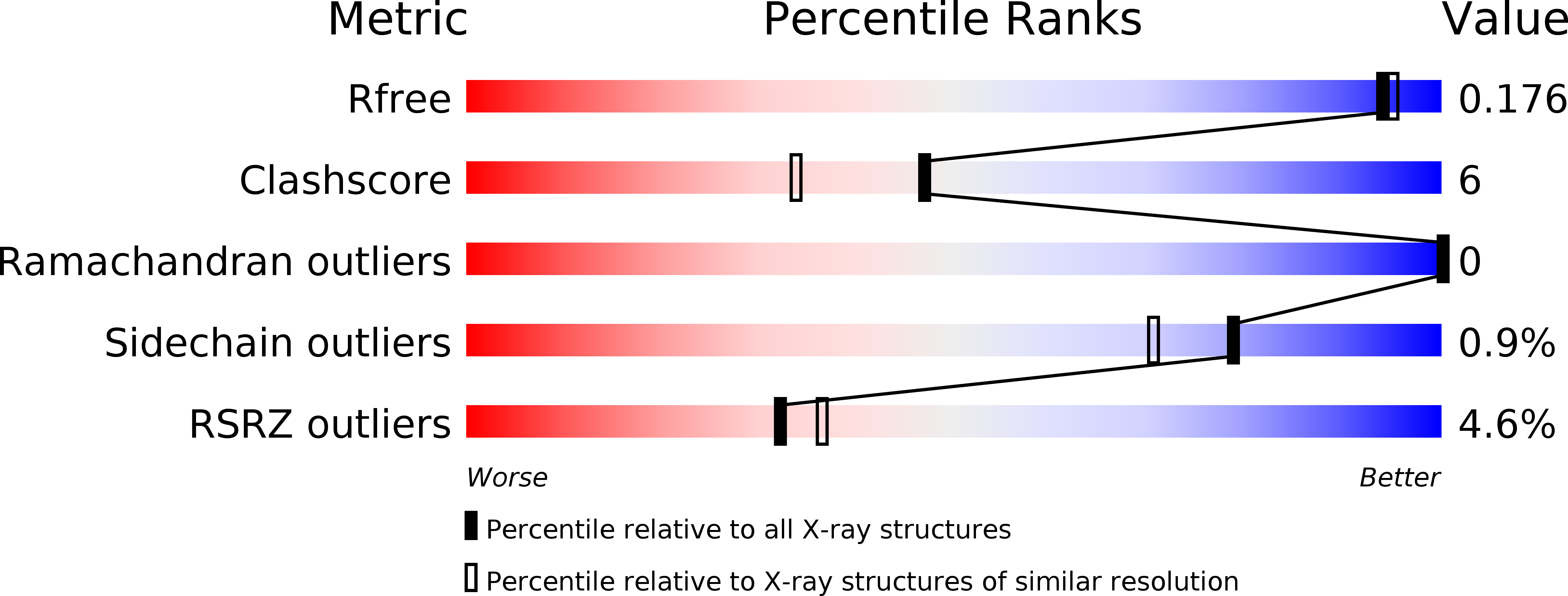
Macromolecular Entities
Structures with similar UniProt ID
Protein Blast
Polymer Type:polypeptide(L)
Molecule:GLUCOSE DEHYDROGENASE
Chain IDs:A, B, C (auth: E), D (auth: F)
Chain Length:261
Number of Molecules:4
Biological Source:Bacillus megaterium
Ligand Molecules
Primary Citation
Crystal structure of glucose dehydrogenase from Bacillus megaterium IWG3 at 1.7 A resolution.
J.Biochem. 129 303 312 (2001)
PMID: 11173533 DOI: 10.1093/oxfordjournals.jbchem.a002858

Abstact

The crystal structure of glucose dehydrogenase (GlcDH) from Bacillus megaterium IWG3 has been determined to an R-factor of 17.9% at 1.7 A resolution. The enzyme consists of four identical subunits, which are similar to those of other short-chain reductases/dehydrogenases (SDRs) in their overall folding and subunit architecture, although cofactor binding sites and subunit interactions differ. Whereas a pair of basic residues is well conserved among NADP(+)-preferring SDRs, only Arg39 was found around the adenine ribose moiety of GlcDH. This suggests that one basic amino acid is enough to determine the coenzyme specificity. The four subunits are interrelated by three mutually perpendicular diad axes (P, Q, and R). While subunit interactions through the P-axis for GlcDH are not so different from those of the other SDRs, those through the Q-axis differ significantly. GlcDH was found to have weaker hydrophobic interactions in the Q-interface. Moreover, GlcDH lacks the salt bridge that stabilizes the subunit interaction in the Q-interface in the other SDRs. Hydrogen bonds between Q-axis related subunits are also less common than in the other SDRs. The GlcDH tetramer dissociates into inactive monomers at pH 9.0, which can be attributed mainly to the weakness of the Q-axis interface.

Legend

Protein

Chemical

Disease

Primary Citation of related structures
Feedback Form
Name
Email
Institute
Feedback