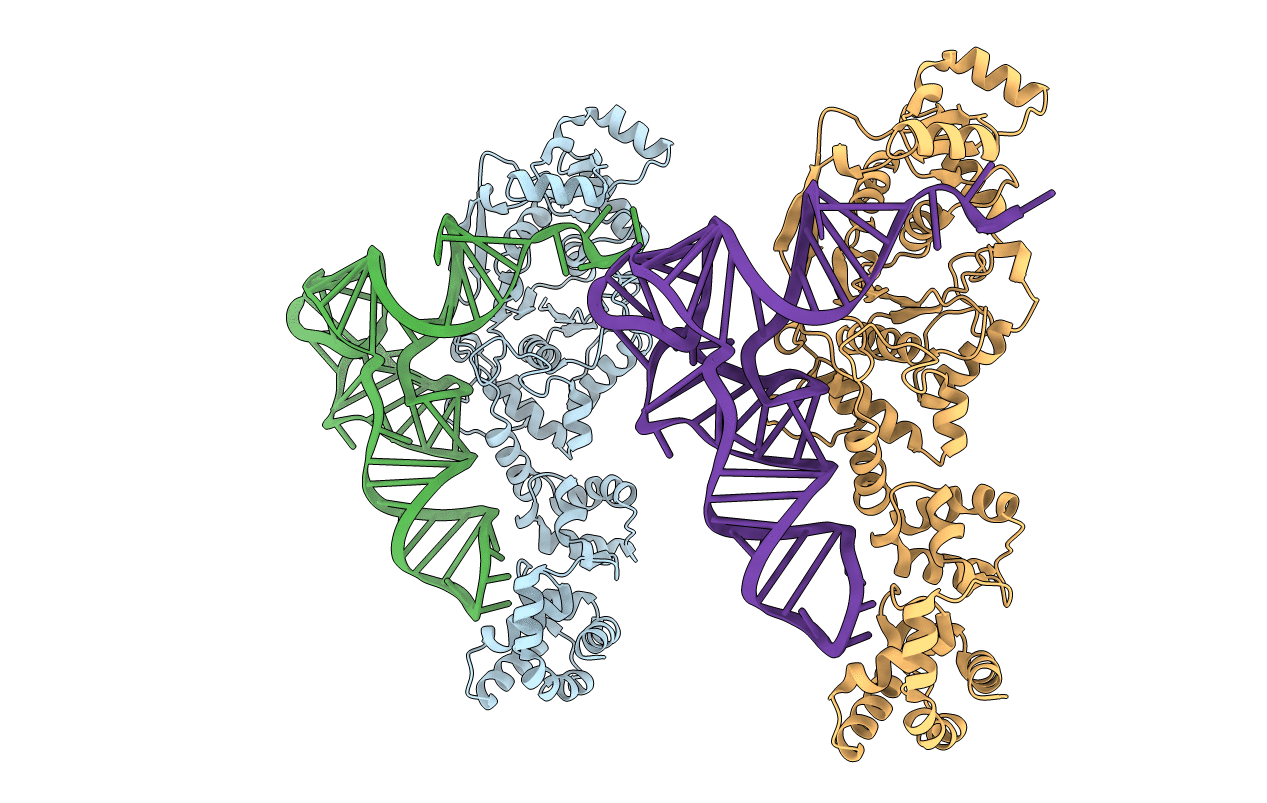
1G59 image
Deposition Date 2000-10-31
Release Date 2001-09-01
Last Version Date 2023-08-02
Entry Detail
PDB ID:
1G59
Keywords:
Title:
GLUTAMYL-TRNA SYNTHETASE COMPLEXED WITH TRNA(GLU).
Biological Source:
Source Organism:
Host Organism:
Method Details:
Experimental Method:
Resolution:
2.40 Å
R-Value Free:
0.29
R-Value Work:
0.21
R-Value Observed:
0.21
Space Group:
C 2 2 21

Macromolecular Entities
Structures with similar UniProt ID
Protein Blast
Polymer Type:polypeptide(L)
Molecule:GLUTAMYL-TRNA SYNTHETASE
Gene (Uniprot):gltX
Chain IDs:C (auth: A), D (auth: C)
Chain Length:468
Number of Molecules:2
Biological Source:Thermus thermophilus
Primary Citation
Structural basis for anticodon recognition by discriminating glutamyl-tRNA synthetase.
Nat.Struct.Biol. 8 203 206 (2001)
PMID: 11224561 DOI: 10.1038/84927

Abstact

Glutamyl-tRNA synthetases (GluRSs) are divided into two distinct types, with regard to the presence or absence of glutaminyl-tRNA synthetase (GlnRS) in the genetic translation systems. In the original 19-synthetase systems lacking GlnRS, the 'non-discriminating' GluRS glutamylates both tRNAGlu and tRNAGln. In contrast, in the evolved 20-synthetase systems with GlnRS, the 'discriminating' GluRS aminoacylates only tRNAGlu. Here we report the 2.4 A resolution crystal structure of a 'discriminating' GluRS.tRNAGlu complex from Thermus thermophilus. The GluRS recognizes the tRNAGlu anticodon bases via two alpha-helical domains, maintaining the base stacking. We show that the discrimination between the Glu and Gln anticodons (34YUC36 and 34YUG36, respectively) is achieved by a single arginine residue (Arg 358). The mutation of Arg 358 to Gln resulted in a GluRS that does not discriminate between the Glu and Gln anticodons. This change mimics the reverse course of GluRS evolution from anticodon 'non-dicsriminating' to 'discriminating'.

Legend

Protein

Chemical

Disease

Primary Citation of related structures
Feedback Form
Name
Email
Institute
Feedback