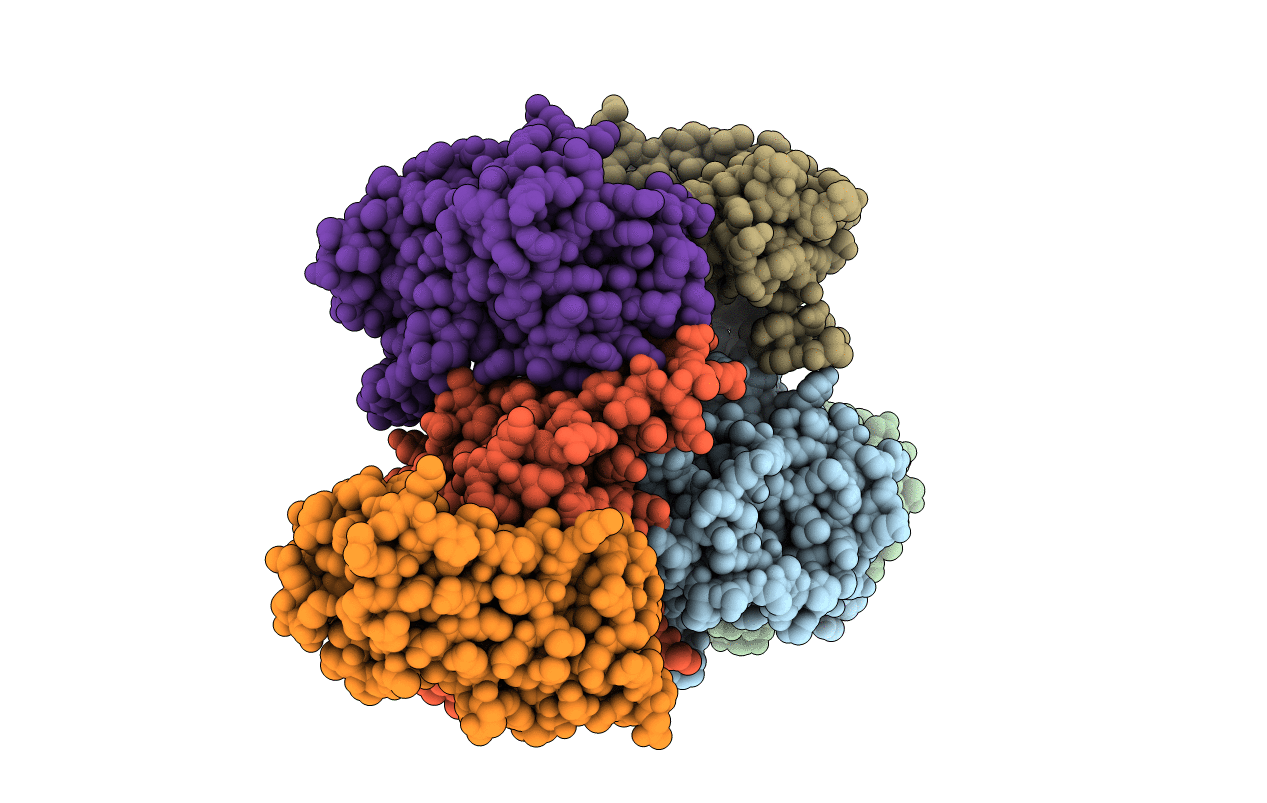
1G3N image
Deposition Date 2000-10-24
Release Date 2001-01-10
Last Version Date 2024-02-07
Entry Detail
PDB ID:
1G3N
Title:
STRUCTURE OF A P18(INK4C)-CDK6-K-CYCLIN TERNARY COMPLEX
Biological Source:
Source Organism:
Method Details:
Experimental Method:
Resolution:
2.90 Å
R-Value Free:
0.26
R-Value Work:
0.22
R-Value Observed:
0.22
Space Group:
P 21 21 21

Macromolecular Entities
Structures with similar UniProt ID
Protein Blast
Polymer Type:polypeptide(L)
Molecule:CYCLIN-DEPENDENT KINASE 6
Gene (Uniprot):CDK6
Chain IDs:A, D (auth: E)
Chain Length:326
Number of Molecules:2
Biological Source:Homo sapiens
Structures with similar UniProt ID
Protein Blast
Polymer Type:polypeptide(L)
Molecule:CYCLIN-DEPENDENT KINASE 6 INHIBITOR
Gene (Uniprot):CDKN2C
Chain IDs:B, E (auth: F)
Chain Length:168
Number of Molecules:2
Biological Source:Homo sapiens
Structures with similar UniProt ID
Protein Blast
Polymer Type:polypeptide(L)
Molecule:V-CYCLIN
Chain IDs:C, F (auth: G)
Chain Length:257
Number of Molecules:2
Biological Source:Human herpesvirus 8
Ligand Molecules
Primary Citation
Structural basis of inhibition of CDK-cyclin complexes by INK4 inhibitors.
Genes Dev. 14 3115 3125 (2000)
PMID: 11124804 DOI: 10.1101/gad.851100

Abstact

The cyclin-dependent kinases 4 and 6 (Cdk4/6) that drive progression through the G(1) phase of the cell cycle play a central role in the control of cell proliferation, and CDK deregulation is a frequent event in cancer. Cdk4/6 are regulated by the D-type cyclins, which bind to CDKs and activate the kinase, and by the INK4 family of inhibitors. INK4 proteins can bind both monomeric CDK, preventing its association with a cyclin, and also the CDK-cyclin complex, forming an inactive ternary complex. In vivo, binary INK4-Cdk4/6 complexes are more abundant than ternary INK4-Cdk4/6-cyclinD complexes, and it has been suggested that INK4 binding may lead to the eventual dissociation of the cyclin. Here we present the 2.9-A crystal structure of the inactive ternary complex between Cdk6, the INK4 inhibitor p18(INK4c), and a D-type viral cyclin. The structure reveals that p18(INK4c) inhibits the CDK-cyclin complex by distorting the ATP binding site and misaligning catalytic residues. p18(INK4c) also distorts the cyclin-binding site, with the cyclin remaining bound at an interface that is substantially reduced in size. These observations support the model that INK4 binding weakens the cyclin's affinity for the CDK. This structure also provides insights into the specificity of the D-type cyclins for Cdk4/6.

Legend

Protein

Chemical

Disease

Primary Citation of related structures
Feedback Form
Name
Email
Institute
Feedback