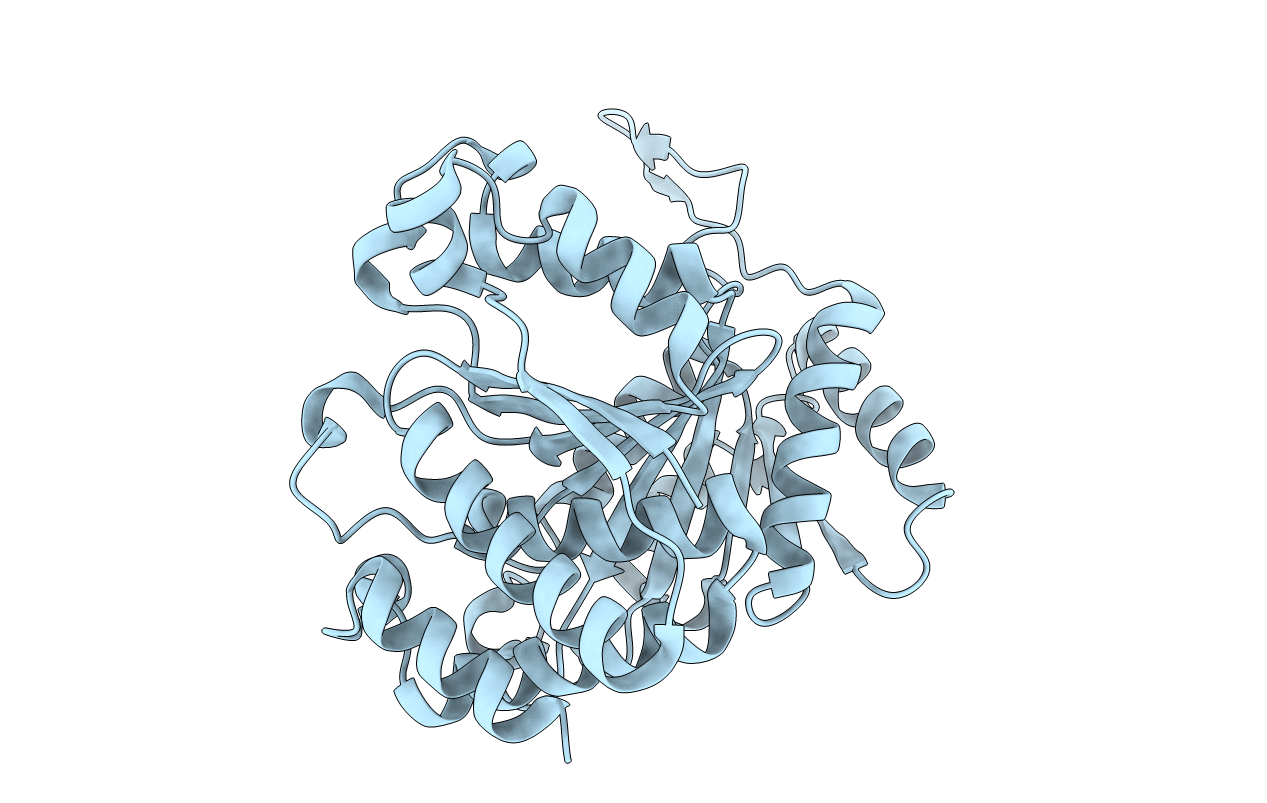
1G2U image
Deposition Date 2000-10-21
Release Date 2000-11-01
Last Version Date 2024-02-07
Entry Detail
PDB ID:
1G2U
Keywords:
Title:
THE STRUCTURE OF THE MUTANT, A172V, OF 3-ISOPROPYLMALATE DEHYDROGENASE FROM THERMUS THERMOPHILUS HB8 : ITS THERMOSTABILITY AND STRUCTURE.
Biological Source:
Source Organism:
Host Organism:
Method Details:
Experimental Method:
Resolution:
2.10 Å
R-Value Free:
0.23
R-Value Work:
0.18
R-Value Observed:
0.18
Space Group:
P 32 2 1

Macromolecular Entities
Structures with similar UniProt ID
Protein Blast
Polymer Type:polypeptide(L)
Molecule:3-ISOPROPYLMALATE DEHYDROGENASE
Gene (Uniprot):leuB
Mutagens:A172V
Chain IDs:A
Chain Length:345
Number of Molecules:1
Biological Source:Thermus thermophilus
Primary Citation
Design, X-ray crystallography, molecular modelling and thermal stability studies of mutant enzymes at site 172 of 3-isopropylmalate dehydrogenase from Thermus thermophilus.
Acta Crystallogr.,Sect.D 57 225 232 (2001)
PMID: 11173468 DOI: 10.1107/S0907444900017388

Abstact

The relationship between the structure and the thermostability of the 3-isopropylmalate dehydrogenase from Thermus thermophilus was studied by site-directed mutation of a single Ala residue located at the domain interface. The crystal structures of three mutant enzymes, replacing Ala172 with Gly, Val and Phe, were successfully determined at 2.3, 2.2 and 2.5 A resolution, respectively. Substitution of Ala172 by relatively 'short' residues (Gly, Val or Ile) enlarges or narrows the cavity in the vicinity of the C(beta) atom of Ala172 and the thermostablity of the enzyme shows a good correlation with the hydrophobicity of the substituted residues. Substitution of Ala172 by the 'longer' residues Leu or Phe causes a rearrangement of the domain structure, which leads to a higher thermostability of the enzymes than that expected from the hydrophobicity of the substituted residues. Mutation of Ala172 to negatively charged residues gave an unexpected result: the melting temperature of the Asp mutant enzyme was reduced by 2.7 K while that of the Glu mutant increased by 1.8 K. Molecular-modelling studies indicated that the glutamate side chain was sufficiently long that it did not act as a buried charge as did the aspartate, but instead protruded to the outside of the hydrophobic cavity and contributed to the stability of the enzyme by enhancing the packing of the local side chains and forming an extra salt bridge with the side chain of Lys175.

Legend

Protein

Chemical

Disease

Primary Citation of related structures
Feedback Form
Name
Email
Institute
Feedback