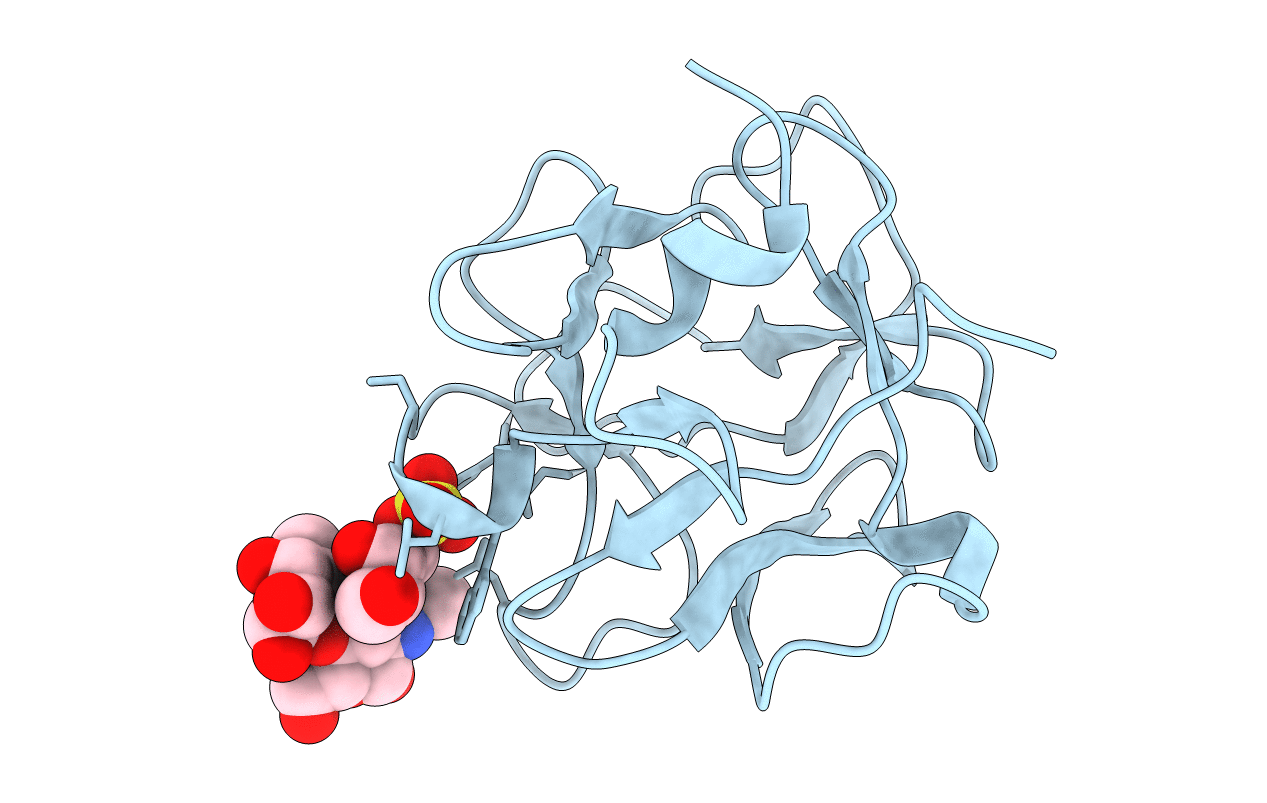
1FWV image
Deposition Date 2000-09-24
Release Date 2001-01-17
Last Version Date 2024-10-30
Entry Detail
PDB ID:
1FWV
Title:
CRYSTAL STRUCTURE OF THE CYSTEINE-RICH DOMAIN OF MANNOSE RECEPTOR COMPLEXED WITH 3-SO4-LEWIS(A)
Biological Source:
Source Organism:
Mus musculus (Taxon ID: 10090)
Host Organism:
Method Details:
Experimental Method:
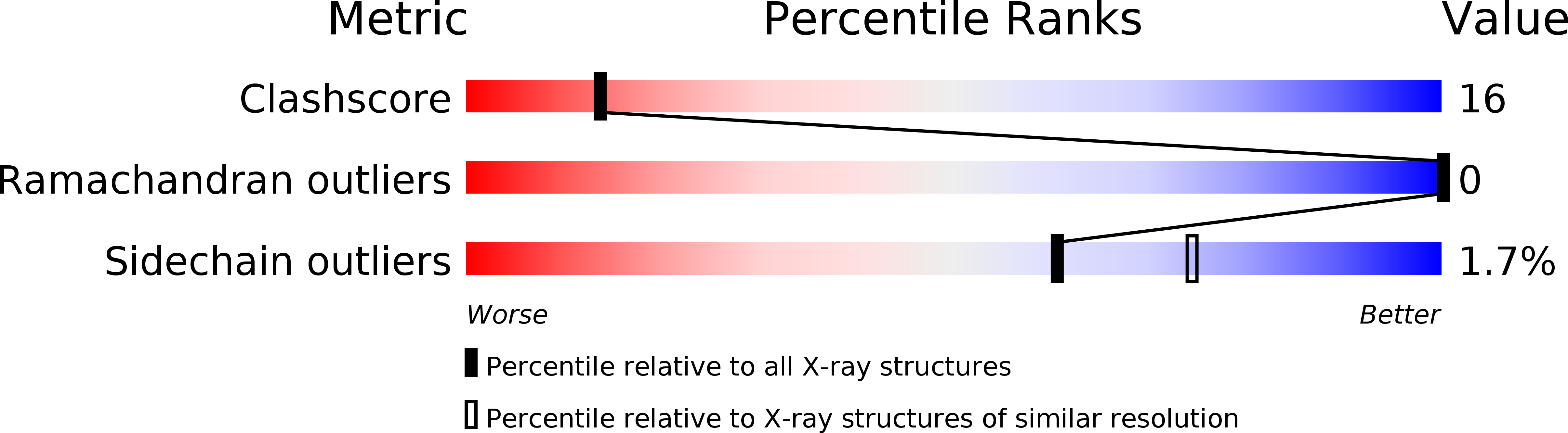
Resolution:
2.20 Å
R-Value Free:
0.23
R-Value Work:
0.20
R-Value Observed:
0.20
Space Group:
P 21 21 21
Macromolecular Entities
Structures with similar UniProt ID
Protein Blast
Polymer Type:polypeptide(L)
Molecule:CYSTEINE-RICH DOMAIN OF MANNOSE RECEPTOR
Chain IDs:A
Chain Length:134
Number of Molecules:1
Biological Source:Mus musculus
Primary Citation
The molecular mechanism of sulfated carbohydrate recognition by the cysteine-rich domain of mannose receptor.
J.Mol.Biol. 305 481 490 (2001)
PMID: 11152606 DOI: 10.1006/jmbi.2000.4326

Abstact

The mannose receptor (MR) binds foreign and host ligands through interactions with their carbohydrates. Two portions of MR have distinct carbohydrate recognition properties. One is conferred by the amino-terminal cysteine-rich domain (Cys-MR), which plays a critical role in binding sulfated glycoproteins including pituitary hormones. The other is achieved by tandemly arranged C-type lectin domains that facilitate carbohydrate-dependent uptake of infectious microorganisms. This dual carbohydrate binding specificity enables MR to bind ligands by interacting with both sulfated and non-sulfated polysaccharide chains. We previously determined crystal structures of Cys-MR complexed with 4-SO(4)-N-acetylglucosamine and with an unidentified ligand resembling Hepes (N-[2-hydroxyethyl]piperazine-N'-[2-ethanesulfonic acid]). In continued efforts to elucidate the mechanism of sulfated carbohydrate recognition by Cys-MR, we characterized the binding affinities between Cys-MR and potential carbohydrate ligands using a fluorescence-based assay. We find that Cys-MR binds sulfated carbohydrates with relatively high affinities (K(D)=0.1 mM to 1.0 mM) compared to the affinities of other lectins. Cys-MR also binds Hepes with a K(D) value of 3.9 mM, consistent with the suggestion that the ligand in the original Cys-MR crystal structure is Hepes. We also determined crystal structures of Cys-MR complexed with 3-SO(4)-Lewis(x), 3-SO(4)-Lewis(a), and 6-SO(4)-N-acetylglucosamine at 1.9 A, 2.2 A, and 2.5 A resolution, respectively, and the 2.0 A structure of Cys-MR that had been treated to remove Hepes. The conformation of the Cys-MR binding site is virtually identical in all Cys-MR crystal structures, suggesting that Cys-MR does not undergo conformational changes upon ligand binding. The structures are used to rationalize the binding affinities derived from the biochemical studies and to elucidate the molecular mechanism of sulfated carbohydrate recognition by Cys-MR.

Legend

Protein

Chemical

Disease

Primary Citation of related structures
Feedback Form
Name
Email
Institute
Feedback