1FUY image
Deposition Date 2000-09-18
Release Date 2001-01-17
Last Version Date 2021-11-03
Entry Detail
PDB ID:
1FUY
Keywords:
Title:
CRYSTAL STRUCTURE OF BETAA169L/BETAC170W DOUBLE MUTANT OF TRYPTOPHAN SYNTHASE COMPLEXED WITH 5-FLUORO-INDOLE-PROPANOL PHOSPHATE
Biological Source:
Source Organism:
Host Organism:
Method Details:
Experimental Method:
Resolution:
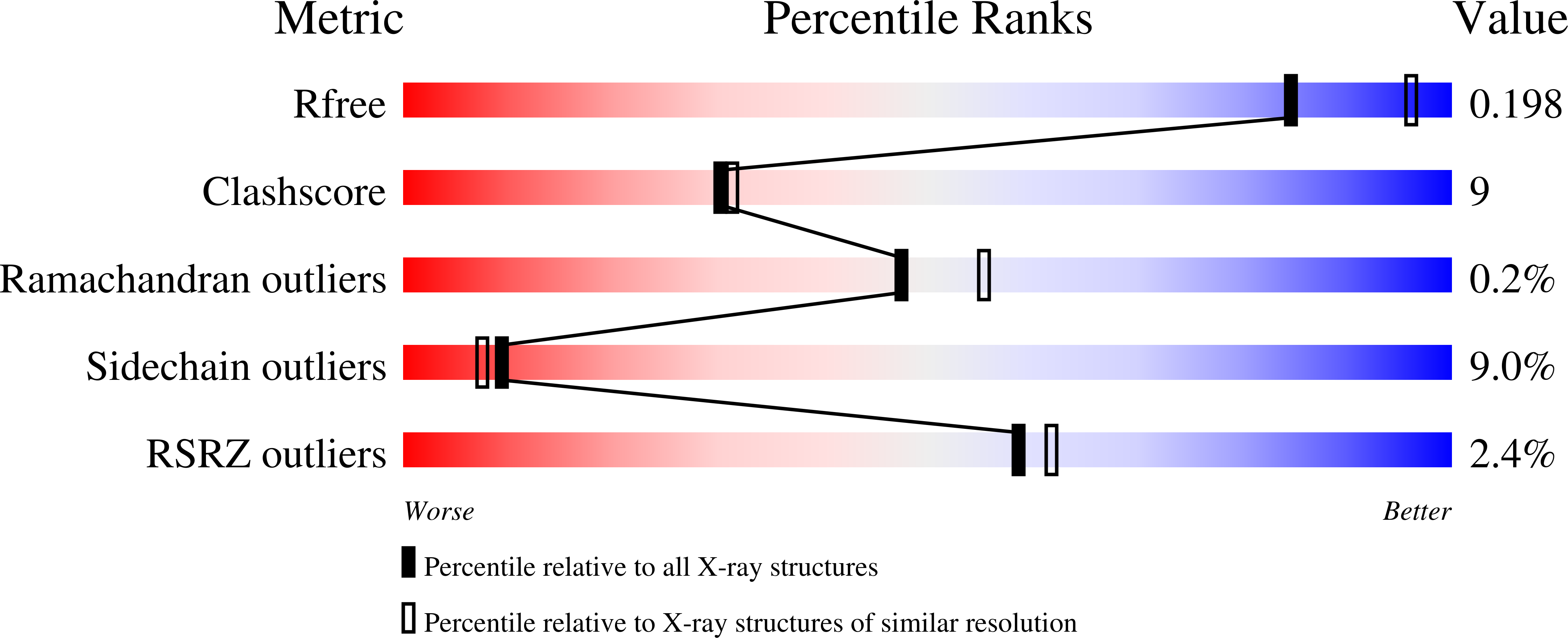
2.25 Å
R-Value Free:
0.22
R-Value Work:
0.17
R-Value Observed:
0.17
Space Group:
C 1 2 1
Macromolecular Entities
Structures with similar UniProt ID
Protein Blast
Polymer Type:polypeptide(L)
Molecule:TRYPTOPHAN SYNTHASE ALPHA CHAIN
Gene (Uniprot):trpA
Chain IDs:A
Chain Length:268
Number of Molecules:1
Biological Source:Salmonella typhimurium
Structures with similar UniProt ID
Protein Blast
Polymer Type:polypeptide(L)
Molecule:TRYPTOPHAN SYNTHASE BETA CHAIN
Gene (Uniprot):trpB
Mutagens:R34S, A169L, C170W
Chain IDs:B
Chain Length:396
Number of Molecules:1
Biological Source:Salmonella typhimurium
Primary Citation
Structural basis for the impaired channeling and allosteric inter-subunit communication in the beta A169L/beta C170W mutant of tryptophan synthase.
J.Biol.Chem. 275 41058 41063 (2000)
PMID: 11034989 DOI: 10.1074/jbc.C000479200

Abstact

We determined the 2.25 A resolution crystal structure of the betaA169L/betaC170W mutant form of the tryptophan synthase alpha(2)beta(2) complex from Salmonella typhimurium complexed with the alpha-active site substrate analogue 5-fluoro-indole-propanol-phosphate to identify the structural basis for the changed kinetic properties of the mutant (Anderson, K. S., Kim, A. Y., Quillen, J. M., Sayers, E., Yang, X. J., and Miles, E. W. (1995) J. Biol. Chem. 270, 29936-29944). Comparison with the wild-type enzyme showed that the betaTrp(170) side chain occludes the tunnel connecting the alpha- and beta-active sites, explaining the accumulation of the intermediate indole during a single enzyme turnover. To prevent a steric clash between betaLeu(169) and betaGly(135), located in the beta-sheet of the COMM (communication) domain (betaGly(102)-betaGly(189)), the latter reorganizes. The changed COMM domain conformation results in a loss of the hydrogen bonding networks between the alpha- and beta-active sites, explaining the poor activation of the alpha-reaction upon formation of the aminoacrylate complex at the beta-active site. The 100-fold reduced affinity for serine seems to result from a movement of betaAsp(305) away from the beta-active site so that it cannot interact with the hydroxyl group of a pyridoxal phosphate-bound serine. The proposed structural dissection of the effects of each single mutation in the betaA169L/betaC170W mutant would explain the very different kinetics of this mutant and betaC170F.

Legend

Protein

Chemical

Disease

Primary Citation of related structures
Feedback Form
Name
Email
Institute
Feedback