1FUK image
Deposition Date 2000-09-15
Release Date 2000-11-29
Last Version Date 2024-02-07
Entry Detail
PDB ID:
1FUK
Keywords:
Title:
CRYSTAL STRUCTURE OF THE CARBOXY TERMINAL DOMAIN OF YEAST EIF4A
Biological Source:
Source Organism:
Method Details:
Experimental Method:
Resolution:
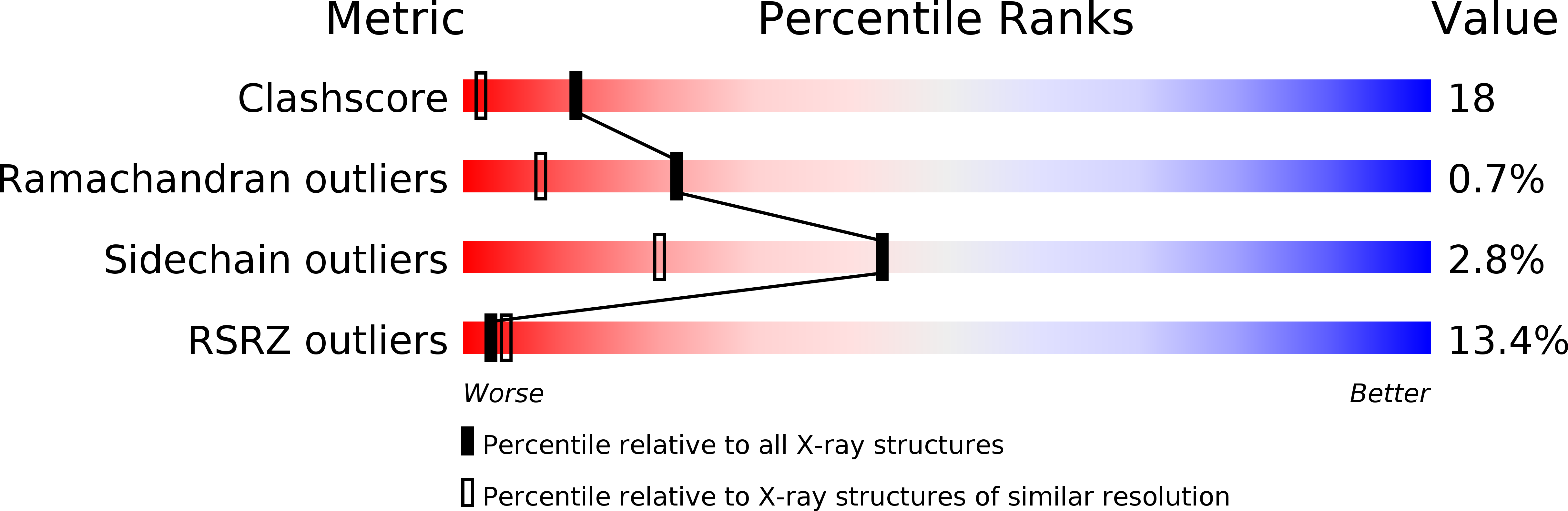
1.75 Å
R-Value Free:
0.25
R-Value Work:
0.22
R-Value Observed:
0.22
Space Group:
P 21 21 21
Macromolecular Entities
Structures with similar UniProt ID
Protein Blast
Polymer Type:polypeptide(L)
Molecule:EUKARYOTIC INITIATION FACTOR 4A
Gene (Uniprot):TIF1, TIF2
Chain IDs:A
Chain Length:165
Number of Molecules:1
Biological Source:Saccharomyces cerevisiae
Ligand Molecules
Primary Citation
Crystal structure of yeast initiation factor 4A, a DEAD-box RNA helicase.
Proc.Natl.Acad.Sci.USA 97 13080 13085 (2000)
PMID: 11087862 DOI: 10.1073/pnas.97.24.13080

Abstact

The eukaryotic translation initiation factor 4A (eIF4A) is a member of the DEA(D/H)-box RNA helicase family, a diverse group of proteins that couples an ATPase activity to RNA binding and unwinding. Previous work has provided the structure of the amino-terminal, ATP-binding domain of eIF4A. Extending those results, we have solved the structure of the carboxyl-terminal domain of eIF4A with data to 1.75 A resolution; it has a parallel alpha-beta topology that superimposes, with minor variations, on the structures and conserved motifs of the equivalent domain in other, distantly related helicases. Using data to 2.8 A resolution and molecular replacement with the refined model of the carboxyl-terminal domain, we have completed the structure of full-length eIF4A; it is a "dumbbell" structure consisting of two compact domains connected by an extended linker. By using the structures of other helicases as a template, compact structures can be modeled for eIF4A that suggest (i) helicase motif IV binds RNA; (ii) Arg-298, which is conserved in the DEA(D/H)-box RNA helicase family but is absent from many other helicases, also binds RNA; and (iii) motifs V and VI "link" the carboxyl-terminal domain to the amino-terminal domain through interactions with ATP and the DEA(D/H) motif, providing a mechanism for coupling ATP binding and hydrolysis with conformational changes that modulate RNA binding.

Legend

Protein

Chemical

Disease

Primary Citation of related structures
Feedback Form
Name
Email
Institute
Feedback