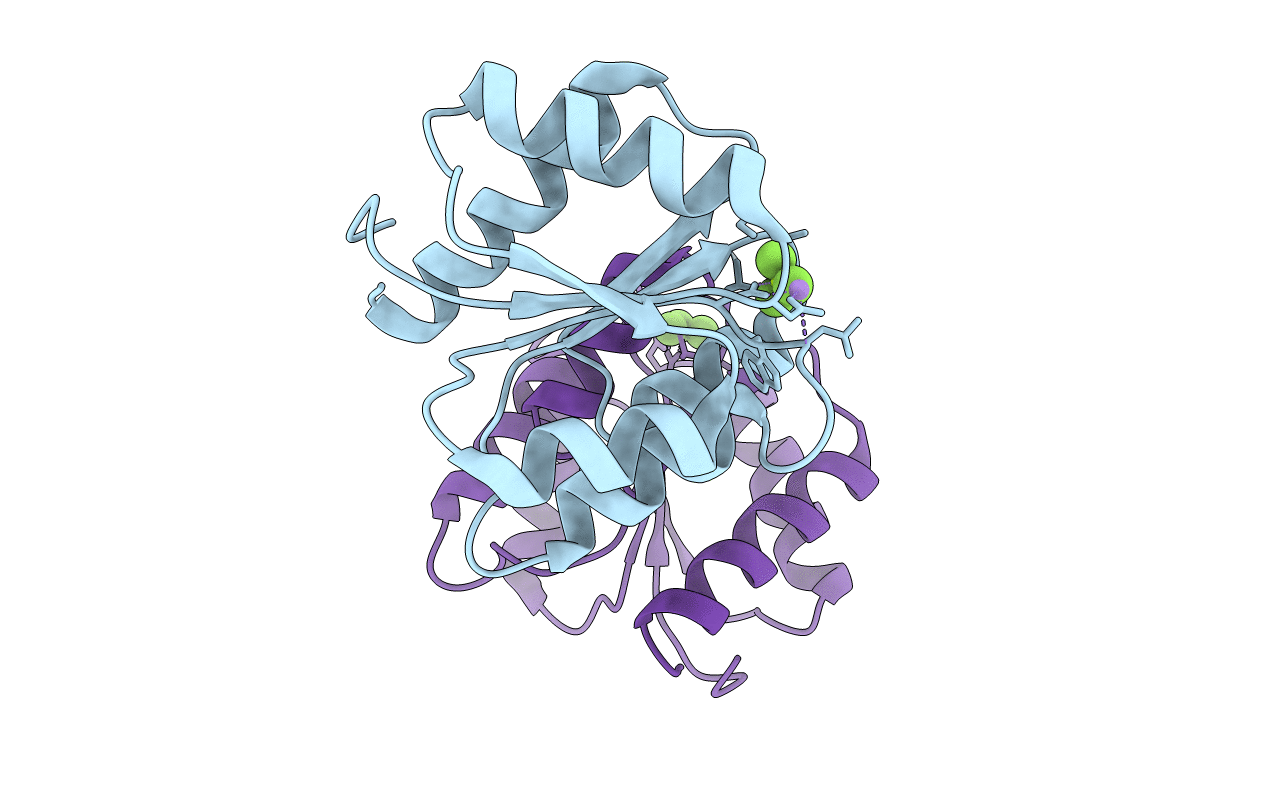
1FQW image
Deposition Date 2000-09-07
Release Date 2001-07-18
Last Version Date 2024-02-07
Entry Detail
PDB ID:
1FQW
Title:
CRYSTAL STRUCTURE OF ACTIVATED CHEY
Biological Source:
Source Organism:
Escherichia coli (Taxon ID: 562)
Host Organism:
Method Details:
Experimental Method:
Resolution:
2.37 Å
R-Value Free:
0.24
R-Value Work:
0.21
R-Value Observed:
0.21
Space Group:
P 21 21 21
Macromolecular Entities
Structures with similar UniProt ID
Protein Blast
Polymer Type:polypeptide(L)
Molecule:CHEMOTAXIS CHEY PROTEIN
Chain IDs:A, B
Chain Length:128
Number of Molecules:2
Biological Source:Escherichia coli
Primary Citation

Abstact

The crystal structure of BeF(3)(-)-activated CheY, with manganese in the magnesium binding site, was determined at 2.4-A resolution. BeF(3)(-) bonds to Asp(57), the normal site of phosphorylation, forming a hydrogen bond and salt bridge with Thr(87) and Lys(109), respectively. The six coordination sites for manganese are satisfied by a fluorine of BeF(3)(-), the side chain oxygens of Asp(13) and Asp(57), the carbonyl oxygen of Asn(59), and two water molecules. All of the active site interactions seen for BeF(3)(-)-CheY are also observed in P-Spo0A(r). Thus, BeF(3)(-) activates CheY as well as other receiver domains by mimicking both the tetrahedral geometry and electrostatic potential of a phosphoryl group. The aromatic ring of Tyr(106) is found buried within a hydrophobic pocket formed by beta-strand beta4 and helix H4. The tyrosine side chain is stabilized in this conformation by a hydrogen bond between the hydroxyl group and the backbone carbonyl oxygen of Glu(89). This hydrogen bond appears to stabilize the active conformation of the beta4/H4 loop. Comparison of the backbone coordinates for the active and inactive states of CheY reveals that only modest changes occur upon activation, except in the loops, with the largest changes occurring in the beta4/H4 loop. This region is known to be conformationally flexible in inactive CheY and is part of the surface used by activated CheY for binding its target, FliM. The pattern of activation-induced backbone coordinate changes is similar to that seen in FixJ(r). A common feature in the active sites of BeF(3)(-)-CheY, P-Spo0A(r), P-FixJ(r), and phosphono-CheY is a salt bridge between Lys(109) Nzeta and the phosphate or its equivalent, beryllofluoride. This suggests that, in addition to the concerted movements of Thr(87) and Tyr(106) (Thr-Tyr coupling), formation of the Lys(109)-PO(3)(-) salt bridge is directly involved in the activation of receiver domains generally.

Legend

Protein

Chemical

Disease

Primary Citation of related structures
Feedback Form
Name
Email
Institute
Feedback