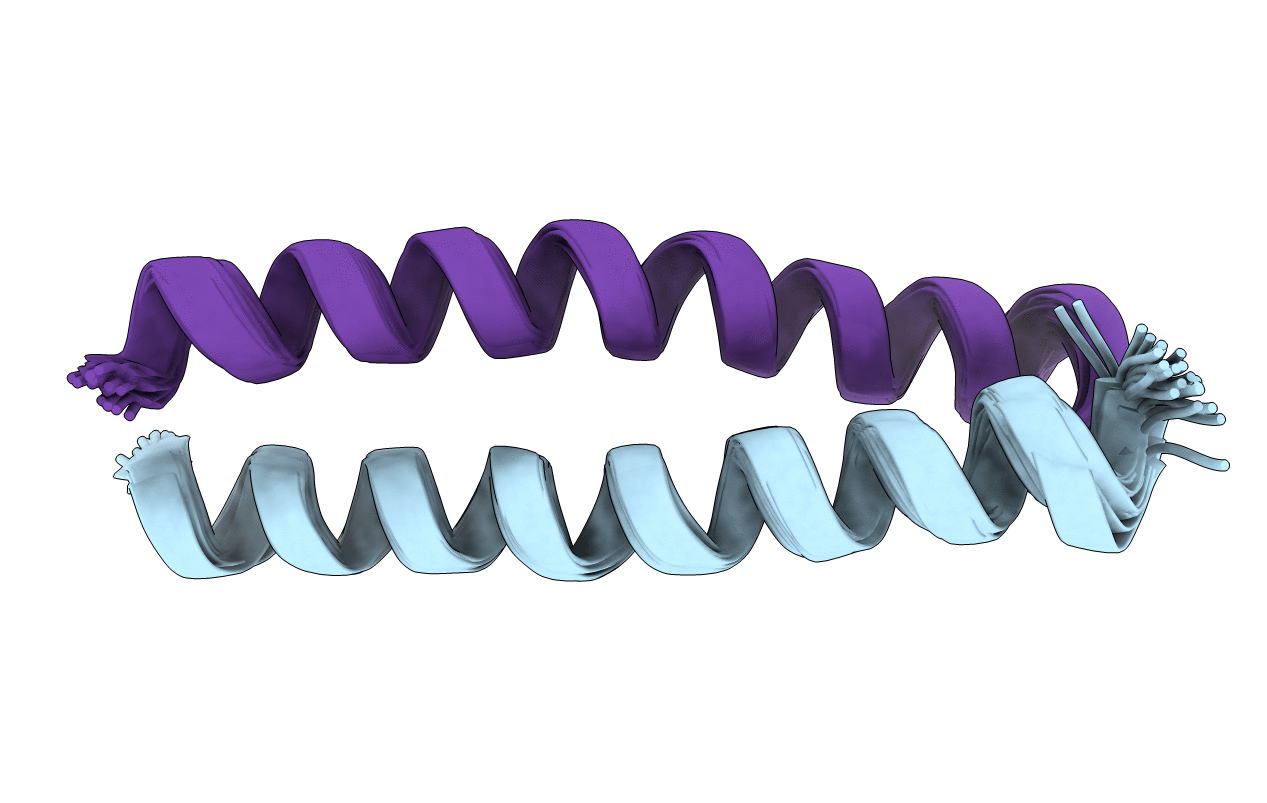
1FMH image
Deposition Date 2000-08-17
Release Date 2000-11-01
Last Version Date 2024-11-06
Entry Detail
PDB ID:
1FMH
Keywords:
Title:
NMR SOLUTION STRUCTURE OF A DESIGNED HETERODIMERIC LEUCINE ZIPPER
Biological Source:
Source Organism:
Method Details:
Experimental Method:
Conformers Calculated:
50
Conformers Submitted:
25
Selection Criteria:
structures with the least restraint violations,structures with the lowest energy

Macromolecular Entities
Structures with similar UniProt ID
Protein Blast
Polymer Type:polypeptide(L)
Molecule:GENERAL CONTROL PROTEIN GCN4
Gene (Uniprot):GCN4
Mutagens:R249E M250V K251A D255K K256E E258A E259Q L260A L261E S262A K263E H266Q N269Q R273Q K275E K276H L277E V278C
Chain IDs:A
Chain Length:33
Number of Molecules:1
Biological Source:
Structures with similar UniProt ID
Protein Blast
Polymer Type:polypeptide(L)
Molecule:GENERAL CONTROL PROTEIN GCN4
Gene (Uniprot):GCN4
Mutagens:R249E M250V K251Q Q252A E254K D255K K256R E258Q E259A L261K S262A K263R H266A L267A E268K N269Q E270K A272Q R273A K275R K276H L277K V278C
Chain IDs:B
Chain Length:33
Number of Molecules:1
Biological Source:
Ligand Molecules
Primary Citation
Interhelical ion pairing in coiled coils: solution structure of a heterodimeric leucine zipper and determination of pKa values of Glu side chains.
Biochemistry 39 12804 12818 (2000)
PMID: 11041845 DOI: 10.1021/bi001242e

Abstact

Residues of opposite charge often populate heptad positions g (heptad i on chain 1) and e' (heptad i + 1 on chain 2) in dimeric coiled coils and may stabilize the dimer by formation of interchain ion pairs. To investigate the contribution to stability of such electrostatic interactions we have designed a disulfide-linked heterodimeric zipper (AB zipper) consisting of the acidic chain Ac-E-VAQLEKE-VAQAEAE-NYQLEQE-VAQLEHE-CG-NH(2) and the basic chain Ac-E-VQALKKR-VQALKAR-NYAAKQK-VQALRHK-CG-NH(2) in which all e and g positions are occupied by either E or K/R to form a maximum of seven interhelical salt bridges. Temperature-induced denaturation experiments monitored by circular dichroism reveal a stable coiled coil conformation below 50 degrees C and in the pH range 1.2-8.0. Stability is highest at pH approximately 4.0 [DeltaG(U) (37 degrees C) = 5.18 +/- 0.51 kcal mol(-)(1)]. The solution structure of the AB zipper at pH 5.65 has been elucidated on the basis of homonuclear (1)H NMR data collected at 800 MHz [heavy atom rmsd's for the ensemble of 50 calculated structures are 0.47 +/- 0.13 A (backbone) and 0.95 +/- 0.16 A (all)]. Both chains of the AB zipper are almost entirely in alpha-helical conformation and form a superhelix with a left-handed twist. Overhauser connectivities reveal close contacts between g position residues (heptad i on chain 1) and residues d/f (heptad i on chain 1), residues a/d (heptad i + 1 on chain 1), and residue a' (heptad i + 1 on chain 2). Residues in position e (heptad i on chain 1) are in contact with residues a/b/d/f (heptad i on chain 1) and residue d' (heptad i on chain 2). These connectivities hint at a relatively defined alignment of the side chains across the helix interface. Partial H-bond formation between the functional groups of residues g and e'(+1) is observed in the calculated structures. NMR pH titration experiments disclose pK(a) values for Glu delta-carboxylate groups: 4.14 +/- 0.02 (E(1)), 4.82 +/- 0.07 (E(6)), 4.52 +/- 0.01 (E(8)), 4.37 +/- 0.03 (E(13)), 4.11 +/- 0.02 (E(15)), 4.41 +/- 0.07 (E(20)), 4.82 +/- 0.03 (E(22)), 4.65 +/- 0.04 (E(27)), 4.63 +/- 0.03 (E(29)), 4.22 +/- 0.02 (E(1)(')). By comparison with pK(a) of Glu in unfolded peptides ( approximately 4. 3 +/- 0.1), our pK(a) data suggest marginal or even unfavorable contribution of charged Glu to the stability of the AB zipper. The electrostatic energy gained from interhelical ion pairs is likely to be surpassed by hydrophobic energy terms upon protonation of Glu, due to increased hydrophobicity of uncharged Glu and, thus, better packing against apolar residues at the chain interface.

Legend

Protein

Chemical

Disease

Primary Citation of related structures
Feedback Form
Name
Email
Institute
Feedback