1FIZ image
Deposition Date 2000-08-07
Release Date 2000-11-08
Last Version Date 2024-10-30
Entry Detail
PDB ID:
1FIZ
Keywords:
Title:
THREE DIMENSIONAL STRUCTURE OF BETA-ACROSIN FROM BOAR SPERMATOZOA
Biological Source:
Source Organism:
Sus scrofa (Taxon ID: 9823)
Method Details:
Experimental Method:
Resolution:
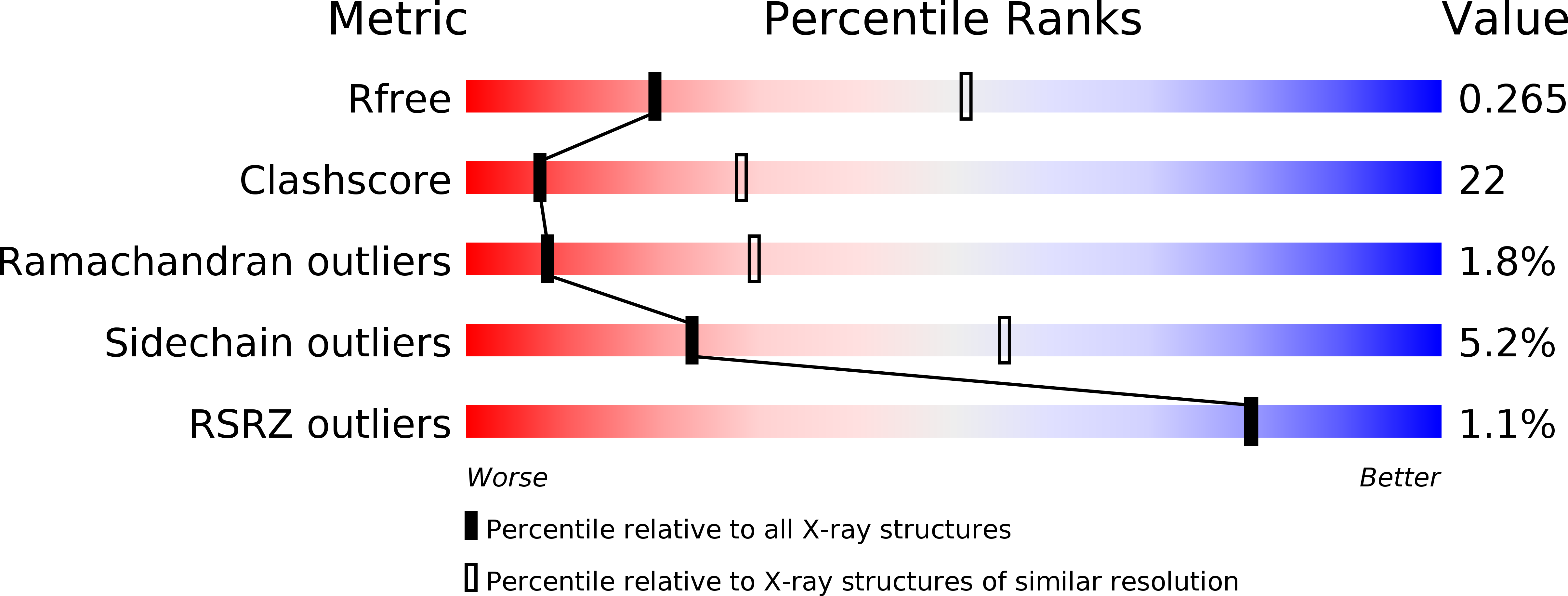
2.90 Å
R-Value Free:
0.26
R-Value Work:
0.21
Space Group:
P 43 3 2
Macromolecular Entities
Structures with similar UniProt ID
Protein Blast
Polymer Type:polypeptide(L)
Molecule:BETA-ACROSIN HEAVY CHAIN
Gene (Uniprot):ACR
Chain IDs:A
Chain Length:263
Number of Molecules:1
Biological Source:Sus scrofa
Structures with similar UniProt ID
Protein Blast
Polymer Type:polypeptide(L)
Molecule:BETA-ACROSIN LIGHT CHAIN
Gene (Uniprot):ACR
Chain IDs:B (auth: L)
Chain Length:23
Number of Molecules:1
Biological Source:Sus scrofa
Modified Residue
Compound ID Chain ID Parent Comp ID Details 2D Image
ASN A ASN GLYCOSYLATION SITE
Primary Citation
Effector sites in the three-dimensional structure of mammalian sperm beta-acrosin.
Structure Fold.Des. 8 1179 1188 (2000)
PMID: 11080640 DOI: 10.1016/S0969-2126(00)00523-2

Abstact

BACKGROUND: Proacrosin is a serine protease found specifically within the acrosomal vesicle of all mammalian spermatozoa. During fertilization proacrosin autoactivates to form beta-acrosin, in which there is a "light" chain cross-linked to a "heavy" chain by two disulphide bonds. beta-acrosin is thought to be multifunctional with roles in acrosomal exocytosis, as a receptor for zona pellucida proteins, and as a protease to facilitate penetration of spermatozoa into the egg. RESULTS: The crystal structures of both ram and boar beta-acrosins have been solved in complex with p-aminobenzamidine to 2.1 A and 2.9 A resolution, respectively. Both enzymes comprise a heavy chain with structural homology to trypsin, and a light chain covalently associated in a similar manner to blood coagulation enzymes. In crystals of boar beta-acrosin, the carboxyl terminus of the heavy chain is inserted into the active site of the neighboring molecule. In both enzyme structures, there are distinctive positively charged surface "patches" close to the active site, which associate with carbohydrate from adjacent molecules and also bind sulfate ions. CONCLUSIONS: From the three-dimensional structure of beta-acrosin, two separate effector sites are evident. First, proteolytic activity, believed to be important at various stages during fertilization, arises from the trypsin-like active site. Activity of this site may be autoregulated through intermolecular associations. Second, positively charged regions on the surface adjacent to the active site may act as receptors for binding zona pellucida glycoproteins. The spatial proximity of these two effector sites suggests there may be synergy between them.

Legend

Protein

Chemical

Disease

Primary Citation of related structures
Feedback Form
Name
Email
Institute
Feedback