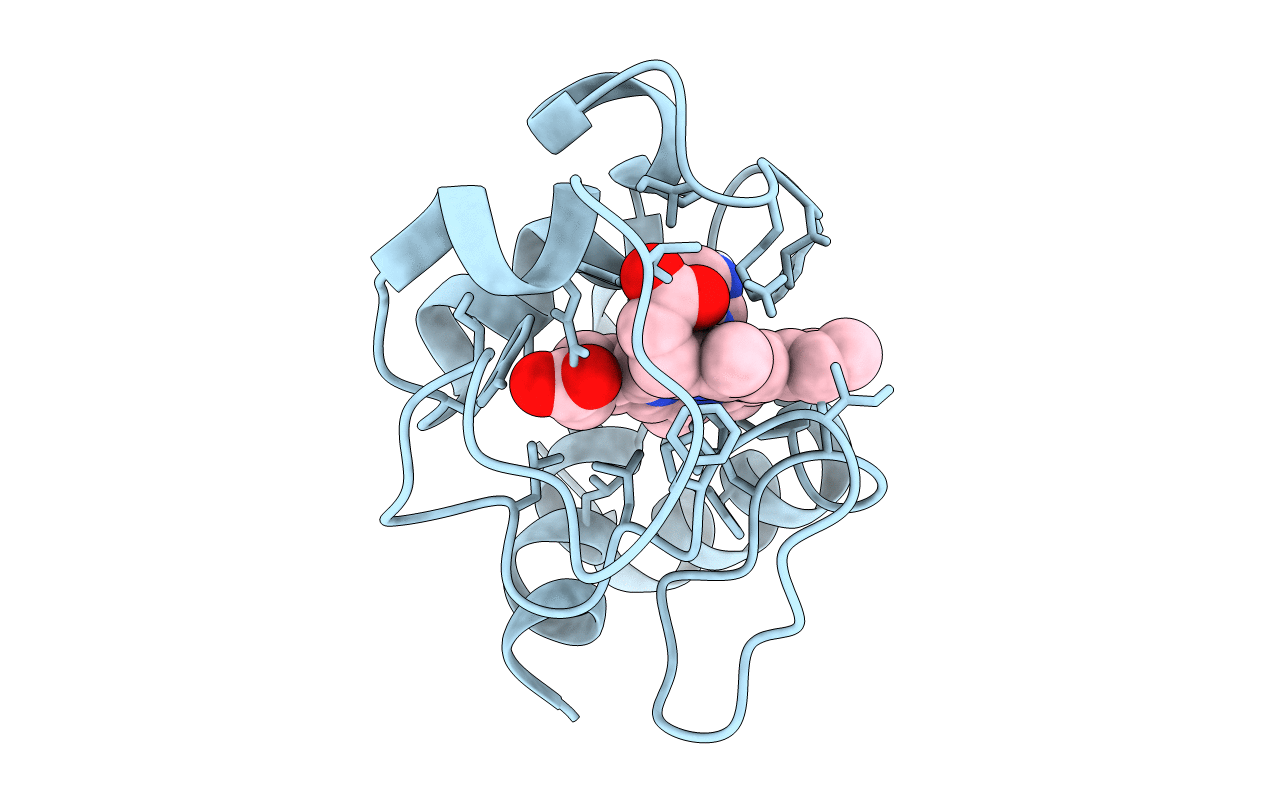
1FI7 image
Deposition Date 2000-08-03
Release Date 2000-08-23
Last Version Date 2024-10-09
Entry Detail
PDB ID:
1FI7
Title:
Solution structure of the imidazole complex of cytochrome C
Biological Source:
Source Organism:
Equus caballus (Taxon ID: 9796)
Method Details:
Experimental Method:
Conformers Submitted:
1

Macromolecular Entities
Structures with similar UniProt ID
Protein Blast
Polymer Type:polypeptide(L)
Molecule:CYTOCHROME C
Gene (Uniprot):CYCS
Chain IDs:A
Chain Length:104
Number of Molecules:1
Biological Source:Equus caballus
Primary Citation
Effects of extrinsic imidazole ligation on the molecular and electronic structure of cytochrome c
J.Biol.Inorg.Chem. 6 628 637 (2001)
PMID: 11472026 DOI: 10.1007/s007750100240

Abstact

Although imidazole ligand binding to cytochrome c is not directly related to its physiological function, it has the potential to provide valuable information on the molecular and electronic structure of the protein. The solution structure of the imidazole adduct of oxidized horse heart cytochrome c (Im-cyt c) has been determined through 2D NMR spectroscopy. The Im-cyt c, 8 mM in 1.2 M imidazole solution at pH 5.7 and 313 K, provided altogether 2,542 NOEs (1,901 meaningful NOEs) and 194 pseudocontact shifts. The 35 conformers of the family show the RMSD values to the average structure of 0.063+/-0.007 nm for the backbone and 0.107+/-0.007 nm for all heavy atoms, respectively. The characterization of Im-cyt c is discussed in detail both in terms of structure and electronic properties. The replacement of the axial ligand Met80 with the exogenous imidazole ligand induces significant conformation changes in both backbone and side chains of the residues located in the distal axial ligand regions. The imidazole ligand binds essentially parallel to the imidazole of the proximal histidine, the two planes forming an angle of 8+/-7 degrees. The electron delocalization on the heme moiety and the magnetic susceptibility tensor are consistent with these structural features.

Legend

Protein

Chemical

Disease

Primary Citation of related structures
Feedback Form
Name
Email
Institute
Feedback