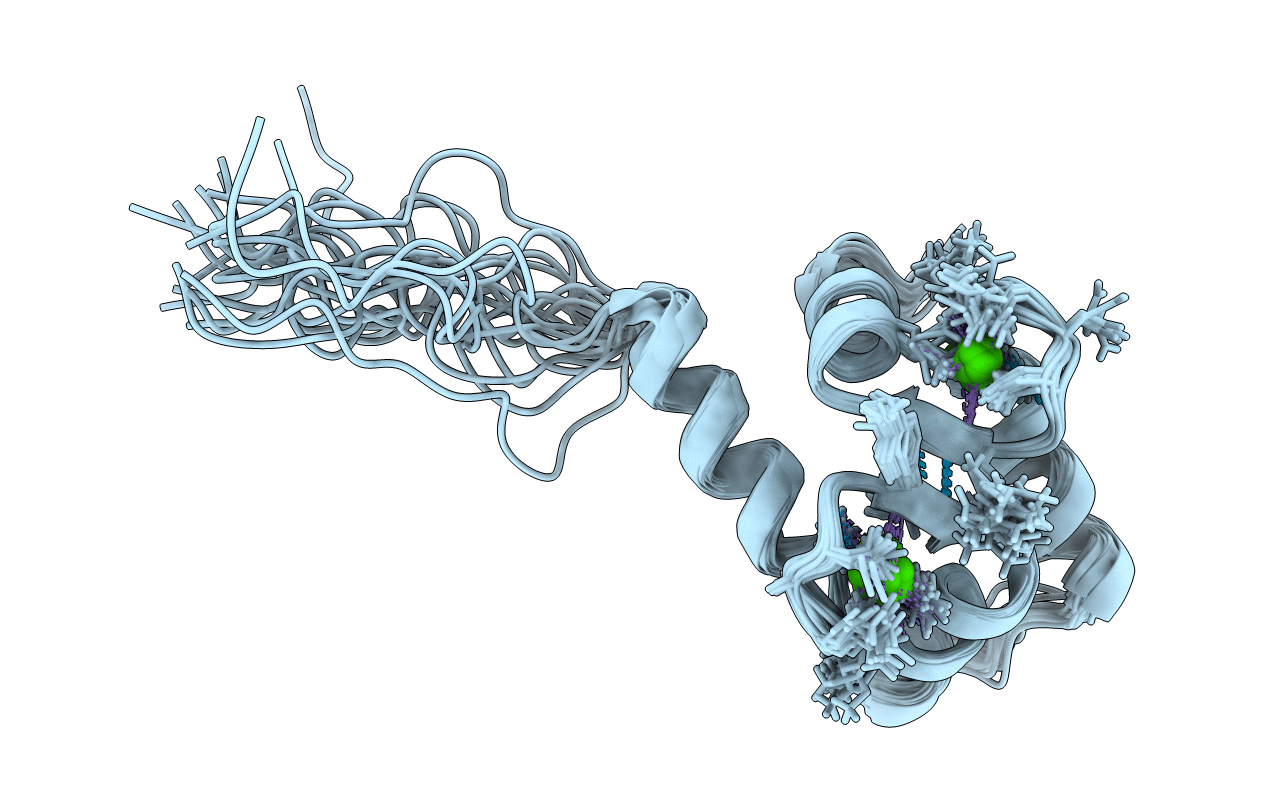
1FI5 image
Deposition Date 2000-08-03
Release Date 2000-08-23
Last Version Date 2024-05-22
Entry Detail
PDB ID:
1FI5
Title:
NMR STRUCTURE OF THE C TERMINAL DOMAIN OF CARDIAC TROPONIN C BOUND TO THE N TERMINAL DOMAIN OF CARDIAC TROPONIN I.
Biological Source:
Source Organism:
Gallus gallus (Taxon ID: 9031)
Method Details:
Experimental Method:
Conformers Calculated:
500
Conformers Submitted:
20
Selection Criteria:
SMALLEST RMSD TO AVERAGE STRUCTURE
Macromolecular Entities
Structures with similar UniProt ID
Protein Blast
Polymer Type:polypeptide(L)
Molecule:PROTEIN (TROPONIN C)
Gene (Uniprot):TNNC1
Chain IDs:A
Chain Length:81
Number of Molecules:1
Biological Source:Gallus gallus
Ligand Molecules
Primary Citation
Solution structures of the C-terminal domain of cardiac troponin C free and bound to the N-terminal domain of cardiac troponin I.
Biochemistry 38 8313 8322 (1999)
PMID: 10387077 DOI: 10.1021/bi9902642

Abstact

The N-terminal domain of cardiac troponin I (cTnI) comprising residues 33-80 and lacking the cardiac-specific amino terminus forms a stable binary complex with the C-terminal domain of cardiac troponin C (cTnC) comprising residues 81-161. We have utilized heteronuclear multidimensional NMR to assign the backbone and side-chain resonances of Ca2+-saturated cTnC(81-161) both free and bound to cTnI(33-80). No significant differences were observed between secondary structural elements determined for free and cTnI(33-80)-bound cTnC(81-161). We have determined solution structures of Ca2+-saturated cTnC(81-161) free and bound to cTnI(33-80). While the tertiary structure of cTnC(81-161) is qualitatively similar to that observed free in solution, the binding of cTnI(33-80) results mainly in an opening of the structure and movement of the loop region between helices F and G. Together, these movements provide the binding site for the N-terminal domain of cTnI. The putative binding site for cTnI(33-80) was determined by mapping amide proton and nitrogen chemical shift changes, induced by the binding of cTnI(33-80), onto the C-terminal cTnC structure. The binding interface for cTnI(33-80), as suggested from chemical shift changes, involves predominantly hydrophobic interactions located in the expanded hydrophobic pocket. The largest chemical shift changes were observed in the loop region connecting helices F and G. Inspection of available TnC sequences reveals that these residues are highly conserved, suggesting a common binding motif for the Ca2+/Mg2+-dependent interaction site in the TnC/TnI complex.

Legend

Protein

Chemical

Disease

Primary Citation of related structures
Feedback Form
Name
Email
Institute
Feedback