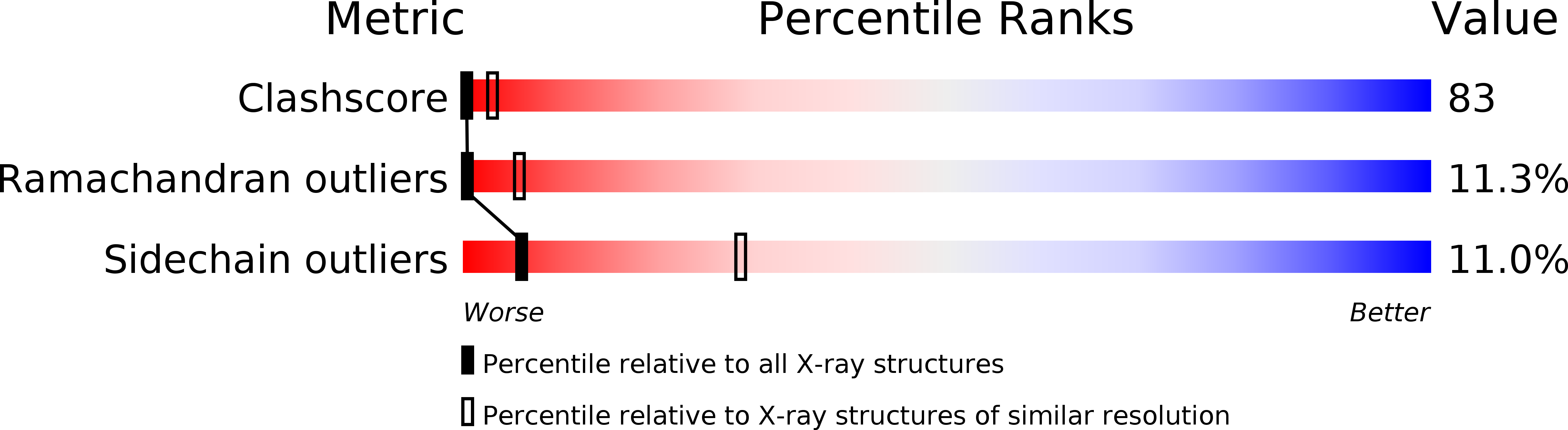
1FFT image
Deposition Date 2000-07-26
Release Date 2000-10-18
Last Version Date 2024-02-07
Entry Detail
PDB ID:
1FFT
Keywords:
Title:
The structure of ubiquinol oxidase from Escherichia coli
Biological Source:
Source Organism:
Escherichia coli (Taxon ID: 562)
Host Organism:
Method Details:
Experimental Method:
Resolution:
3.50 Å
Space Group:
C 2 2 21
Macromolecular Entities
Structures with similar UniProt ID
Protein Blast
Polymer Type:polypeptide(L)
Molecule:UBIQUINOL OXIDASE
Gene (Uniprot):cyoB
Chain IDs:A, E (auth: F)
Chain Length:663
Number of Molecules:2
Biological Source:Escherichia coli
Structures with similar UniProt ID
Protein Blast
Polymer Type:polypeptide(L)
Molecule:UBIQUINOL OXIDASE
Gene (Uniprot):cyoA
Chain IDs:B, F (auth: G)
Chain Length:315
Number of Molecules:2
Biological Source:Escherichia coli
Structures with similar UniProt ID
Protein Blast
Polymer Type:polypeptide(L)
Molecule:UBIQUINOL OXIDASE
Gene (Uniprot):cyoC
Chain IDs:C, G (auth: H)
Chain Length:204
Number of Molecules:2
Biological Source:Escherichia coli
Polymer Type:polypeptide(L)
Molecule:UBIQUINOL OXIDASE
Chain IDs:D, H (auth: I)
Chain Length:109
Number of Molecules:2
Biological Source:Escherichia coli
Primary Citation
The structure of the ubiquinol oxidase from Escherichia coli and its ubiquinone binding site.
Nat.Struct.Biol. 7 910 917 (2000)
PMID: 11017202 DOI: 10.1038/82824

Abstact

Cell respiration is catalyzed by the heme-copper oxidase superfamily of enzymes, which comprises cytochrome c and ubiquinol oxidases. These membrane proteins utilize different electron donors through dissimilar access mechanisms. We report here the first structure of a ubiquinol oxidase, cytochrome bo3, from Escherichia coli. The overall structure of the enzyme is similar to those of cytochrome c oxidases; however, the membrane-spanning region of subunit I contains a cluster of polar residues exposed to the interior of the lipid bilayer that is not present in the cytochrome c oxidase. Mutagenesis studies on these residues strongly suggest that this region forms a quinone binding site. A sequence comparison of this region with known quinone binding sites in other membrane proteins shows remarkable similarities. In light of these findings we suggest specific roles for these polar residues in electron and proton transfer in ubiquinol oxidase.

Legend

Protein

Chemical

Disease

Primary Citation of related structures
Feedback Form
Name
Email
Institute
Feedback