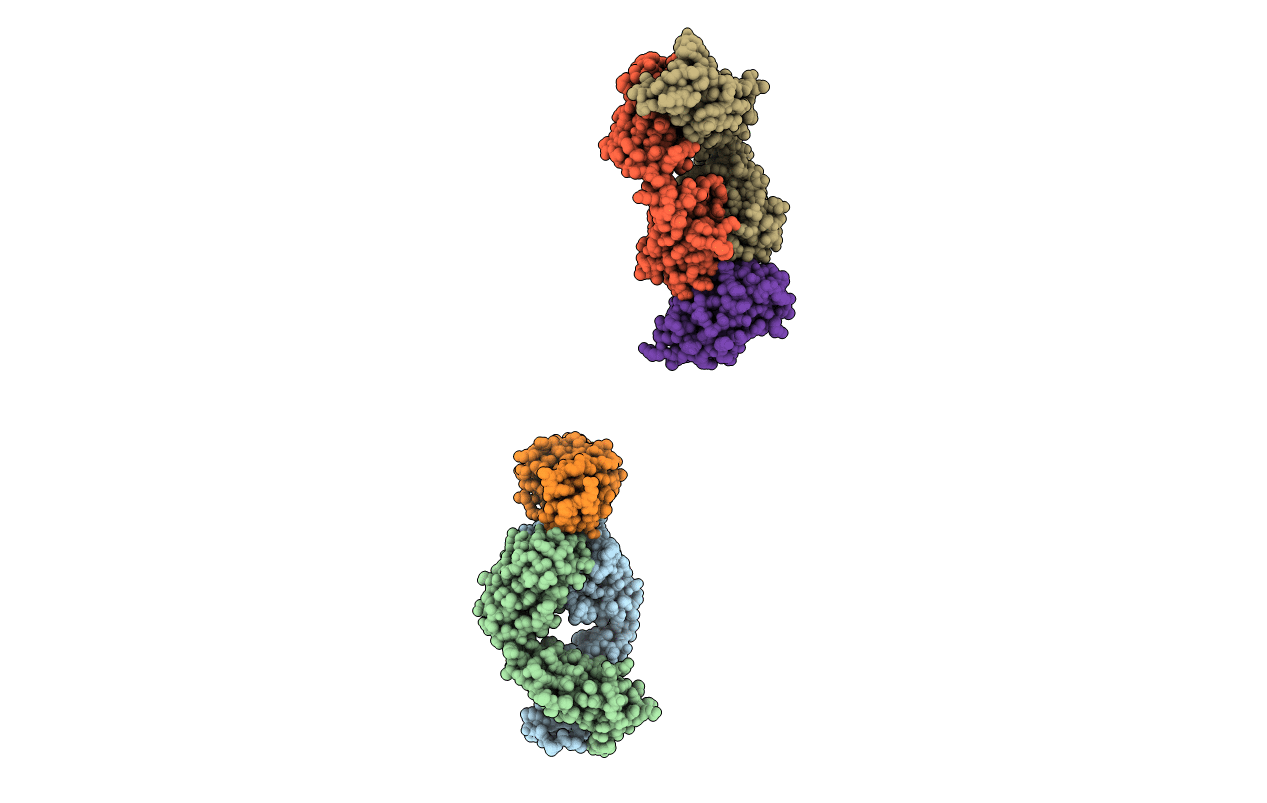
1FBI image
Deposition Date 1995-01-19
Release Date 1995-02-27
Last Version Date 2024-11-20
Entry Detail
PDB ID:
1FBI
Title:
CRYSTAL STRUCTURE OF A CROSS-REACTION COMPLEX BETWEEN FAB F9.13.7 AND GUINEA-FOWL LYSOZYME
Biological Source:
Source Organism:
Mus musculus (Taxon ID: 10090)
Numida meleagris (Taxon ID: 8996)
Method Details:
Experimental Method:
Resolution:
3.00 Å
R-Value Work:
0.19
R-Value Observed:
0.19
Space Group:
P 1 21 1

Macromolecular Entities
Structures with similar UniProt ID
Protein Blast
Polymer Type:polypeptide(L)
Molecule:IGG1 F9.13.7 FAB (HEAVY CHAIN)
Gene (Uniprot):Ighg1
Chain IDs:B (auth: H), E (auth: Q)
Chain Length:221
Number of Molecules:2
Biological Source:Mus musculus
Structures with similar UniProt ID
Protein Blast
Polymer Type:polypeptide(L)
Molecule:IGG1 F9.13.7 FAB (LIGHT CHAIN)
Chain IDs:A (auth: L), D (auth: P)
Chain Length:214
Number of Molecules:2
Biological Source:Mus musculus
Structures with similar UniProt ID
Protein Blast
Polymer Type:polypeptide(L)
Molecule:GUINEA FOWL LYSOZYME
Gene (Uniprot):LYZ
Chain IDs:C (auth: X), F (auth: Y)
Chain Length:129
Number of Molecules:2
Biological Source:Numida meleagris
Ligand Molecules
Primary Citation
Crystal structure of a cross-reaction complex between Fab F9.13.7 and guinea fowl lysozyme.
J.Biol.Chem. 270 18067 18076 (1995)
PMID: 7629116 DOI: 10.1074/jbc.270.30.18067

Abstact

The crystal structure of the complex between the cross-reacting antigen Guinea fowl lysozyme and the Fab from monoclonal antibody F9.13.7, raised against hen egg lysozyme, has been determined by x-ray diffraction to 3-A resolution. The antibody interacts with exposed residues of an alpha-helix and surrounding loops adjacent to the lysozyme active site cleft. The epitope of lysozyme bound by antibody F9.13.7 overlaps almost completely with that bound by antibody HyHEL10; the same 12 residues of the antigen interact with the two antibodies. The antibodies, however, have different combining sites with no sequence homology at any of their complementarity-determining regions and show a dissimilar pattern of cross-reactivity with heterologous antigens. Side chain mobility of epitope residues contributes to confer steric and electrostatic complementarity to differently shaped combining sites, allowing functional mimicry to occur. The capacity of two antibodies that have different fine specificities to bind the same area of the antigen emphasizes the operational character of the definition of an antigenic determinant. This example demonstrates that degenerate binding of the same structural motif does not require the existence of sequence homology or other chemical similarities between the different binding sites.

Legend

Protein

Chemical

Disease

Primary Citation of related structures
Feedback Form
Name
Email
Institute
Feedback