1EZ0 image
Deposition Date 2000-05-09
Release Date 2000-05-24
Last Version Date 2023-08-09
Entry Detail
PDB ID:
1EZ0
Keywords:
Title:
CRYSTAL STRUCTURE OF THE NADP+ DEPENDENT ALDEHYDE DEHYDROGENASE FROM VIBRIO HARVEYI.
Biological Source:
Source Organism:
Vibrio harveyi (Taxon ID: 669)
Host Organism:
Method Details:
Experimental Method:
Resolution:
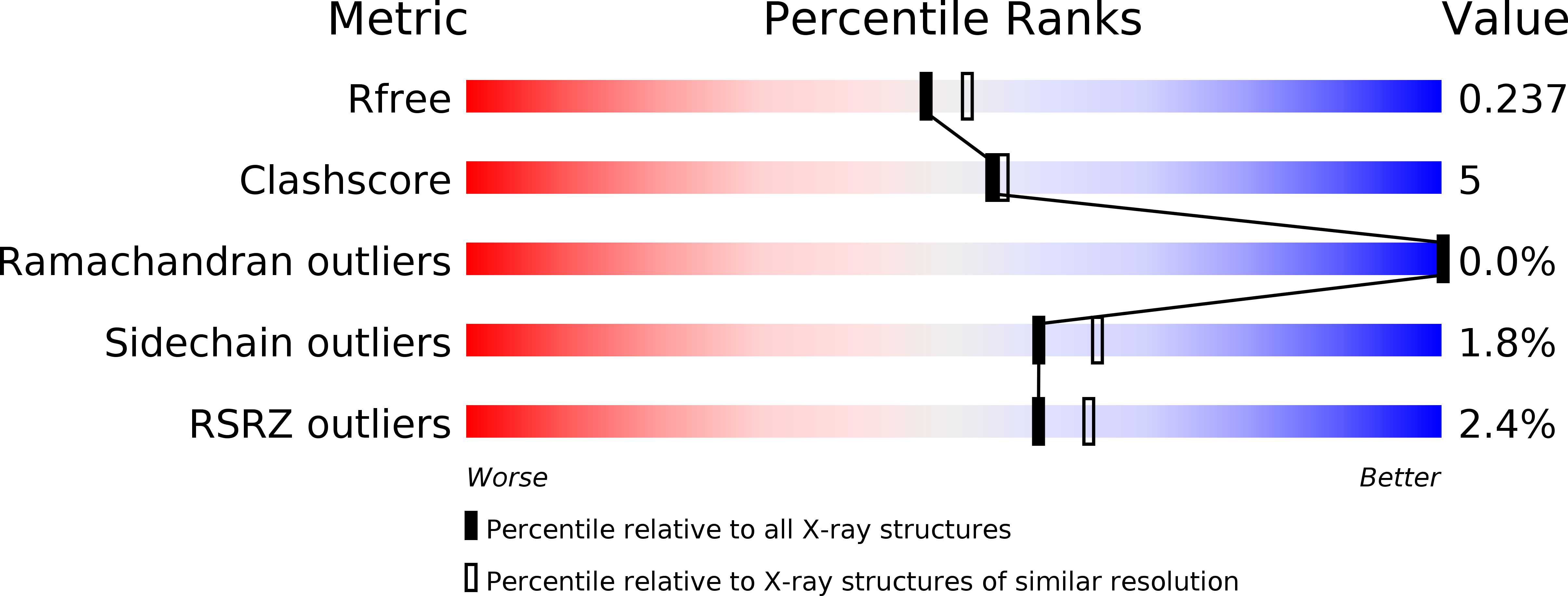
2.10 Å
R-Value Free:
0.24
R-Value Work:
0.21
Space Group:
P 1 21 1
Macromolecular Entities
Structures with similar UniProt ID
Protein Blast
Polymer Type:polypeptide(L)
Molecule:ALDEHYDE DEHYDROGENASE
Gene (Uniprot):aldH
Chain IDs:A, B, C, D
Chain Length:510
Number of Molecules:4
Biological Source:Vibrio harveyi
Ligand Molecules
Primary Citation
Crystal structure of the NADP+-dependent aldehyde dehydrogenase from Vibrio harveyi: structural implications for cofactor specificity and affinity.
Biochem.J. 349 853 861 (2000)
PMID: 10903148

Abstact

Aldehyde dehydrogenase from the bioluminescent bacterium, Vibrio harveyi, catalyses the oxidation of long-chain aliphatic aldehydes to acids. The enzyme is unique compared with other forms of aldehyde dehydrogenase in that it exhibits a very high specificity and affinity for the cofactor NADP(+). Structural studies of this enzyme and comparisons with other forms of aldehyde dehydrogenase provide the basis for understanding the molecular features that dictate these unique properties and will enhance our understanding of the mechanism of catalysis for this class of enzyme. The X-ray structure of aldehyde dehydrogenase from V. harveyi has been solved to 2.5-A resolution as a partial complex with the cofactor NADP(+) and to 2. 1-A resolution as a fully bound 'holo' complex. The cofactor preference exhibited by different forms of the enzyme is predominantly determined by the electrostatic environment surrounding the 2'-hydroxy or the 2'-phosphate groups of the adenosine ribose moiety of NAD(+) or NADP(+), respectively. In the NADP(+)-dependent structures the presence of a threonine and a lysine contribute to the cofactor specificity. In the V. harveyi enzyme an arginine residue (Arg-210) contributes to the high cofactor affinity through a pi stacking interaction with the adenine ring system of the cofactor. Further differences between the V. harveyi enzyme and other aldehyde dehydrogenases are seen in the active site, in particular a histidine residue which is structurally conserved with phosphorylating glyceraldehyde-3-phosphate dehydrogenase. This may suggest an alternative mechanism for activation of the reactive cysteine residue for nucleophilic attack.

Legend

Protein

Chemical

Disease

Primary Citation of related structures
Feedback Form
Name
Email
Institute
Feedback