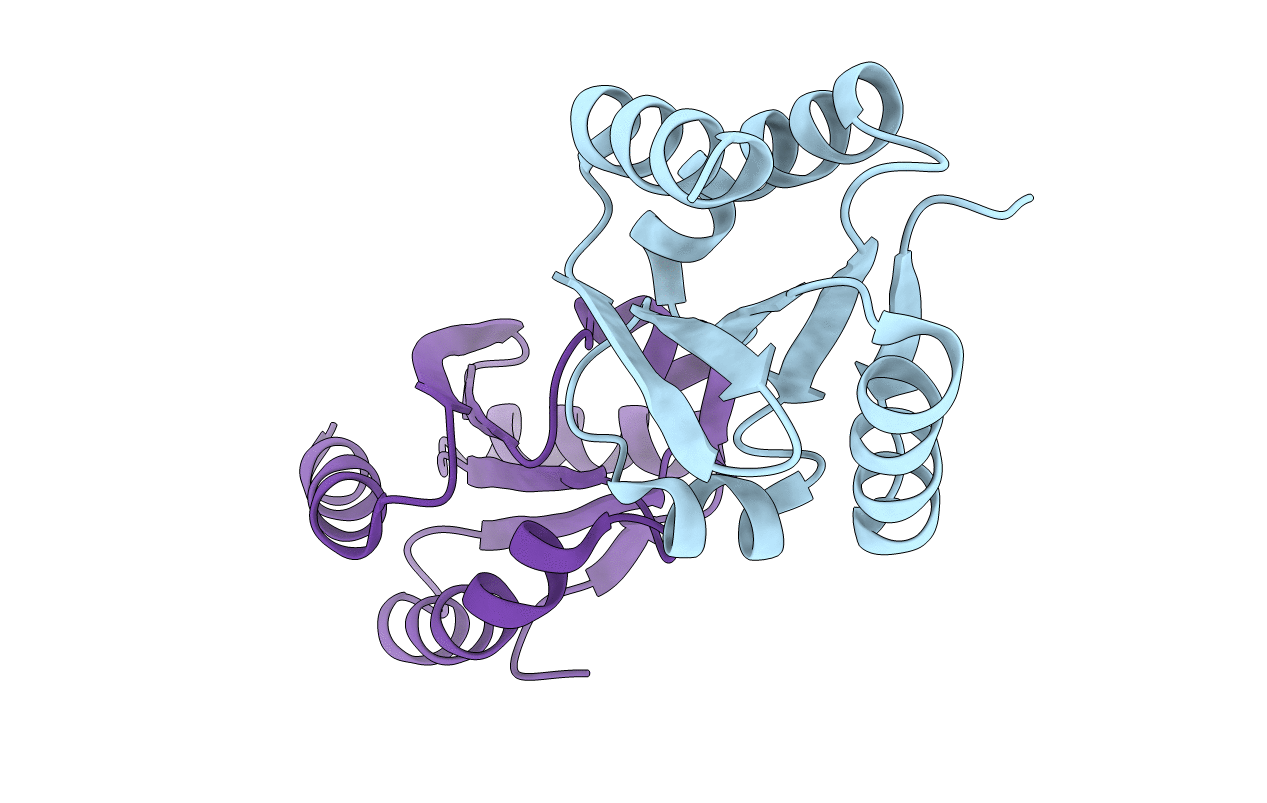
1EP7 image
Deposition Date 2000-03-28
Release Date 2001-12-12
Last Version Date 2024-11-20
Entry Detail
PDB ID:
1EP7
Title:
CRYSTAL STRUCTURE OF WT THIOREDOXIN H FROM CHLAMYDOMONAS REINHARDTII
Biological Source:
Source Organism(s):
Expression System(s):
Method Details:
Experimental Method:
Resolution:
2.10 Å
R-Value Free:
0.25
R-Value Work:
0.20
Space Group:
P 31 2 1

Macromolecular Entities
Structures with similar UniProt ID
Protein Blast
Polymer Type:polypeptide(L)
Molecule:THIOREDOXIN CH1, H-TYPE
Gene (Uniprot):TRXH
Chain IDs:A, B
Chain Length:112
Number of Molecules:2
Biological Source:Chlamydomonas reinhardtii
Primary Citation
Crystal structure of the wild-type and D30A mutant thioredoxin h of Chlamydomonas reinhardtii and implications for the catalytic mechanism.
Biochem.J. 359 65 75 (2001)
PMID: 11563970 DOI: 10.1042/0264-6021:3590065

Abstact

Thioredoxins are ubiquitous proteins which catalyse the reduction of disulphide bridges on target proteins. The catalytic mechanism proceeds via a mixed disulphide intermediate whose breakdown should be enhanced by the involvement of a conserved buried residue, Asp-30, as a base catalyst towards residue Cys-39. We report here the crystal structure of wild-type and D30A mutant thioredoxin h from Chlamydomonas reinhardtii, which constitutes the first crystal structure of a cytosolic thioredoxin isolated from a eukaryotic plant organism. The role of residue Asp-30 in catalysis has been revisited since the distance between the carboxylate OD1 of Asp-30 and the sulphur SG of Cys-39 is too great to support the hypothesis of direct proton transfer. A careful analysis of all available crystal structures reveals that the relative positioning of residues Asp-30 and Cys-39 as well as hydrophobic contacts in the vicinity of residue Asp-30 do not allow a conformational change sufficient to bring the two residues close enough for a direct proton transfer. This suggests that protonation/deprotonation of Cys-39 should be mediated by a water molecule. Molecular-dynamics simulations, carried out either in vacuo or in water, as well as proton-inventory experiments, support this hypothesis. The results are discussed with respect to biochemical and structural data.

Legend

Protein

Chemical

Disease

Primary Citation of related structures
Feedback Form
Name
Email
Institute
Feedback