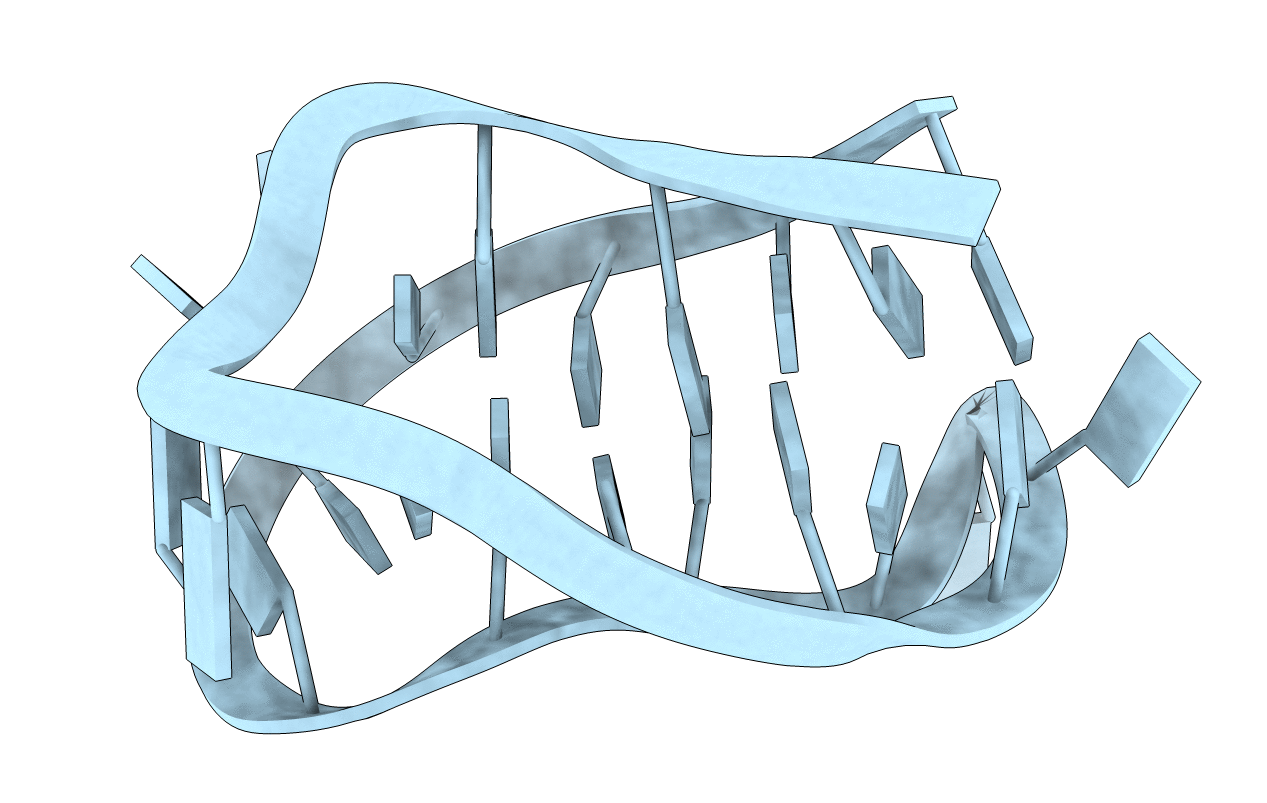
1EL2 image
Deposition Date 2000-03-13
Release Date 2000-03-27
Last Version Date 2024-05-22
Entry Detail
PDB ID:
1EL2
Keywords:
Title:
SOLUTION STRUCTURE OF A MODIFIED HUMAN TELOMERE FRAGMENT (STRUCTURE "A")
Biological Source:
Source Organism:
Method Details:
Experimental Method:
Conformers Calculated:
100
Conformers Submitted:
1
Selection Criteria:
structures with the least restraint violations, structures with the lowest energy
Macromolecular Entities
Polymer Type:polydeoxyribonucleotide
Molecule:5'-D(*CP*CP*CP*TP*AP*AP*(5CM)P*CP*CP*TP*AP*AP*CP*CP*CP*UP*AP*AP*CP*CP*CP*T)-3'
Chain IDs:A
Chain Length:22
Number of Molecules:1
Biological Source:
Modified Residue
Compound ID Chain ID Parent Comp ID Details 2D Image
5CM A DC ?
Ligand Molecules
Primary Citation
The solution structure and internal motions of a fragment of the cytidine-rich strand of the human telomere.
J.Mol.Biol. 299 123 144 (2000)
PMID: 10860727 DOI: 10.1006/jmbi.2000.3613

Abstact

We present the solution structure of d(CCCTA2CCCTA2CCCTA2CCCT), a fragment of the vertebrate telomere which folds intramolecularly. The four cytidine stretches form an i-motif which includes six intercalated C.C+ pairs and terminates with the cytidines at the 5' extremity of each stretch. Above, the second TA2 linker loops across one of the narrow grooves, while at the bottom, the first and third linkers loop across the wide grooves. At 30 degrees C, the spectra of the first and third linkers are quasi-degenerate. Severe broadening at lower temperature indicates that this results from motional averaging between at least two structures of each bottom loop, and makes it impossible to solve the configuration of the bottom loops directly, in contrast to the rest of the structure. We therefore turned to the modified sequence d(CCCTA(2)5MCCCTA2CCCUA2CCCT) in which the two base substitutions (underlined) break the quasi-symmetry between linkers 1 and 3. The three loops follow approximately the hairpin "second pattern" of Hilbers. In the first loop, T4 is in the syn orientation, whereas its analog in the third loop, U16, oriented anti, is in a central location, where it interacts with bases of both loops, thus contributing to their tight association. The only motion is a syn/anti flip of A18 in the third loop. Returning to the telomere fragment, we show that each of the bottom loops switches between the structures identified in the first and third loops of the modified structure. The motions are concerted, and the resulting configurations of the bottom loop cluster present a bulge to either right (T4 syn) or left (T16 syn).

Legend

Protein

Chemical

Disease

Primary Citation of related structures
Feedback Form
Name
Email
Institute
Feedback