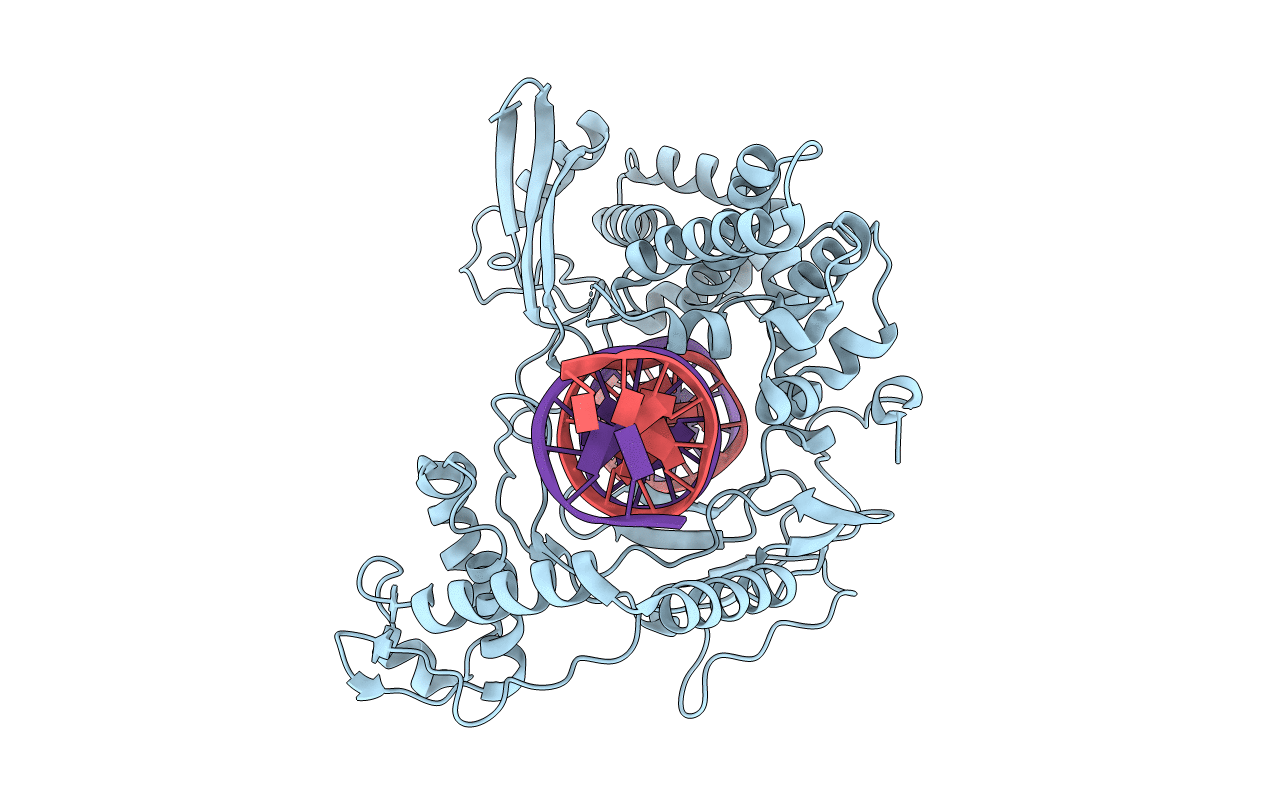
1EJ9 image
Deposition Date 2000-03-01
Release Date 2000-08-03
Last Version Date 2024-02-07
Entry Detail
PDB ID:
1EJ9
Keywords:
Title:
CRYSTAL STRUCTURE OF HUMAN TOPOISOMERASE I DNA COMPLEX
Biological Source:
Source Organism:
Homo sapiens (Taxon ID: 9606)
Host Organism:
Method Details:
Experimental Method:
Resolution:
2.60 Å
R-Value Free:
0.28
R-Value Work:
0.21
Space Group:
P 1 21 1

Macromolecular Entities
Structures with similar UniProt ID
Protein Blast
Polymer Type:polypeptide(L)
Molecule:DNA TOPOISOMERASE I
Gene (Uniprot):TOP1
Mutagens:Y723F
Chain IDs:C (auth: A)
Chain Length:563
Number of Molecules:1
Biological Source:Homo sapiens
Primary Citation
Novel insights into catalytic mechanism from a crystal structure of human topoisomerase I in complex with DNA.
Biochemistry 39 6832 6840 (2000)
PMID: 10841763 DOI: 10.1021/bi992690t

Abstact

Human topoisomerase I helps to control the level of DNA supercoiling in cells and is vital for numerous DNA metabolic events, including replication, transcription, and recombination. The 2.6 A crystal structure of human topoisomerase I in noncovalent complex with a DNA duplex containing a cytosine at the -1 position of the scissile strand rather than the favored thymine is reported. The hydrogen bond between the O2 position of this -1 base and the epsilon-amino of the conserved Lys-532 residue, the only base-specific contact observed previously in the human topoisomerase I-DNA interaction, is maintained in this complex. Several unique features of this structure, however, have implications for the DNA-binding and active-site mechanisms of the enzyme. First, the ends of the DNA duplex were observed to shift by up to 5.4 A perpendicular to the DNA helical axis relative to structures reported previously, suggesting a novel degree of plasticity in the interaction between human topoisomerase I and its DNA substrate. Second, 12 additional residues at the NH(2) terminus of the protein (Trp-203-Gly-214) could be built in this structure, and they were found to pack against the putative hinge region implicated in the clamping of the enzyme around duplex DNA. Third, a water molecule was observed adjacent to the scissile phosphate and the active-site residues; the potential specific base character of this solvent molecule in the active-site mechanism of the enzyme is discussed. Fourth, the scissile phosphate group was found to be rotated by 75 degrees, bringing Lys-532 into hydrogen-bonding distance of one of the nonbridging phosphate oxygens. This orientation of the scissile phosphate group implicates Lys-532 as a fifth active-site residue, and also mimics the orientation observed for the 3'-phosphotyrosine linkage in the covalent human topoisomerase I-DNA complex structure. The implications of these structural features for the mechanism of the enzyme are discussed, including the potential requirement for a rotation of the scissile phosphate group during DNA strand cleavage and covalent attachment.

Legend

Protein

Chemical

Disease

Primary Citation of related structures
Feedback Form
Name
Email
Institute
Feedback