1EIH image
Deposition Date 2000-02-25
Release Date 2000-12-06
Last Version Date 2024-10-30
Entry Detail
PDB ID:
1EIH
Keywords:
Title:
SOLUTION STRUCTURE OF THE HUMAN CHEMOKINE EOTAXIN-2
Biological Source:
Source Organism:
Homo sapiens (Taxon ID: 9606)
Host Organism:
Method Details:
Experimental Method:
Conformers Calculated:
100
Conformers Submitted:
20
Selection Criteria:
structures with acceptable covalent geometry,structures with the least restraint violations,structures with the lowest energy
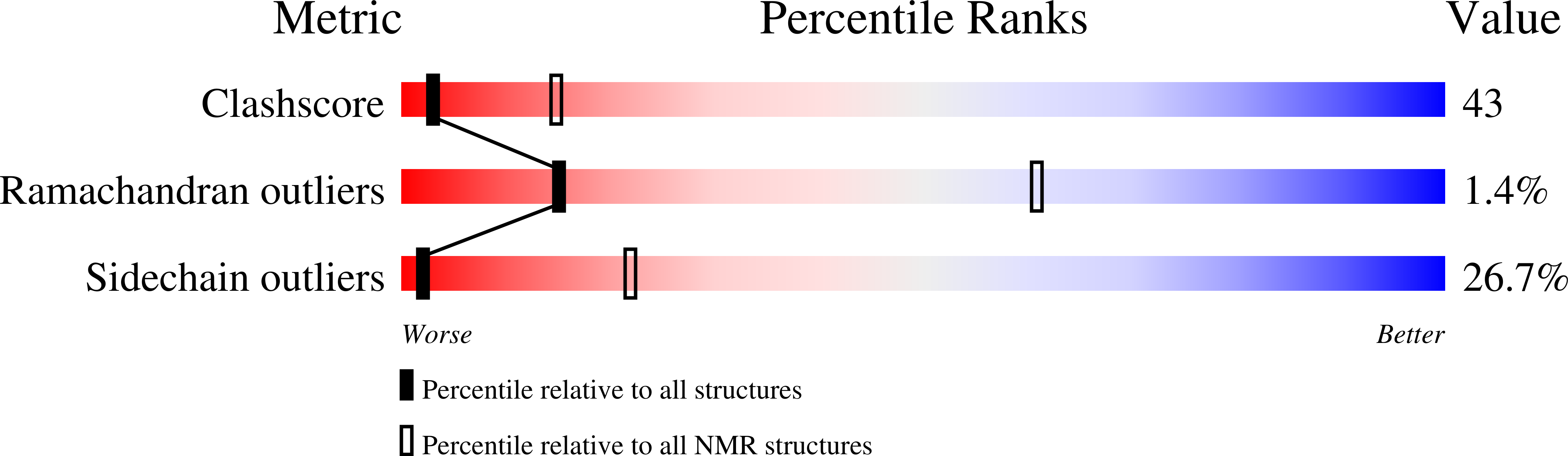
Macromolecular Entities
Structures with similar UniProt ID
Protein Blast
Polymer Type:polypeptide(L)
Molecule:EOTAXIN-2
Gene (Uniprot):CCL24
Chain IDs:A
Chain Length:73
Number of Molecules:1
Biological Source:Homo sapiens
Ligand Molecules
Primary Citation
NMR solution structure and receptor peptide binding of the CC chemokine eotaxin-2.
Biochemistry 39 8382 8395 (2000)
PMID: 10913244 DOI: 10.1021/bi000523j

Abstact

The human CC chemokine eotaxin-2 is a specific agonist for the chemokine receptor CCR3 and may play a role in the recruitment of eosinophils in allergic diseases and parasitic infections. We report the solution structure of eotaxin-2 determined using heteronuclear and triple resonance NMR methods. A family of 20 structures was calculated by hybrid distance geometry-simulated annealing from 854 NOE distance restraints, 48 dihedral angle restraints, and 12 hydrogen bond restraints. The structure of eotaxin-2 (73 amino acid residues) consists of a helical turn (residues 17-20) followed by a 3-stranded antiparallel beta-sheet (residues 22-26, 37-41, and 44-49) and an alpha-helix (residues 54-66). The N-loop (residues 9-16) is packed against both the sheet and the helix with the two conserved disulfide bonds tethering the N-terminal/N-loop region to the beta-sheet. The average backbone and heavy atom rmsd values of the 20 structures (residues 7-66) are 0.52 and 1.13 A, respectively. A linear peptide corresponding to the N-terminal region of CCR3 binds to eotaxin-2, inducing concentration-dependent chemical shift changes or line broadening of many residues. The distribution of these residues suggests that the peptide binds into an extended groove located at the interface between the N-loop and the beta2-beta3 hairpin. The receptor peptide may also interact with the N-terminus of the chemokine and part of the alpha-helix. Comparison of the eotaxin-2 structure with those of related chemokines indicates several structural features that may contribute to receptor specificity.

Legend

Protein

Chemical

Disease

Primary Citation of related structures
Feedback Form
Name
Email
Institute
Feedback