1EEQ image
Deposition Date 2000-02-01
Release Date 2001-02-01
Last Version Date 2024-10-30
Entry Detail
PDB ID:
1EEQ
Keywords:
Title:
M4L/Y(27D)D/T94H Mutant of LEN
Biological Source:
Source Organism:
Homo sapiens (Taxon ID: 9606)
Host Organism:
Method Details:
Experimental Method:
Resolution:
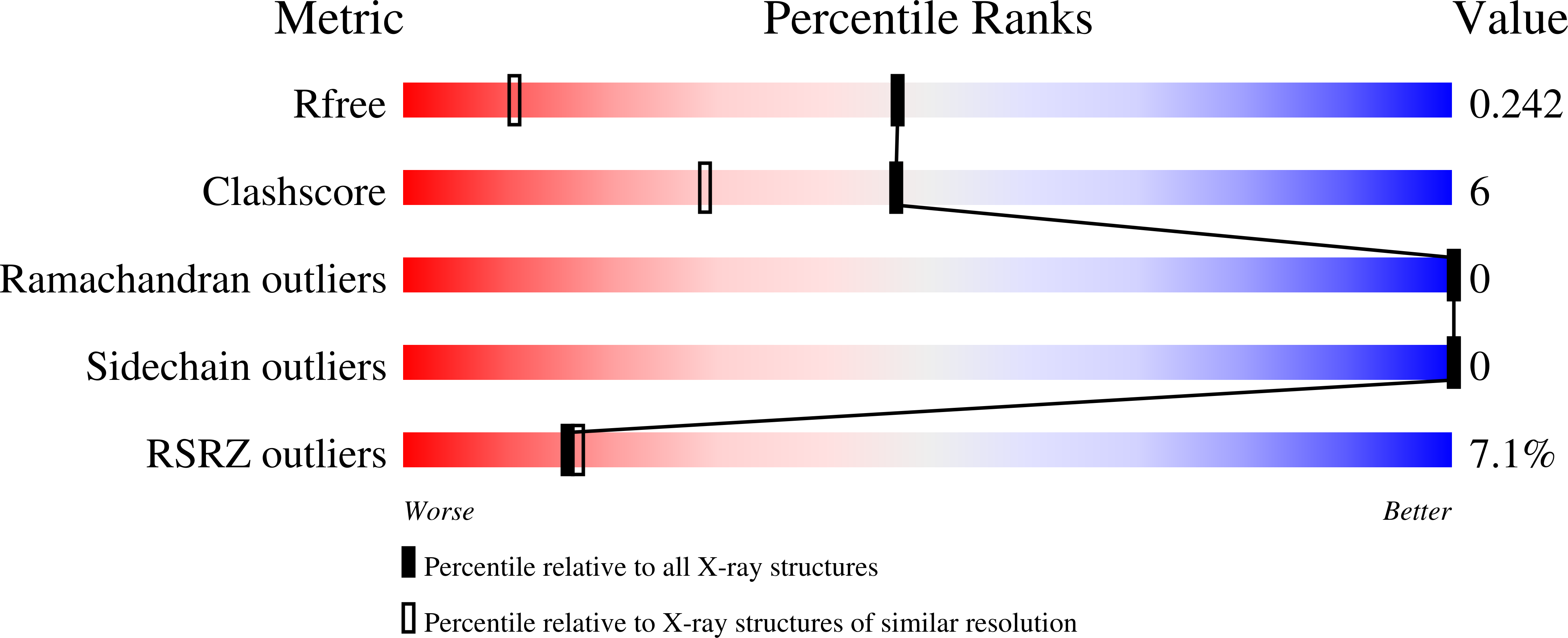
1.50 Å
R-Value Free:
0.23
R-Value Work:
0.21
R-Value Observed:
0.21
Space Group:
P 21 21 2
Macromolecular Entities
Structures with similar UniProt ID
Protein Blast
Polymer Type:polypeptide(L)
Molecule:KAPPA-4 IMMUNOGLOBULIN (LIGHT CHAIN)
Mutagens:M4L/Y(27D)D/T94H
Chain IDs:A, B
Chain Length:114
Number of Molecules:2
Biological Source:Homo sapiens
Primary Citation
Increasing protein stability by polar surface residues: domain-wide consequences of interactions within a loop.
Biophys.J. 82 391 398 (2002)
PMID: 11751325

Abstact

We have examined the influence of surface hydrogen bonds on the stability of proteins by studying the effects of mutations of human immunoglobulin light chain variable domain (V(L)). In addition to the variants Y27dD, N28F, and T94H of protein kappa IV Len that were previously described, we characterized mutants M4L, L27cN, L27cQ, and K39T, double mutant M4L/Y27dD, and triple mutant M4L/Y27dD/T94H. The triple mutant had an enhanced thermodynamic stability of 4.2 kcal/mol. We determined the structure of the triple mutant by x-ray diffraction and correlated the changes in stability due to the mutations with changes in the three-dimensional structure. Y27dD mutant had increased stability of Len by 2.7 kcal/mol, a large value for a single mutation. Asp27d present in CDR1 formed hydrogen bonds with the side-chain and main-chain atoms within the loop. In the case of the K39T mutant, which reduces stability by 2 kcal/mol, Lys39 in addition to forming a hydrogen bond with a carbonyl oxygen of a neighboring loop may also favorably influence the surface electrostatics of the molecule. We showed that hydrogen bonds between residues in surface loops can add to the overall stability of the V(L) domains. The contribution to stability is further increased if the surface residue makes more than one hydrogen bond or if it forms a hydrogen bond between neighboring turns or loops separated from each other in the amino acid sequence. Based on our experiments we suggest that stabilization of proteins might be systematically accomplished by introducing additional hydrogen bonds on the surface. These substitutions are more straightforward to predict than core-packing interactions and can be selected to avoid affecting the protein's function.

Legend

Protein

Chemical

Disease

Primary Citation of related structures
Feedback Form
Name
Email
Institute
Feedback