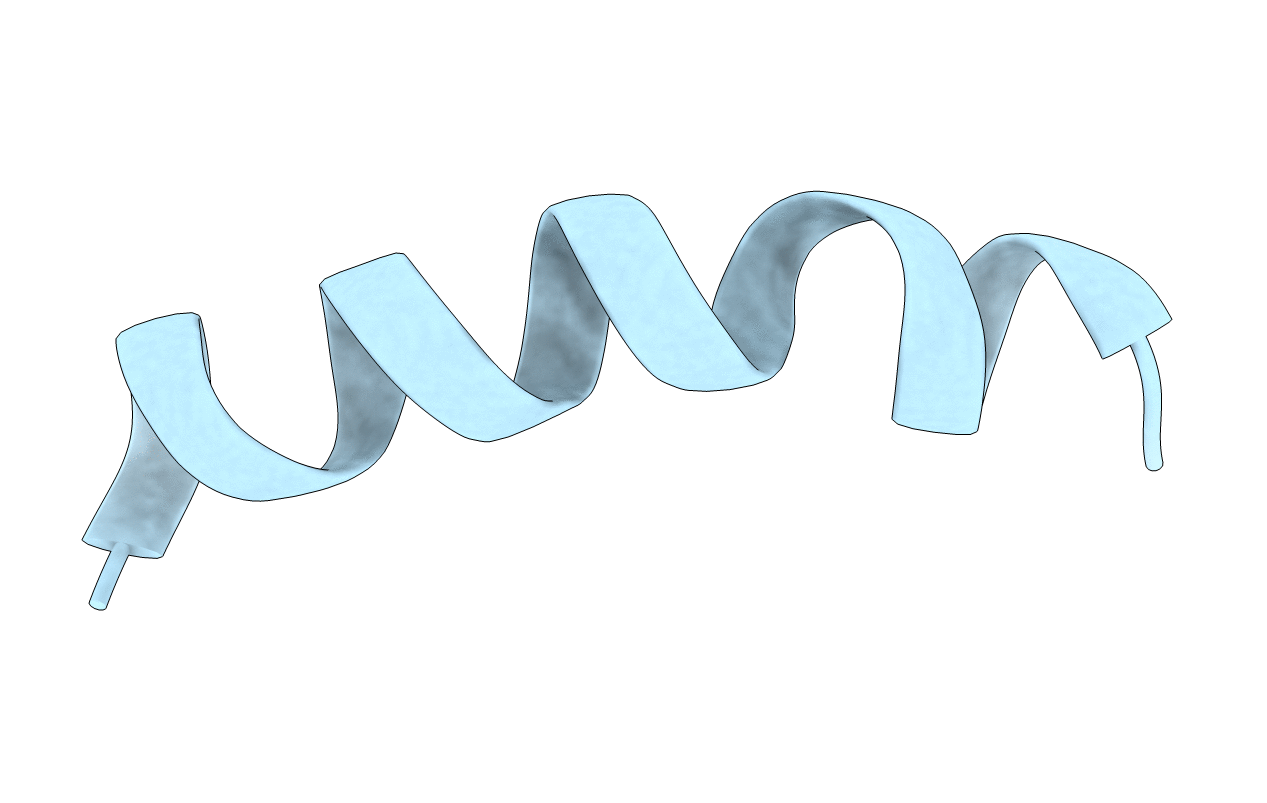
1EE7 image
Deposition Date 2000-01-31
Release Date 2000-05-10
Last Version Date 2023-11-15
Entry Detail
PDB ID:
1EE7
Keywords:
Title:
NMR STRUCTURE OF THE PEPTAIBOL CHRYSOSPERMIN C BOUND TO DPC MICELLES
Biological Source:
Source Organism:
Method Details:
Experimental Method:
Conformers Calculated:
100
Conformers Submitted:
1
Selection Criteria:
MINIMIZED DG STRUCTURE, CLOSEST TO AVERAGE STRUCTURE
Macromolecular Entities
Polymer Type:polypeptide(L)
Molecule:CHRYSOSPERMIN C
Chain IDs:A
Chain Length:20
Number of Molecules:1
Biological Source:HYPOMYCES CHRYSOSPERMUS
Ligand Molecules
Peptide-like Molecules
PRD_000162
Primary Citation
The NMR Solution Structure of the Ion Channel Peptaibol Chrysospermin C Bound to Dodecylphosphocholine Micelles.
Eur.J.Biochem. 267 1784 ? (2000)
PMID: 10712611 DOI: 10.1046/J.1432-1327.2000.01177.X

Abstact

Chrysospermin C is a 19-residue peptaibol capable of forming transmembrane ion channels in phospholipid bilayers. The conformation of chrysospermin C bound to dodecylphosphocholine micelles has been solved using heteronuclear NMR spectroscopy. Selective 15N-labeling and 13C-labeling of specific alpha-aminoisobutyric acid residues was used to obtain complete stereospecific assignments for all eight alpha-aminoisobutyric acid residues. Structures were calculated using 339 distance constraints and 40 angle constraints obtained from NMR data. The NMR structures superimpose with mean global rmsd values to the mean structure of 0. 27 A (backbone heavy atoms) and 0.42 A (all heavy atoms). Chrysospermin C bound to decylphosphocholine micelles displays two well-defined helices at the N-terminus (residues Phe1-Aib9) and C-terminus (Aib13-Trp-ol19). A slight bend preceding Pro14, i.e. encompassing residues 10-12, results in an angle of approximately 38 degrees between the mean axes of the two helical regions. The bend structure observed for chrysospermin C is compatible with the sequences of all 18 long peptaibols and may represent a common 'active' conformation. The structure of chrysospermin C shows clear hydrophobic and hydrophilic surfaces which would be appropriate for the formation of oligomeric ion channels.

Legend

Protein

Chemical

Disease

Primary Citation of related structures
Feedback Form
Name
Email
Institute
Feedback