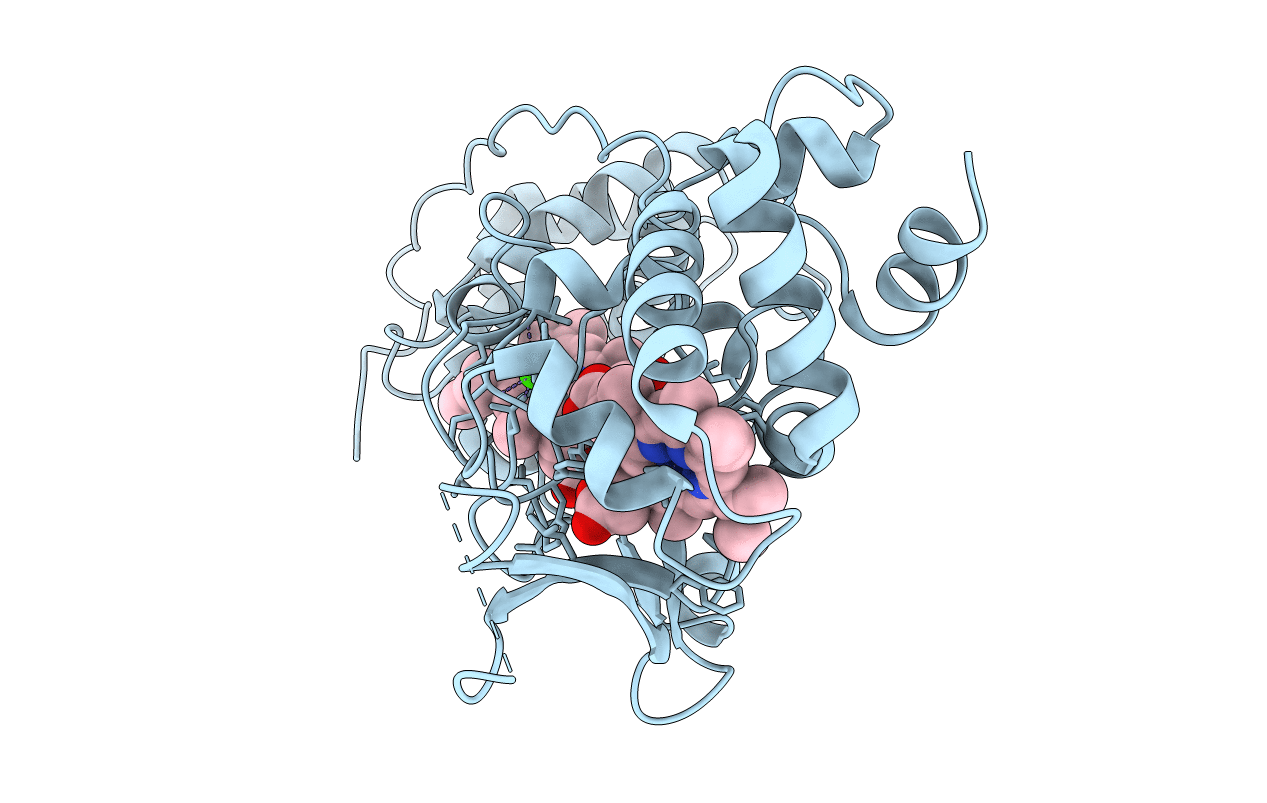
1EB7 image
Deposition Date 2001-07-24
Release Date 2001-07-24
Last Version Date 2025-10-01
Entry Detail
PDB ID:
1EB7
Keywords:
Title:
Crystal structure of the di-haem cytochrome c peroxidase from Pseudomonas aeruginosa
Biological Source:
Source Organism:
Method Details:
Experimental Method:
Resolution:
2.40 Å
R-Value Free:
0.22
R-Value Work:
0.17
R-Value Observed:
0.17
Space Group:
P 31 2 1

Macromolecular Entities
Structures with similar UniProt ID
Protein Blast
Polymer Type:polypeptide(L)
Molecule:CYTOCHROME C551 PEROXIDASE
Gene (Uniprot):ccpA
Chain IDs:A
Chain Length:323
Number of Molecules:1
Biological Source:PSEUDOMONAS AERUGINOSA
Primary Citation
Crystal Structure of the Di-Haemcytochrome C Peroxidase from Pseudomonas Aeruginosa
Structure 3 1225 ? (1995)
PMID: 8591033 DOI: 10.1016/S0969-2126(01)00258-1

Abstact

BACKGROUND Cytochrome c peroxidase from Pseudomonas aeruginosa (PsCCP) represents a new class of peroxidases which work without the need to create a semi-stable free radical for catalysis. The enzyme is located in the bacterial periplasm where its likely function is to provide protection against toxic peroxides. The soluble 323-residue single polypeptide chain contains two covalent c-type haems with very different properties: one of them is a low-potential (-330 mV) centre where hydrogen peroxide is reduced (the peroxidatic site); the other is a high-potential (+320 mV) centre which feeds electrons to the peroxidatic site from soluble electron-shuttle proteins such as cytochrome c and azurin. RESULTS The crystal structure of the oxidized form of PsCCP has been determined to 2.4 A resolution by multiple isomorphous replacement, and refined to an R-factor of 19.2%. PsCCP is organized into two domains, both of them containing a covalent c-haem in a structure reminiscent of class 1 cytochromes c. The domains are related by a quasi-twofold axis. The domain interface holds a newly discovered calcium-binding site with an unusual set of ligands. CONCLUSIONS The likely function of the calcium site is to maintain the structural integrity of the enzyme and/or to modulate electron transfer between the two haem domains. The low-potential haem has two histidine axial ligands (His55 and His71) and the high-potential haem is ligated by His201 and Met275. There are no polar residues at the peroxidatic site in the inactive oxidized enzyme. The structure suggests that, in the half-reduced functional form of the enzyme, the low-potential haem has to shed His71 in order to make the enzyme catalytically competent. This process is likely to trigger a reorganization of the active site, and may introduce a new residues into the haem pocket.

Legend

Protein

Chemical

Disease

Primary Citation of related structures
Feedback Form
Name
Email
Institute
Feedback