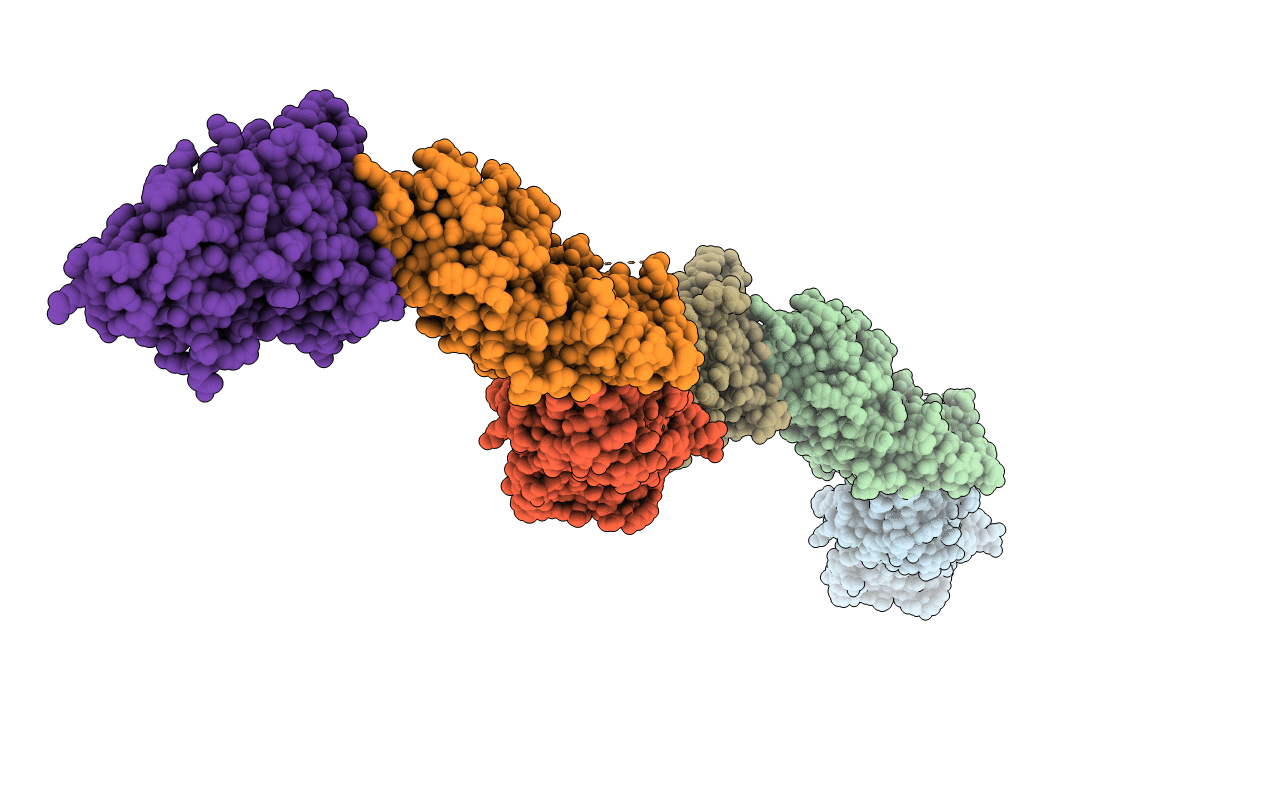
1E69 image
Deposition Date 2000-08-09
Release Date 2000-08-09
Last Version Date 2024-05-08
Entry Detail
PDB ID:
1E69
Title:
SMC head domain from Thermotoga maritima
Biological Source:
Source Organism:
Method Details:
Experimental Method:
Resolution:
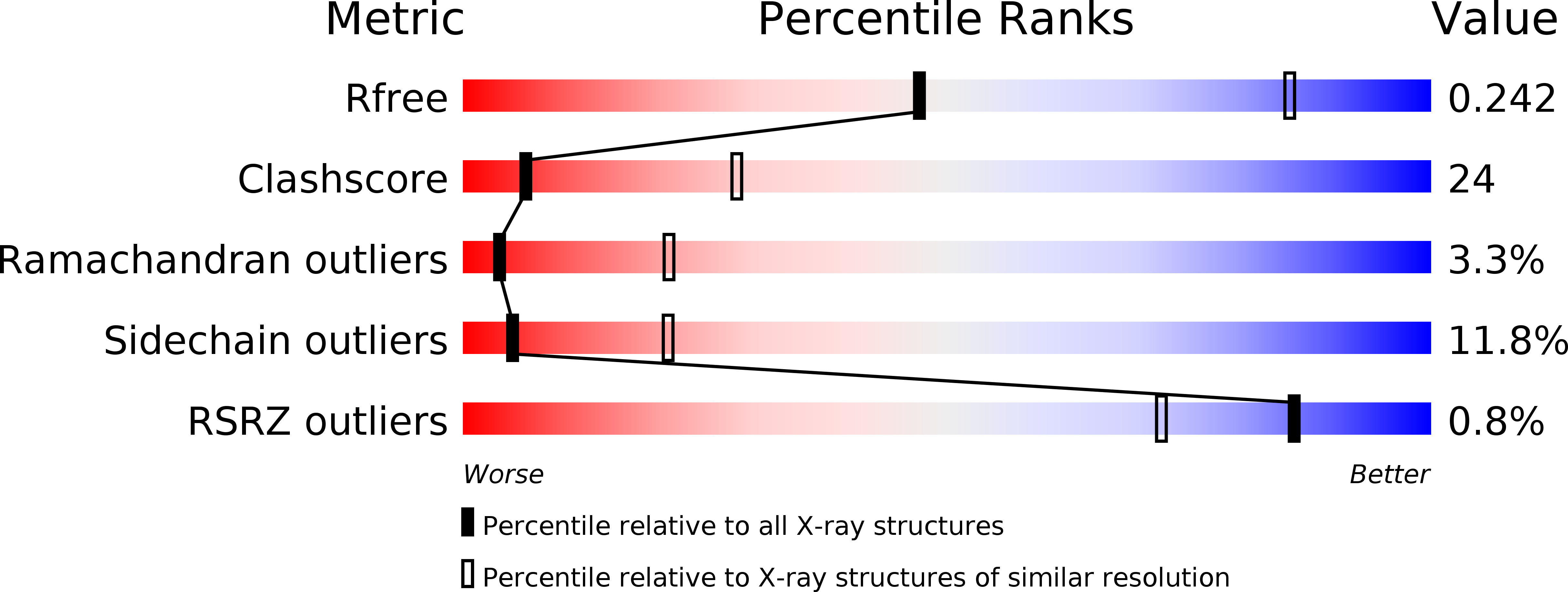
3.10 Å
R-Value Free:
0.27
R-Value Work:
0.25
R-Value Observed:
0.25
Space Group:
P 1 21 1
Macromolecular Entities
Structures with similar UniProt ID
Protein Blast
Polymer Type:polypeptide(L)
Molecule:CHROMOSOME SEGREGATION SMC PROTEIN
Gene (Uniprot):smc
Chain IDs:A, B, C, D, E, F
Chain Length:322
Number of Molecules:6
Biological Source:THERMOTOGA MARITIMA
Ligand Molecules
Primary Citation
Crystal Structure of the Smc Head Domain: An Abc ATPase with 900 Residues Antiparallel Coiled-Coil Inserted
J.Mol.Biol. 306 25 ? (2001)
PMID: 11178891 DOI: 10.1006/JMBI.2000.4379

Abstact

SMC (structural maintenance of chromosomes) proteins are large coiled-coil proteins involved in chromosome condensation, sister chromatid cohesion, and DNA double-strand break processing. They share a conserved five-domain architecture with three globular domains separated by two long coiled-coil segments. The coiled-coil segments are antiparallel, bringing the N and C-terminal globular domains together. We have expressed a fusion protein of the N and C-terminal globular domains of Thermotoga maritima SMC in Escherichia coli by replacing the approximately 900 residue coiled-coil and hinge segment with a short peptide linker. The SMC head domain (SMChd) binds and condenses DNA in an ATP-dependent manner. Using selenomethionine-substituted protein and multiple anomalous dispersion phasing, we have solved the crystal structure of the SMChd to 3.1 A resolution. In the monoclinic crystal form, six SMChd molecules form two turns of a helix. The fold of SMChd is closely related to the ATP-binding cassette (ABC) ATPase family of proteins and Rad50, a member of the SMC family involved in DNA double-strand break repair. In SMChd, the ABC ATPase fold is formed by the N and C-terminal domains with the 900 residue coiled-coil and hinge segment inserted in the middle of the fold. The crystal structure of an SMChd confirms that the coiled-coil segments in SMC proteins are anti-parallel and shows how the N and C-terminal domains come together to form an ABC ATPase. Comparison to the structure of the MukB N-terminal domain demonstrates the close relationship between MukB and SMC proteins, and indicates a helix to strand conversion when N and C-terminal parts come together.

Legend

Protein

Chemical

Disease

Primary Citation of related structures
Feedback Form
Name
Email
Institute
Feedback