1DJR image
Deposition Date 1999-12-03
Release Date 2000-06-30
Last Version Date 2024-10-16
Entry Detail
PDB ID:
1DJR
Keywords:
Title:
HEAT-LABILE ENTEROTOXIN B-PENTAMER COMPLEXED WITH M-CARBOXYPHENYL-ALPHA-D-GALACTOSE
Biological Source:
Source Organism:
Escherichia coli (Taxon ID: 562)
Host Organism:
Method Details:
Experimental Method:
Resolution:
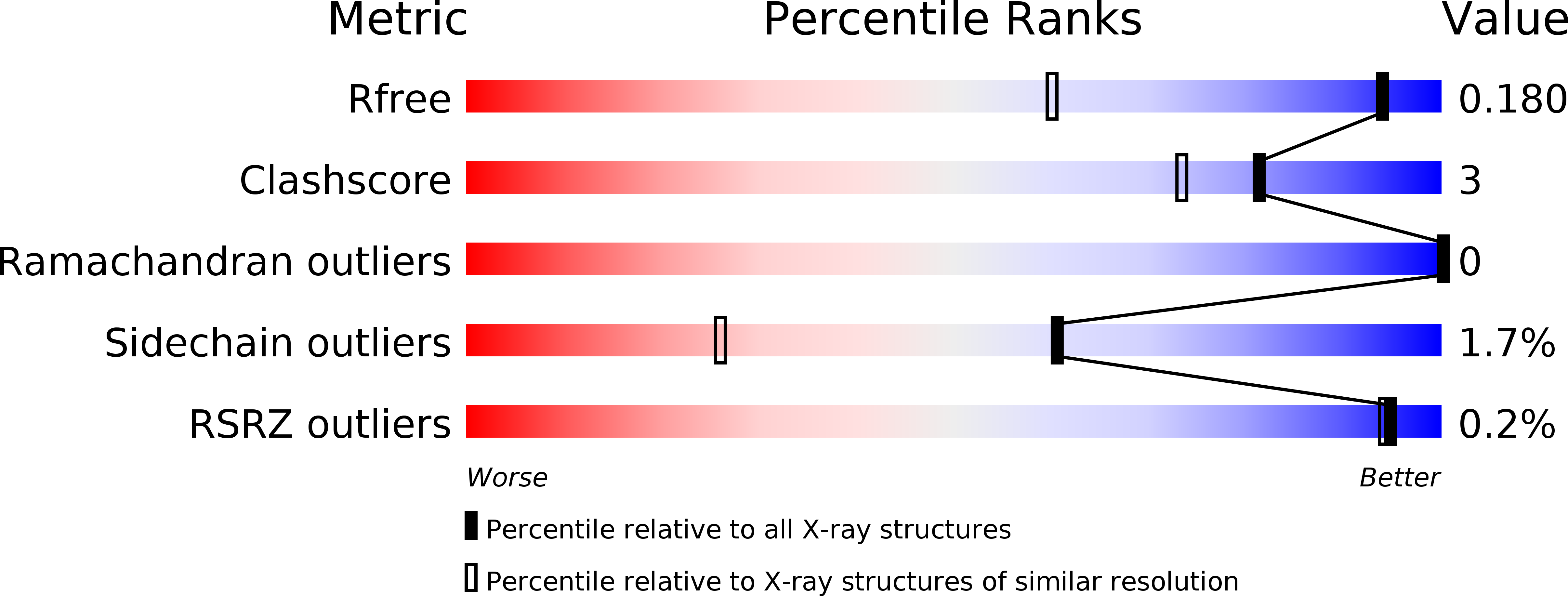
1.30 Å
R-Value Free:
0.18
R-Value Work:
0.13
R-Value Observed:
0.13
Space Group:
P 1 21 1
Macromolecular Entities
Structures with similar UniProt ID
Protein Blast
Polymer Type:polypeptide(L)
Molecule:HEAT-LABILE ENTEROTOXIN
Gene (Uniprot):eltB
Chain IDs:A (auth: D), B (auth: E), C (auth: F), D (auth: G), E (auth: H)
Chain Length:103
Number of Molecules:5
Biological Source:Escherichia coli
Primary Citation
Structure of m-carboxyphenyl-alpha-D-galactopyranoside complexed to heat-labile enterotoxin at 1.3 A resolution: surprising variations in ligand-binding modes.
Acta Crystallogr.,Sect.D 56 795 804 (2000)
PMID: 10930826 DOI: 10.1107/S090744490000514X

Abstact

In the quest to develop drugs against traveller's diarrhoea and cholera, the structure of the B pentamer of heat-labile enterotoxin (LT) complexed with a new receptor-binding antagonist, m-carboxyphenyl-alpha-D-galactopyranoside, has been determined. The high resolution obtained for this structure allowed anisotropic refinement of the model. It was also now possible to confirm at a near-atomic resolution the structural similarity between the B subunits of LT and the closely related cholera toxin (CT), including the similarity in deviations of planarity of the same peptide unit in LT and CT. The structure of the LT complex clearly revealed different conformations for the m--carboxyphenyl moiety of the ligand in the five B subunits of LT, while the binding modes of the well defined galactopyranoside moieties were identical. In two binding sites the m-carboxyphenyl moiety displayed no significant electron density, demonstrating significant flexibility of this moiety. In a third binding site the m-carboxyphenyl moiety could be modelled unambiguously into the density. The two remaining binding sites were involved in crystal packing contacts and the density for the ligands in these two binding sites clearly revealed different binding modes, of which one conformation was identical to and one completely different from the conformation of m-carboxyphenyl-galactopyranoside in the third subunit. The multiple binding modes observed in the crystal may represent the ensemble of conformations of m-carboxyphenyl-alpha-D-galactopyranoside complexed to LT in solution.

Legend

Protein

Chemical

Disease

Primary Citation of related structures
Feedback Form
Name
Email
Institute
Feedback