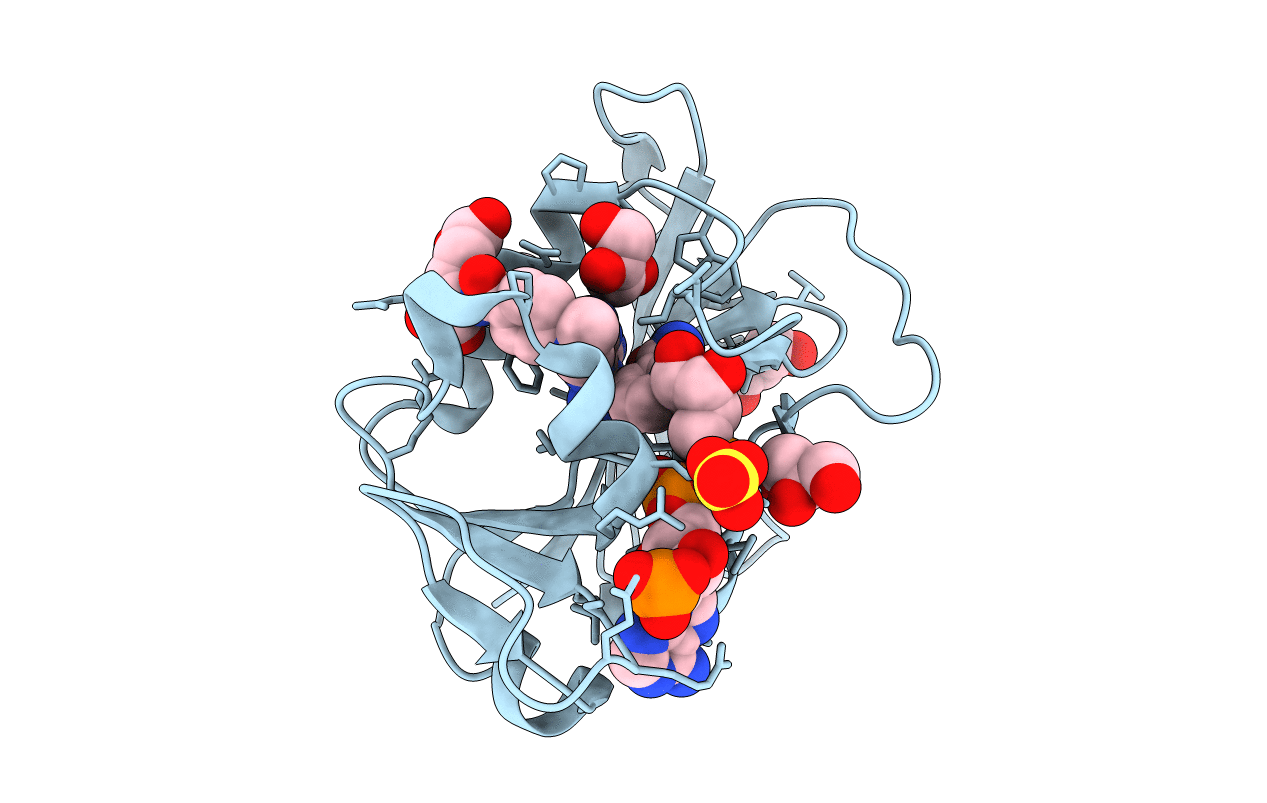
1DF7 image
Deposition Date 1999-11-17
Release Date 2000-03-09
Last Version Date 2024-02-07
Entry Detail
PDB ID:
1DF7
Keywords:
Title:
DIHYDROFOLATE REDUCTASE OF MYCOBACTERIUM TUBERCULOSIS COMPLEXED WITH NADPH AND METHOTREXATE
Biological Source:
Source Organism:
Method Details:
Experimental Method:
Resolution:
1.70 Å
R-Value Free:
0.24
R-Value Work:
0.18
R-Value Observed:
0.18
Space Group:
P 41

Macromolecular Entities
Structures with similar UniProt ID
Protein Blast
Polymer Type:polypeptide(L)
Molecule:DIHYDROFOLATE REDUCTASE
Chain IDs:A
Chain Length:159
Number of Molecules:1
Biological Source:Mycobacterium tuberculosis
Primary Citation
Three-dimensional structure of M. tuberculosis dihydrofolate reductase reveals opportunities for the design of novel tuberculosis drugs.
J.Mol.Biol. 295 307 323 (2000)
PMID: 10623528 DOI: 10.1006/jmbi.1999.3328

Abstact

Dihydrofolate reductase (DHFR) catalyzes the NADPH-dependent reduction of dihydrofolate to tetrahydrofolate and is essential for the synthesis of thymidylate, purines and several amino acids. Inhibition of the enzyme's activity leads to arrest of DNA synthesis and cell death. The enzyme has been studied extensively as a drug target for bacterial, protozoal and fungal infections, and also for neoplastic and autoimmune diseases. Here, we report the crystal structure of dihydrofolate reductase from Mycobacterium tuberculosis, a human pathogen responsible for the death of millions of human beings per year. Three crystal structures of ternary complexes of M. tuberculosis DHFR with NADP and different inhibitors have been determined, as well as the binary complex with NADP, with resolutions ranging from 1.7 to 2.0 A. The three DHFR inhibitors are the anticancer drug methotrexate, the antimicrobial trimethoprim and Br-WR99210, an analogue of the antimalarial agent WR99210. Structural comparison of these complexes with human dihydrofolate reductase indicates that the overall protein folds are similar, despite only 26 % sequence identity, but that the environments of both NADP and of the inhibitors contain interesting differences between the enzymes from host and pathogen. Specifically, residues Ala101 and Leu102 near the N6 of NADP are distinctly more hydrophobic in the M. tuberculosis than in the human enzyme. Another striking difference occurs in a region near atoms N1 and N8 of methotrexate, which is also near atom N1 of trimethoprim, and near the N1 and two methyl groups of Br-WR99210. A glycerol molecule binds here in a pocket of the M. tuberculosis DHFR:MTX complex, while this pocket is essentially filled with hydrophobic side-chains in the human enzyme. These differences between the enzymes from pathogen and host provide opportunities for designing new selective inhibitors of M. tuberculosis DHFR.

Legend

Protein

Chemical

Disease

Primary Citation of related structures
Feedback Form
Name
Email
Institute
Feedback