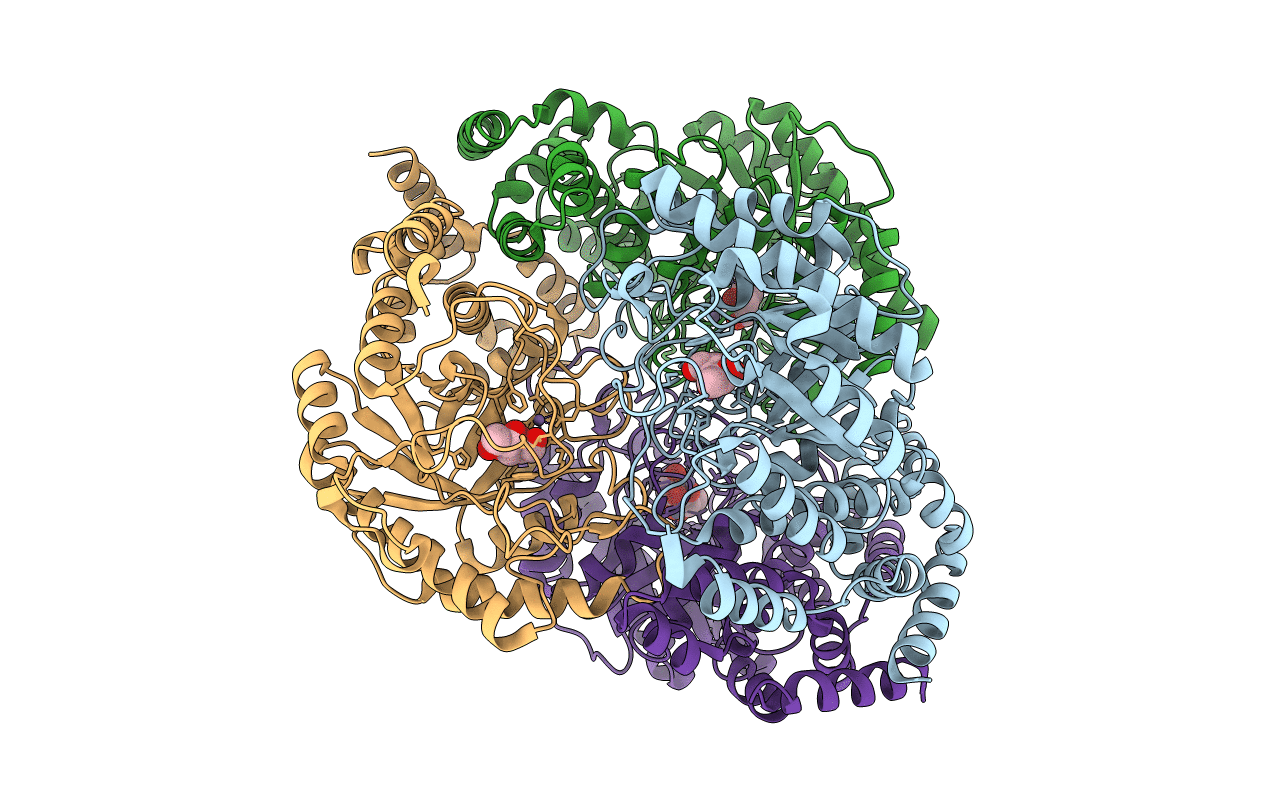
1DE6 image
Deposition Date 1999-11-13
Release Date 2000-08-09
Last Version Date 2024-05-22
Entry Detail
PDB ID:
1DE6
Keywords:
Title:
L-RHAMNOSE ISOMERASE
Biological Source:
Source Organism:
Escherichia coli (Taxon ID: 562)
Host Organism:
Method Details:
Experimental Method:
Resolution:
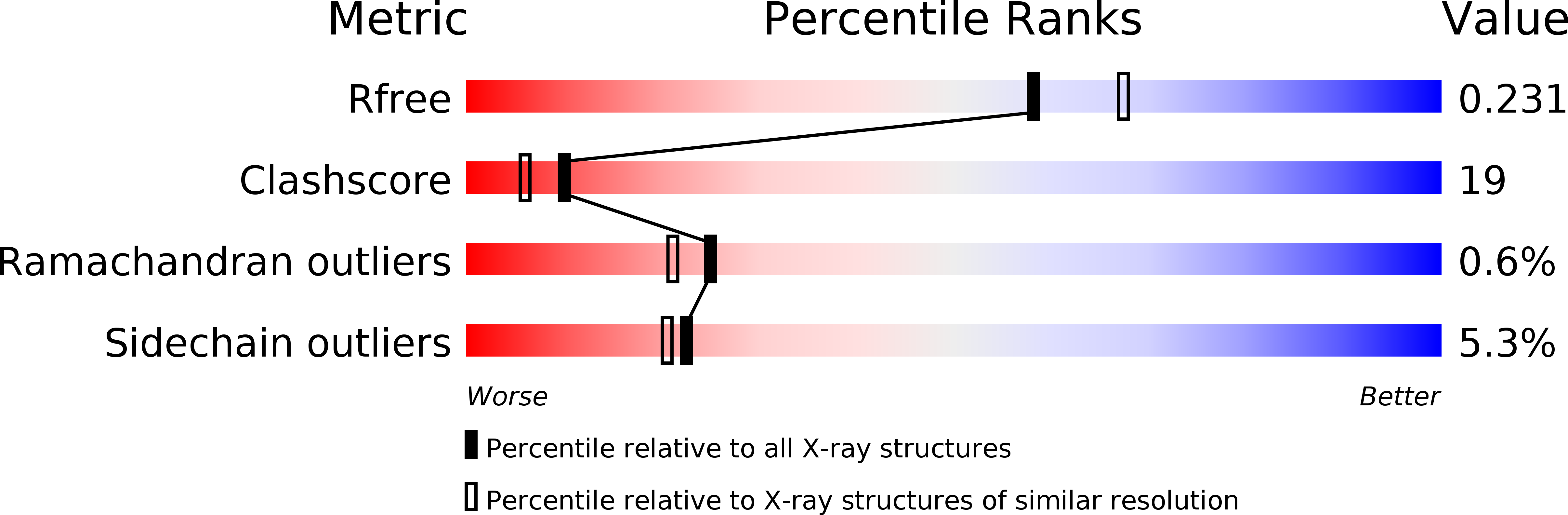
2.10 Å
R-Value Free:
0.24
R-Value Work:
0.24
R-Value Observed:
0.17
Space Group:
C 1 2 1
Macromolecular Entities
Structures with similar UniProt ID
Protein Blast
Polymer Type:polypeptide(L)
Molecule:L-RHAMNOSE ISOMERASE
Gene (Uniprot):rhaA
Chain IDs:A, B, C, D
Chain Length:426
Number of Molecules:4
Biological Source:Escherichia coli
Primary Citation
The structure of rhamnose isomerase from Escherichia coli and its relation with xylose isomerase illustrates a change between inter and intra-subunit complementation during evolution.
J.Mol.Biol. 300 917 933 (2000)
PMID: 10891278 DOI: 10.1006/jmbi.2000.3896

Abstact

Using a new expression construct, rhamnose isomerase from Escherichia coli was purified and crystallized. The crystal structure was solved by multiple isomorphous replacement and refined to a crystallographic residual of 17.4 % at 1.6 A resolution. Rhamnose isomerase is a tight tetramer of four (beta/alpha)(8)-barrels. A comparison with other known structures reveals that rhamnose isomerase is most similar to xylose isomerase. Alignment of the sequences of the two enzymes based on their structures reveals a hitherto undetected sequence identity of 13 %, suggesting that the two enzymes evolved from a common precursor. The structure and arrangement of the (beta/alpha)(8)-barrels of rhamnose isomerase are very similar to xylose isomerase. Each enzyme does, however, have additional alpha-helical domains, which are involved in tetramer association, and largely differ in structure. The structures of complexes of rhamnose isomerase with the inhibitor l-rhamnitol and the natural substrate l-rhamnose were determined and suggest that an extended loop, which is disordered in the native enzyme, becomes ordered on substrate binding, and may exclude bulk solvent during catalysis. Unlike xylose isomerase, this loop does not extend across a subunit interface but contributes to the active site of its own subunit. It illustrates how an interconversion between inter and intra-subunit complementation can occur during evolution. In the crystal structure (although not necessarily in vivo) rhamnose isomerase appears to bind Zn(2+) at a "structural" site. In the presence of substrate the enzyme also binds Mn(2+) at a nearby "catalytic" site. An array of hydrophobic residues, not present in xylose isomerase, is likely to be responsible for the recognition of l-rhamnose as a substrate. The available structural data suggest that a metal-mediated hydride-shift mechanism, which is generally favored for xylose isomerase, is also feasible for rhamnose isomerase.

Legend

Protein

Chemical

Disease

Primary Citation of related structures
Feedback Form
Name
Email
Institute
Feedback