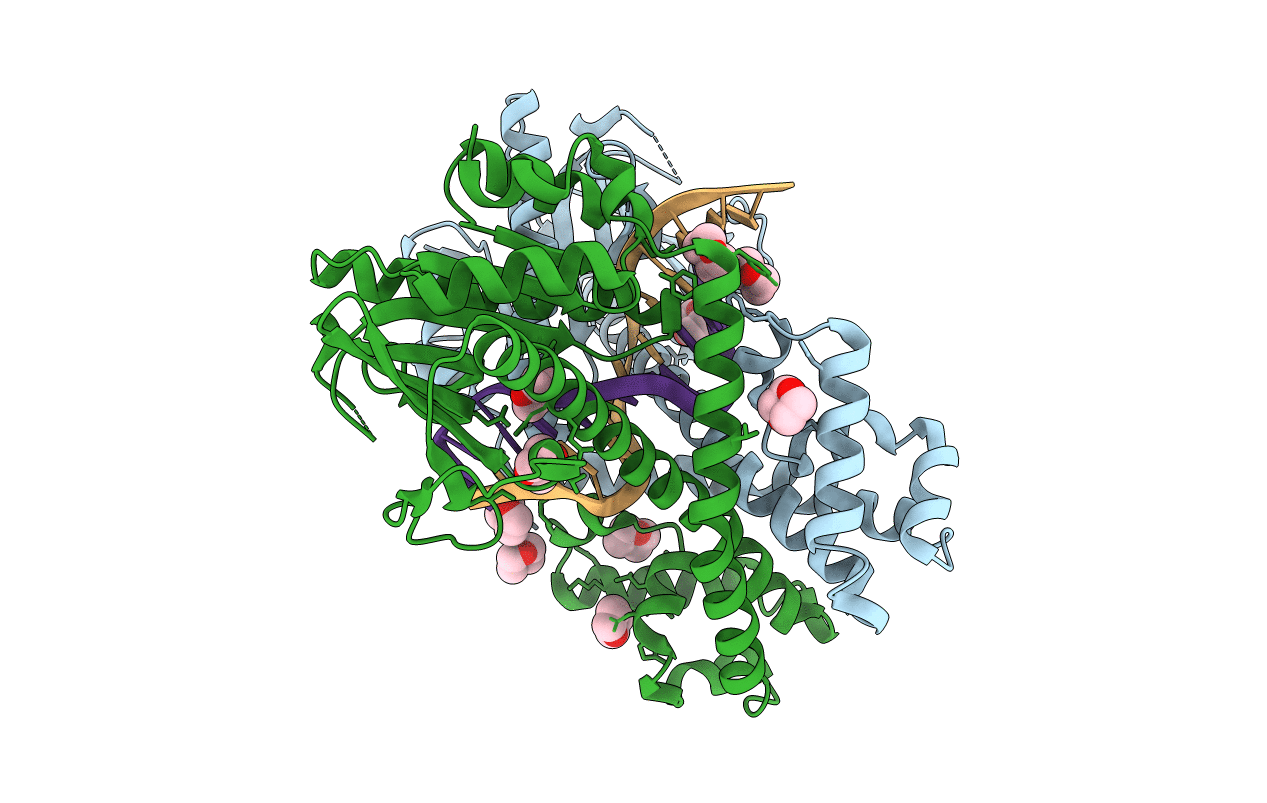
1DC1 image
Deposition Date 1999-11-04
Release Date 2001-02-21
Last Version Date 2024-02-07
Entry Detail
PDB ID:
1DC1
Keywords:
Title:
RESTRICTION ENZYME BSOBI/DNA COMPLEX STRUCTURE: ENCIRCLEMENT OF THE DNA AND HISTIDINE-CATALYZED HYDROLYSIS WITHIN A CANONICAL RESTRICTION ENZYME FOLD
Biological Source:
Source Organism:
Host Organism:
Method Details:
Experimental Method:
Resolution:
1.70 Å
R-Value Free:
0.25
R-Value Work:
0.19
R-Value Observed:
0.19
Space Group:
P 21 21 21

Macromolecular Entities
Structures with similar UniProt ID
Protein Blast
Polymer Type:polypeptide(L)
Molecule:BSOBI RESTRICTION ENDONUCLEASE
Gene (Uniprot):bsoBIR
Chain IDs:C (auth: A), D (auth: B)
Chain Length:323
Number of Molecules:2
Biological Source:Geobacillus stearothermophilus
Polymer Type:polydeoxyribonucleotide
Molecule:DNA (5'-D(*T*AP*TP*AP*CP*TP*CP*GP*AP*GP*TP*AP*T)-3')
Chain IDs:A (auth: W), B (auth: C)
Chain Length:13
Number of Molecules:2
Biological Source:
Ligand Molecules
Primary Citation
Restriction enzyme BsoBI-DNA complex: a tunnel for recognition of degenerate DNA sequences and potential histidine catalysis.
Structure 9 133 144 (2001)
PMID: 11250198 DOI: 10.1016/S0969-2126(01)00564-0

Abstact

BACKGROUND: Restriction endonucleases form a diverse family of proteins with substantial variation in sequence, structure, and interaction with recognition site DNA. BsoBI is a thermophilic restriction endonuclease that exhibits both base-specific and degenerate recognition within the sequence CPyCGPuG. RESULTS: The structure of BsoBI complexed to cognate DNA has been determined to 1.7 A resolution, revealing several unprecedented features. Each BsoBI monomer is formed by inserting a helical domain into an expanded EcoRI-type catalytic domain. DNA is completely encircled by a BsoBI dimer. Recognition sequence DNA lies within a 20 A long tunnel of protein that excludes bulk solvent. Interactions with the specific bases are made in both grooves through direct and water-mediated hydrogen bonding. Interaction with the degenerate position is mediated by a purine-specific hydrogen bond to N7, ensuring specificity, and water-mediated H bonding to the purine N6/O6 and pyrimidine N4/O4, allowing degeneracy. In addition to the conserved active site residues of the DX(n)(E/D)ZK restriction enzyme motif, His253 is positioned to act as a general base. CONCLUSIONS: A catalytic mechanism employing His253 and two metal ions is proposed. If confirmed, this would be the first example of histidine-mediated catalysis in a restriction endonuclease. The structure also provides two novel examples of the role of water in protein-DNA interaction. Degenerate recognition may be mediated by employing water as a hydrogen bond donor or acceptor. The structure of DNA in the tunnel may also be influenced by the absence of bulk solvent.

Legend

Protein

Chemical

Disease

Primary Citation of related structures
Feedback Form
Name
Email
Institute
Feedback