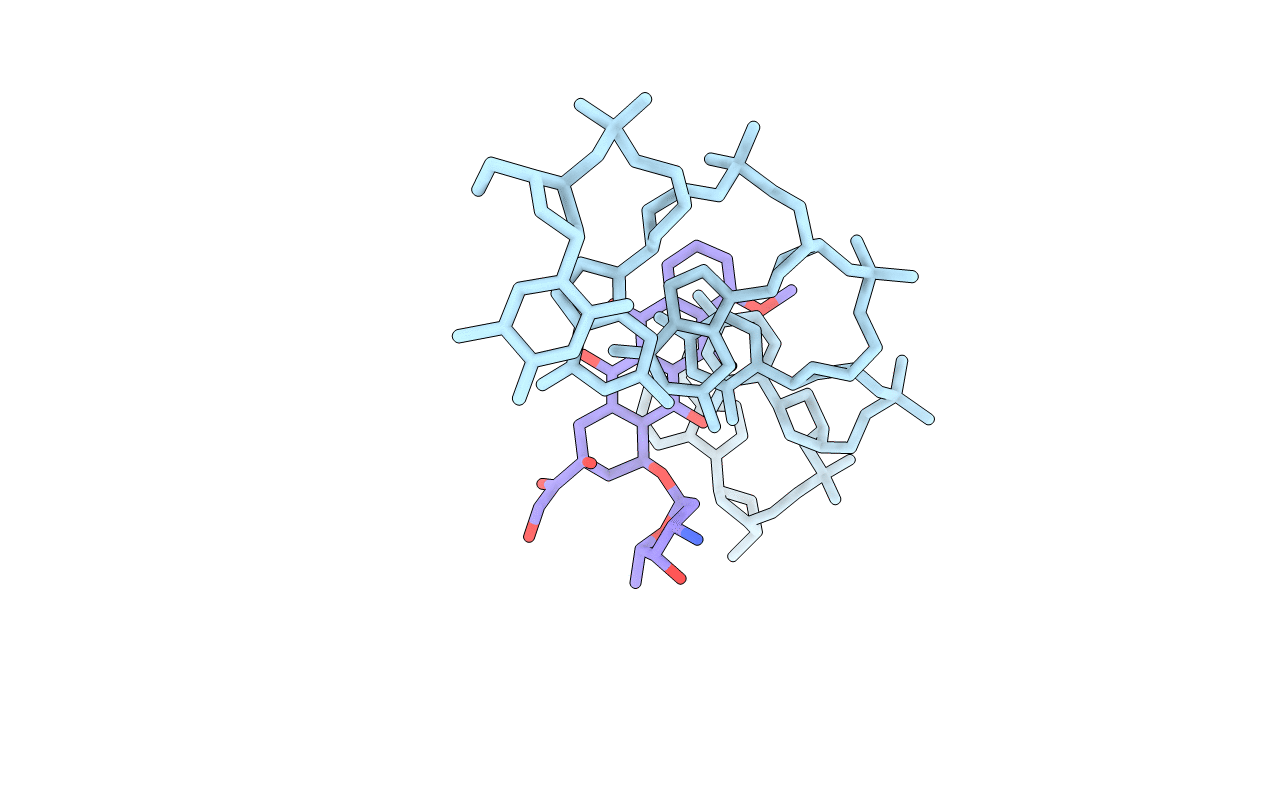
1DA9 image
Deposition Date 1993-01-21
Release Date 1993-04-15
Last Version Date 2024-02-07
Entry Detail
PDB ID:
1DA9
Keywords:
Title:
ANTHRACYCLINE-DNA INTERACTIONS AT UNFAVOURABLE BASE BASE-PAIR TRIPLET-BINDING SITES: STRUCTURES OF D(CGGCCG)/DAUNOMYCIN AND D(TGGCCA)/ADRIAMYCIN COMPL
Biological Source:
Source Organism:
Method Details:
Experimental Method:
Resolution:
1.70 Å
R-Value Observed:
0.21
Space Group:
P 41 21 2

Macromolecular Entities
Polymer Type:polydeoxyribonucleotide
Molecule:DNA (5'-D(*TP*GP*GP*CP*CP*A)-3')
Chain IDs:A
Chain Length:6
Number of Molecules:1
Biological Source:
Ligand Molecules
Primary Citation
Anthracycline-DNA interactions at unfavourable base-pair triplet-binding sites: structures of d(CGGCCG)/daunomycin and d(TGGCCA)/adriamycin complexes.
Acta Crystallogr.,Sect.D 49 458 467 (1993)
PMID: 15299505 DOI: 10.1107/S090744499300527X

Abstact

The structures of two hexanucleotide-anthracycline complexes d(CGGCCG)/daunomycin and d(TGGCCA)/adriamycin have been determined using single-crystal X-ray diffraction techniques. In both cases the anthracycline molecule is bound to non-preferred d(YGG) base-pair triplet sites. For both complexes the crystals are tetragonal and belong to the space group P4(1)2(1)2. Unit-cell dimensions are a = 28.07 (2), c = 53.35 (1) and a = 28.01 (1), c = 52.99 (1) A, respectively, and the asymmetric unit of both structures consists of one strand of DNA, one drug molecule and approximately 50 water molecules. For the d(CGGCCG) complex the refinement converged with an R factor of 0.21 for 1108 reflections with F >/= 2sigma(F) in the resolution range 7.0-1.9 A. For the complex involving d(TGGCCA) the final R value was 0.22 for 1475 reflections in the range 7.0-1.7 A with the same criterion for observed data. Both complexes are essentially isomorphous with related structures but differ in terms of the number of favourable van der Waals interactions of the amino sugars of the drug molecules with the DNA duplexes and the formation in the minor groove of heterodromic pentagonal arrangements of hydrogen bonds involving water molecules which link the amino sugars to the DNA. These differences in structure are used to rationalize the lack of affinity of daunomycin-type anthracyclines for d(YGG) and d(YGC) sites.

Legend

Protein

Chemical

Disease

Primary Citation of related structures
Feedback Form
Name
Email
Institute
Feedback