1D9V image
Deposition Date 1999-10-30
Release Date 1999-11-17
Last Version Date 2024-02-07
Entry Detail
PDB ID:
1D9V
Title:
HAEMOPHILUS INFLUENZAE FERRIC-BINDING PROTEIN APO FORM
Biological Source:
Source Organism:
Host Organism:
Method Details:
Experimental Method:
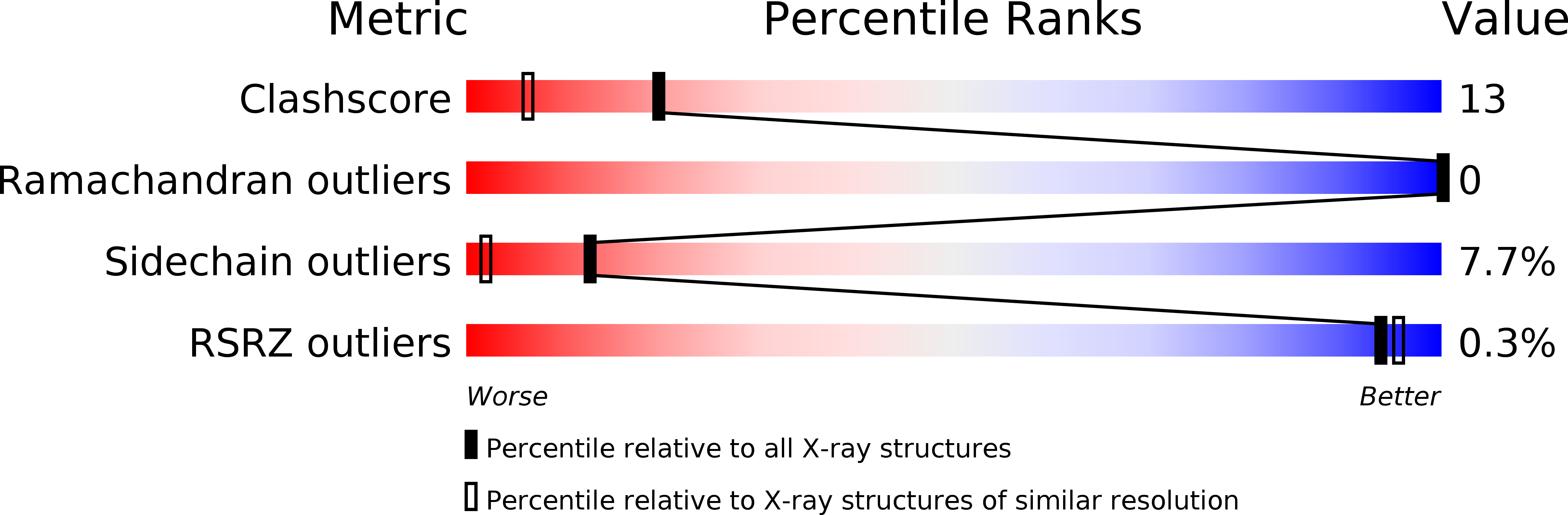
Resolution:
1.75 Å
R-Value Free:
0.26
R-Value Work:
0.17
Space Group:
P 21 21 2
Macromolecular Entities
Structures with similar UniProt ID
Protein Blast
Polymer Type:polypeptide(L)
Molecule:PROTEIN (iron-utilization periplasmic protein)
Gene (Uniprot):fbpA
Chain IDs:A
Chain Length:309
Number of Molecules:1
Biological Source:Haemophilus influenzae
Ligand Molecules
Primary Citation
Crystallographic and biochemical analyses of the metal-free Haemophilus influenzae Fe3+-binding protein.
Biochemistry 40 15631 15637 (2001)
PMID: 11747438 DOI: 10.1021/bi0156759

Abstact

The crystal structure of the iron-free (apo) form of the Haemophilus influenzae Fe(3+)-binding protein (hFbp) has been determined to 1.75 A resolution. Information from this structure complements that derived from the holo structure with respect to the delineation of the process of iron binding and release. A 21 degrees rotation separates the two structural domains when the apo form is compared with the holo conformer, indicating that upon release of iron, the protein undergoes a change in conformation by bending about the central beta-sheet hinge. A surprising finding in the apo-hFbp structure was that the ternary binding site anion, observed in the crystals as phosphate, remained bound. In solution, apo-hFbp bound phosphate with an affinity K(d) of 2.3 x 10(-3) M. The presence of this ternary binding site anion appears to arrange the C-terminal iron-binding residues conducive to complementary binding to Fe(3+), while residues in the N-terminal binding domain must undergo induced fit to accommodate the Fe(3+) ligand. These observations suggest a binding process, the first step of which is the binding of a synergistic anion such as phosphate to the C-terminal domain. Next, iron binds to the preordered half-site on the C-terminal domain. Finally, the presence of iron organizes the N-terminal half-site and closes the interdomain hinge. The use of the synergistic anion and this iron binding process results in an extremely high affinity of the Fe(3+)-binding proteins for Fe(3+) (nFbp K'(eff) = 2.4 x 10(18) M(-1)). This high-affinity ligand binding process is unique among the family of bacterial periplasmic binding proteins and has interesting implications in the mechanism of iron removal from the Fe(3+)-binding proteins during FbpABC-mediated iron transport across the cytoplasmic membrane.

Legend

Protein

Chemical

Disease

Primary Citation of related structures
Feedback Form
Name
Email
Institute
Feedback