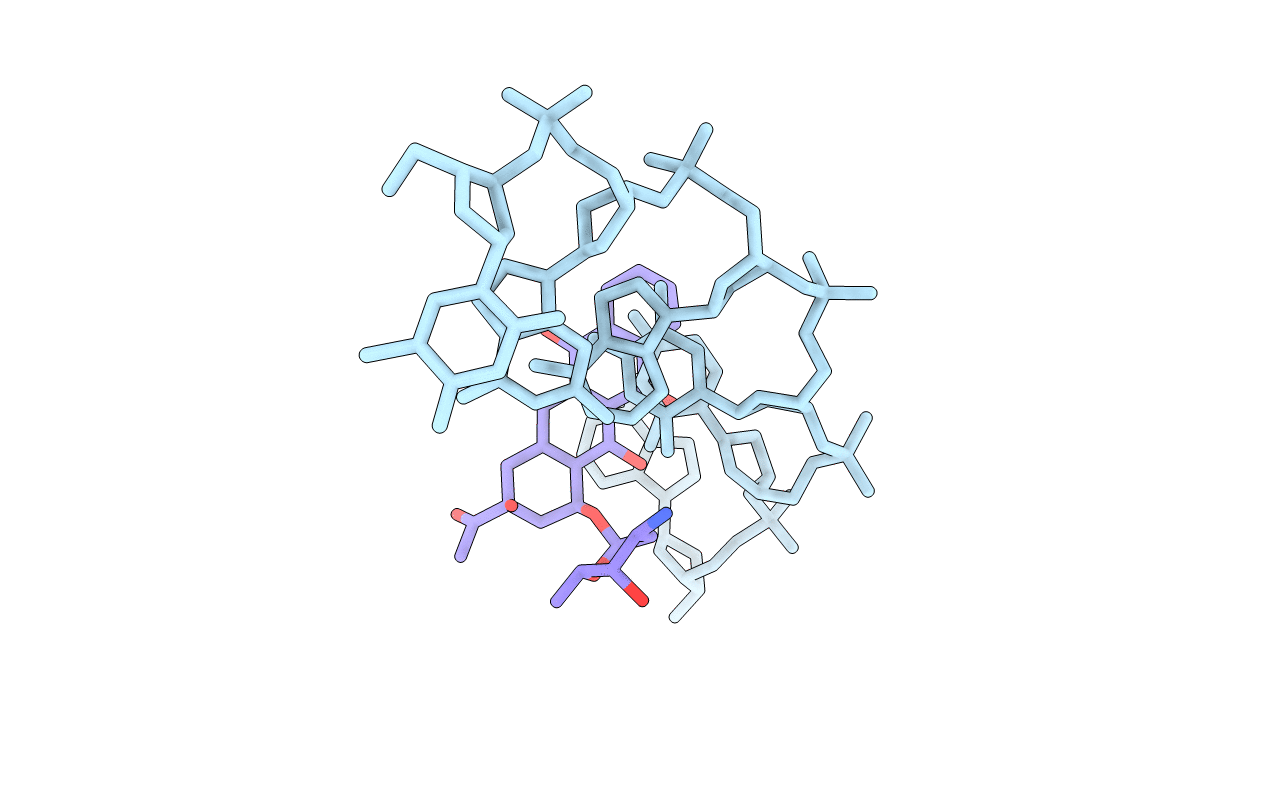
1D67 image
Deposition Date 1992-03-31
Release Date 1993-07-15
Last Version Date 2024-02-07
Entry Detail
PDB ID:
1D67
Keywords:
Title:
THE MOLECULAR STRUCTURE OF AN IDARUBICIN-D(TGATCA) COMPLEX AT HIGH RESOLUTION
Biological Source:
Source Organism:
Method Details:
Experimental Method:
Resolution:
1.60 Å
R-Value Observed:
0.22
Space Group:
P 41 21 2

Macromolecular Entities
Polymer Type:polydeoxyribonucleotide
Molecule:DNA (5'-D(*TP*GP*AP*TP*CP*A)-3')
Chain IDs:A
Chain Length:6
Number of Molecules:1
Biological Source:
Ligand Molecules
Primary Citation
The structure of an idarubicin-d(TGATCA) complex at high resolution.
Acta Crystallogr.,Sect.D 49 311 317 (1993)
PMID: 15299520 DOI: 10.1107/S0907444992009983

Abstact

The crystal structure of the DNA hexamer d(TGATCA) complexed with the anthracycline antibiotic idarubicin has been determined at 1.6 A resolution. The asymmetric unit consists of a single hexamer oligonucleotide strand, one drug molecule and 35 water molecules. The complex crystallizes in the tetragonal space group P4(1)2(1)2, Z = 8 with lattice dimensions of a = b = 28.19 (3), c = 52.77 (4) A, V = 41 935 A(3). The structure is isomorphous with a series of hexamer-anthracycline complexes and was solved by molecular replacement. Restrained least-squares methods interspersed with computer-graphics map inspection and model manipulation were used to refine the structure. The R factor is 0.22 for 2032 reflections with F >/= 3sigma(F) in the resolution range 8.0-1.6 A. The self-complementary DNA forms a distorted B-DNA double helix with two idarubicin molecules intercalated in the d(TpG) steps of the duplex. The duplex is formed by utilization of a crystallographic twofold axis of symmetry. The idarubicin chromophore is oriented at right angles to the long axis of the DNA base pairs with the anthracycline amino-sugar moiety positioned in the minor groove. Our structure determination allows for comparison with a d(CGATCG)-idarubicin complex recently reported. Despite the sequence alteration at the intercalation step, the structures are very similar. The geometry of the intercalation and the nature of the interactions are conserved irrespective of the DNA sequence involved in the binding.

Legend

Protein

Chemical

Disease

Primary Citation of related structures
Feedback Form
Name
Email
Institute
Feedback