1D1U image
Deposition Date 1999-09-21
Release Date 2000-04-02
Last Version Date 2024-02-07
Entry Detail
PDB ID:
1D1U
Keywords:
Title:
USE OF AN N-TERMINAL FRAGMENT FROM MOLONEY MURINE LEUKEMIA VIRUS REVERSE TRANSCRIPTASE TO FACILITATE CRYSTALLIZATION AND ANALYSIS OF A PSEUDO-16-MER DNA MOLECULE CONTAINING G-A MISPAIRS
Biological Source:
Source Organism(s):
Expression System(s):
Method Details:
Experimental Method:
Resolution:
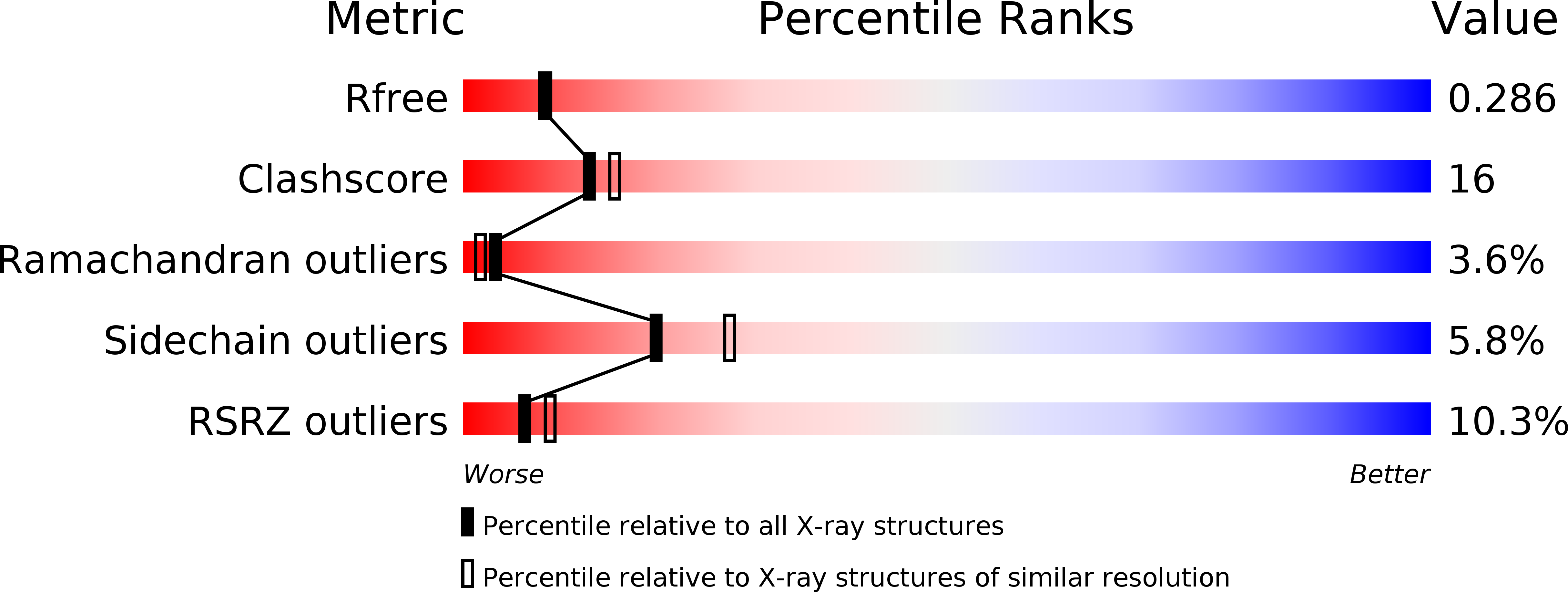
2.30 Å
R-Value Free:
0.28
R-Value Work:
0.23
R-Value Observed:
0.23
Space Group:
P 21 21 2
Macromolecular Entities
Structures with similar UniProt ID
Protein Blast
Polymer Type:polypeptide(L)
Molecule:PROTEIN (REVERSE TRANSCRIPTASE)
Gene (Uniprot):gag-pol
Chain IDs:C (auth: A)
Chain Length:255
Number of Molecules:1
Biological Source:Moloney murine leukemia virus
Polymer Type:polydeoxyribonucleotide
Molecule:DNA (5'-D(*AP*CP*GP*GP*CP*AP*CP*GP*AP*G)-3')
Chain IDs:B (auth: C)
Chain Length:10
Number of Molecules:1
Biological Source:
Primary Citation
Use of an N-terminal fragment from moloney murine leukemia virus reverse transcriptase to facilitate crystallization and analysis of a pseudo-16-mer DNA molecule containing G-A mispairs.
Acta Crystallogr.,Sect.D 56 1120 1131 (2000)
PMID: 10957631 DOI: 10.1107/S0907444900008246

Abstact

Complexation with the N-terminal fragment of Moloney murine leukemia virus reverse transcriptase offers a novel method of obtaining crystal structures of nucleic acid duplexes, which can be phased by molecular replacement. This method is somewhat similar to the method of using a monoclonal antibody Fab fragment complexed to the molecule of interest in order to obtain crystals suitable for X-ray crystallographic analysis. Here a novel DNA structure including two G-A mispairs in a pseudo-hexadecamer determined at 2.3 A resolution in a complex with the N-terminal fragment is reported. This structure has an asymmetric unit consisting of the protein molecule bound to the blunt end of a DNA 6/10-mer, which is composed of a six-base strand (5'-CTCGTG-3') and a ten-base strand (3'-GAGCACGGCA-5'). The 6/10-mer is thus composed of a six-base-pair duplex with a four-base single-stranded overhang. In the crystal structure, the bases of the overhang are reciprocally paired (symmetry element -x - 1, -y, z), yielding a doubly nicked pseudo-hexadecamer primarily B-form DNA molecule, which has some interesting A-like structural features. The pairing between the single strands results in two standard (G-C) Watson-Crick pairs and two G-A mispairs. The structural DNA model can accommodate either a standard syn or a standard anti conformation for the 5'-terminal adenine of the ten-base strand of the DNA based on analysis of simulated-annealing omit maps. Although the DNA model here includes nicks in the phosphodiester backbone, modeling of an intact phosphodiester backbone results in a very similar DNA model and indicates that the structure is biologically relevant.

Legend

Protein

Chemical

Disease

Primary Citation of related structures
Feedback Form
Name
Email
Institute
Feedback