1CNQ image
Deposition Date 1999-05-21
Release Date 1999-05-28
Last Version Date 2024-05-22
Entry Detail
PDB ID:
1CNQ
Keywords:
Title:
FRUCTOSE-1,6-BISPHOSPHATASE COMPLEXED WITH FRUCTOSE-6-PHOSPHATE AND ZINC IONS
Biological Source:
Source Organism:
Sus scrofa (Taxon ID: 9823)
Host Organism:
Method Details:
Experimental Method:
Resolution:
2.27 Å
R-Value Free:
0.22
R-Value Work:
0.16
R-Value Observed:
0.16
Space Group:
I 2 2 2
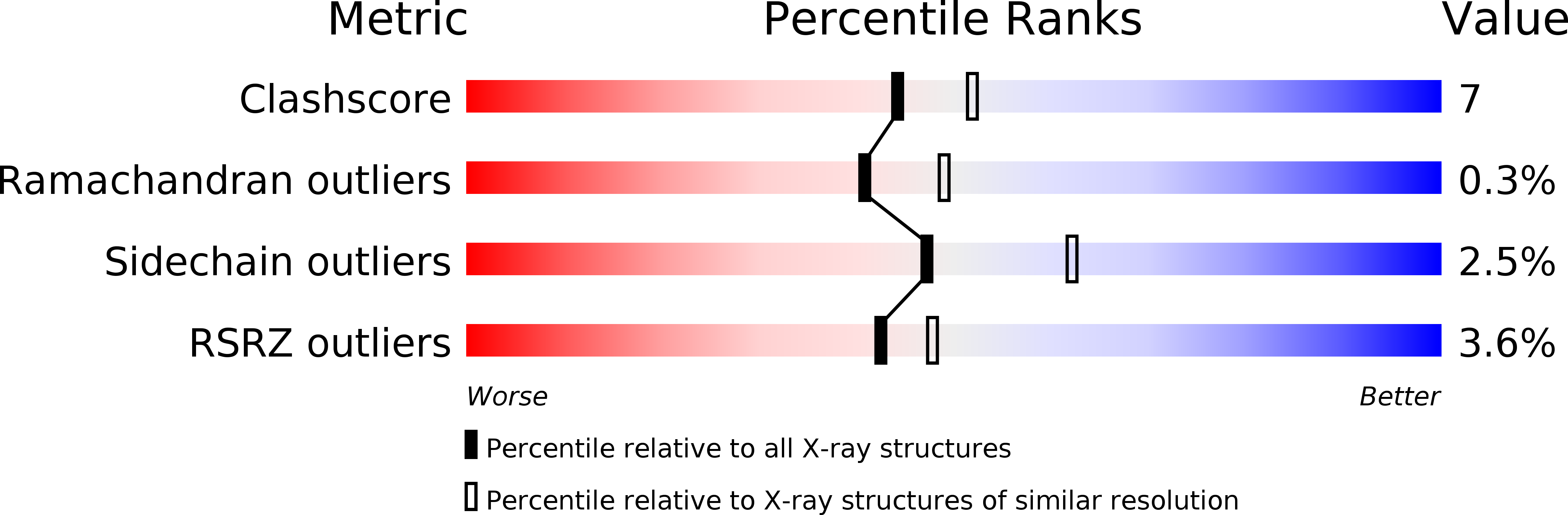
Macromolecular Entities
Structures with similar UniProt ID
Protein Blast
Polymer Type:polypeptide(L)
Molecule:FRUCTOSE-1,6-BISPHOSPHATASE
Gene (Uniprot):FBP1
Chain IDs:A
Chain Length:337
Number of Molecules:1
Biological Source:Sus scrofa
Primary Citation
Role of a dynamic loop in cation activation and allosteric regulation of recombinant porcine fructose-1,6-bisphosphatase.
Biochemistry 37 11441 11450 (1998)
PMID: 9708979 DOI: 10.1021/bi981112u

Abstact

A disordered loop (loop 52-72, residues 52-72) in crystal structures of fructose-1,6-bisphosphatase (FBPase) has been implicated in regulatory and catalytic phenomena by studies in directed mutation. A crystal structure of FBPase in a complex with three zinc cations and the products fructose 6-phosphate (F6P) and phosphate (Pi) reveals loop 52-72 for the first time in a well-defined conformation with strong electron density. Loop 52-57 interacts primarily with the active site of its own subunit. Asp68 of the loop hydrogen bonds with Arg276 and a zinc cation located at the putative potassium activation site. Leu56 and Tyr57 of the loop pack against hydrophobic residues from two separate subunits of FBPase. A mechanism of allosteric regulation of catalysis is presented, in which AMP, by binding to its allosteric pocket, displaces loop 52-72 from the active site. Furthermore, the current structure suggests that both the alpha- and beta-anomers of F6P can be substrates in the reverse reaction catalyzed by FBPase. Mechanisms of catalysis are proposed for the reverse reaction in which Asp121 serves as a catalytic base for the alpha-anomer and Glu280 serves as a catalytic base for the beta-anomer.

Legend

Protein

Chemical

Disease

Primary Citation of related structures
Feedback Form
Name
Email
Institute
Feedback