1CIX image
Deposition Date 1999-04-06
Release Date 2002-05-01
Last Version Date 2024-10-30
Entry Detail
PDB ID:
1CIX
Title:
THREE-DIMENSIONAL STRUCTURE OF ANTIMICROBIAL PEPTIDE TACHYSTATIN A ISOLATED FROM HORSESHOE CRAB
Biological Source:
Source Organism(s):
Method Details:
Experimental Method:
Conformers Calculated:
50
Conformers Submitted:
24
Selection Criteria:
LEAST RESTRAINT VIOLATION
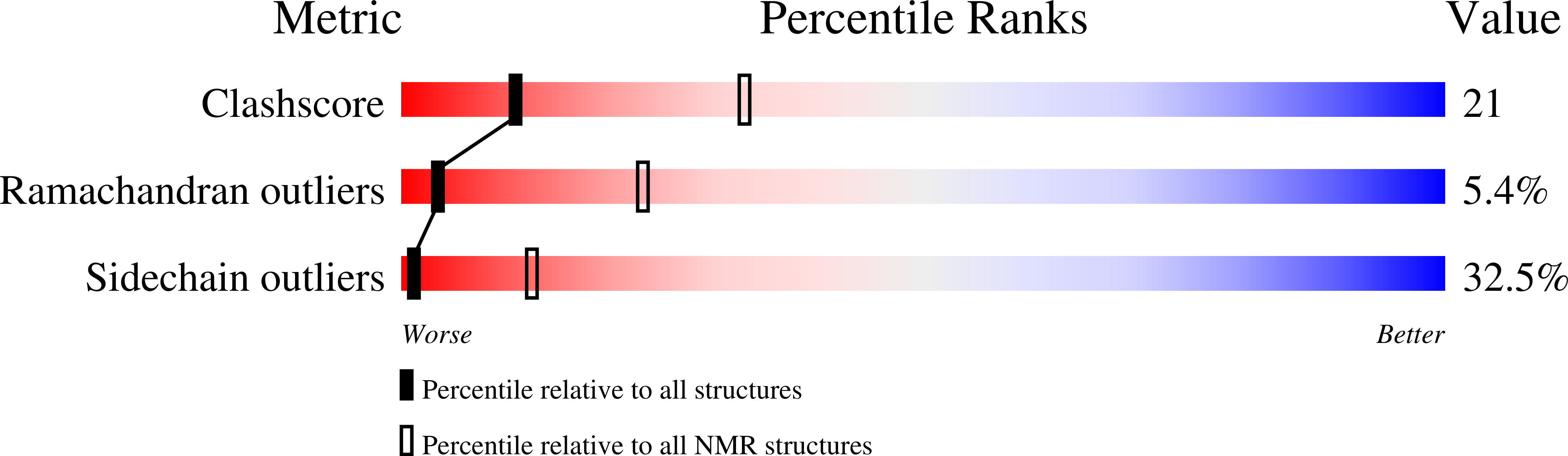
Macromolecular Entities
Structures with similar UniProt ID
Protein Blast
Polymer Type:polypeptide(L)
Molecule:PROTEIN (TACHYSTATIN A)
Chain IDs:A
Chain Length:44
Number of Molecules:1
Biological Source:Tachypleus tridentatus
Ligand Molecules
Primary Citation
Structure of the antimicrobial peptide tachystatin A.
J.Biol.Chem. 277 23651 23657 (2002)
PMID: 11959852 DOI: 10.1074/jbc.M111120200

Abstact

The solution structure of antimicrobial peptide tachystatin A from the Japanese horseshoe crab (Tachypleus tridentatus) was determined by two-dimensional nuclear magnetic resonance measurements and distance-restrained simulated annealing calculations. The correct pairs of disulfide bonds were also confirmed in this study. The obtained structure has a cysteine-stabilized triple-stranded beta-sheet as a dominant secondary structure and shows an amphiphilic folding observed in many membrane-interactive peptides. Interestingly, tachystatin A shares structural similarities with the calcium channel antagonist omega-agatoxin IVA isolated from spider toxin and mammalian defensins, and we predicted that omega-agatoxin IVA also have the antifungal activity. These structural comparisons and functional correspondences suggest that tachystatin A and omega-agatoxin IVA may exert the antimicrobial activity in a manner similar to defensins, and we have confirmed such activity using fungal culture assays. Furthermore, tachystatin A is a chitin-binding peptide, and omega-agatoxin IVA also showed chitin-binding activities in this study. Tachystatin A and omega-agatoxin IVA showed no structural homology with well known chitin-binding motifs, suggesting that their structures belong to a novel family of chitin-binding peptides. Comparison of their structures with those of cellulose-binding proteins indicated that Phe(9) of tachystatin A might be an essential residue for binding to chitin.

Legend

Protein

Chemical

Disease

Primary Citation of related structures
Feedback Form
Name
Email
Institute
Feedback