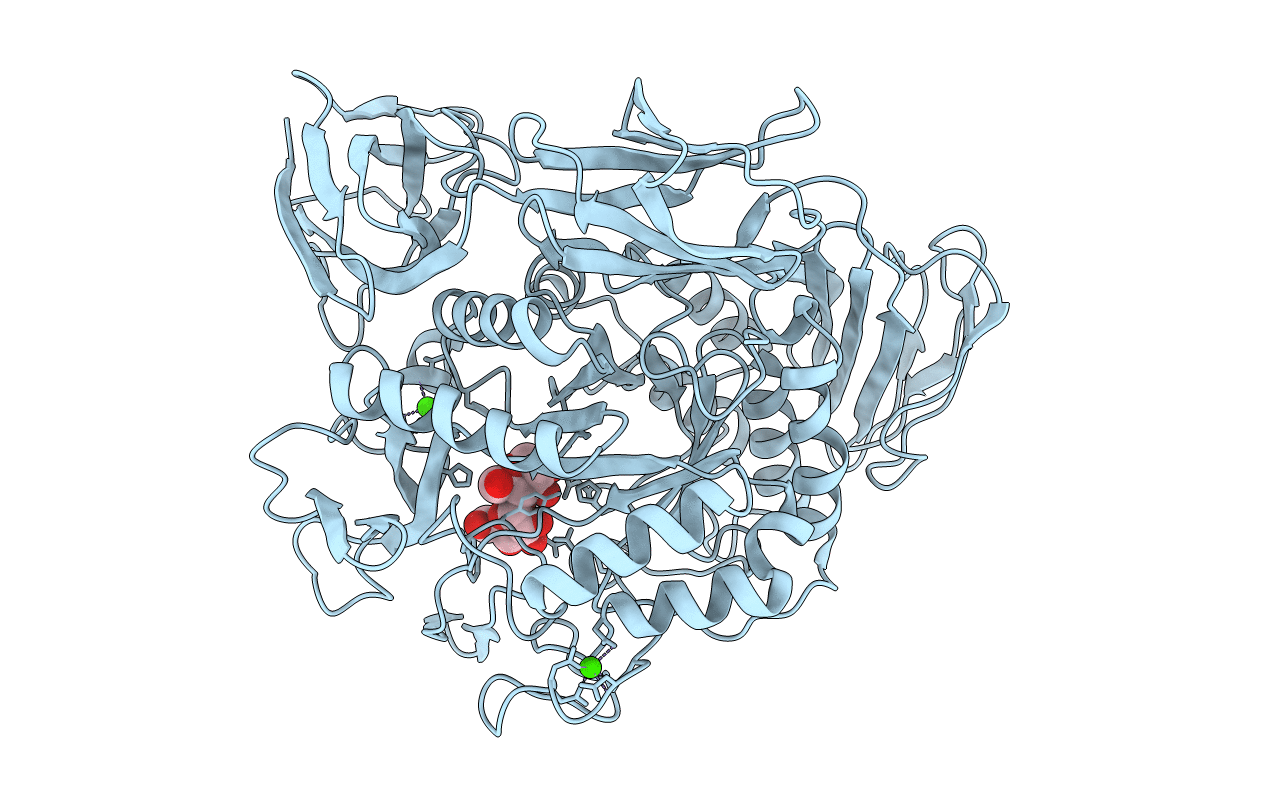
1CGU image
Deposition Date 1992-06-10
Release Date 1994-01-31
Last Version Date 2024-10-16
Entry Detail
PDB ID:
1CGU
Title:
CATALYTIC CENTER OF CYCLODEXTRIN GLYCOSYLTRANSFERASE DERIVED FROM X-RAY STRUCTURE ANALYSIS COMBINED WITH SITE-DIRECTED MUTAGENESIS
Biological Source:
Source Organism:
Method Details:
Experimental Method:
Resolution:
2.50 Å
R-Value Work:
0.18
R-Value Observed:
0.18
Space Group:
P 21 21 21
Macromolecular Entities
Structures with similar UniProt ID
Protein Blast
Polymer Type:polypeptide(L)
Molecule:CYCLODEXTRIN GLYCOSYL-TRANSFERASE
Chain IDs:A
Chain Length:684
Number of Molecules:1
Biological Source:Bacillus circulans
Ligand Molecules
Peptide-like Molecules
PRD_900001
Primary Citation
Catalytic center of cyclodextrin glycosyltransferase derived from X-ray structure analysis combined with site-directed mutagenesis.
Biochemistry 31 8740 8746 (1992)
PMID: 1390660 DOI: 10.1021/bi00152a009

Abstact

An X-ray structure analysis of a crystal of mutant Asp229----Ala of cyclodextrin glycosyltransferase from Bacillus circulans (Ec 2.4.1.19) that had been shortly exposed to beta-cyclodextrin showed density corresponding to a maltose bound at the catalytic center. The crystal structure was refined to an R-factor of 18.7% at 2.5-A resolution. The catalytic center is defined by homology with the structurally known alpha-amylases and by the observation that mutants Asp229----Ala and Asp328----Ala are almost inactive. By model building, the density-defined maltose was extended to a full beta-cyclodextrin, which then indicated the general locations of seven subsites for glucosyl units. The catalytically competent residues Asp229, Glu257, and Asp328 are at the reducing end of the density-defined maltose. In the unligated wild-type structure, Glu257 and Asp328 form a 2.6-A hydrogen bond between their carboxylates in an arrangement that resembles those of the catalytically competent carboxylates in acid proteases. Presumably, the first catalytic step is an attack of the proton between Glu257 and Asp328 on the oxygen of the glycosidic bond.

Legend

Protein

Chemical

Disease

Primary Citation of related structures
Feedback Form
Name
Email
Institute
Feedback