1CEZ image
Deposition Date 1999-03-11
Release Date 1999-05-21
Last Version Date 2023-12-27
Entry Detail
PDB ID:
1CEZ
Keywords:
Title:
CRYSTAL STRUCTURE OF A T7 RNA POLYMERASE-T7 PROMOTER COMPLEX
Biological Source:
Source Organism:
Host Organism:
Method Details:
Experimental Method:
Resolution:
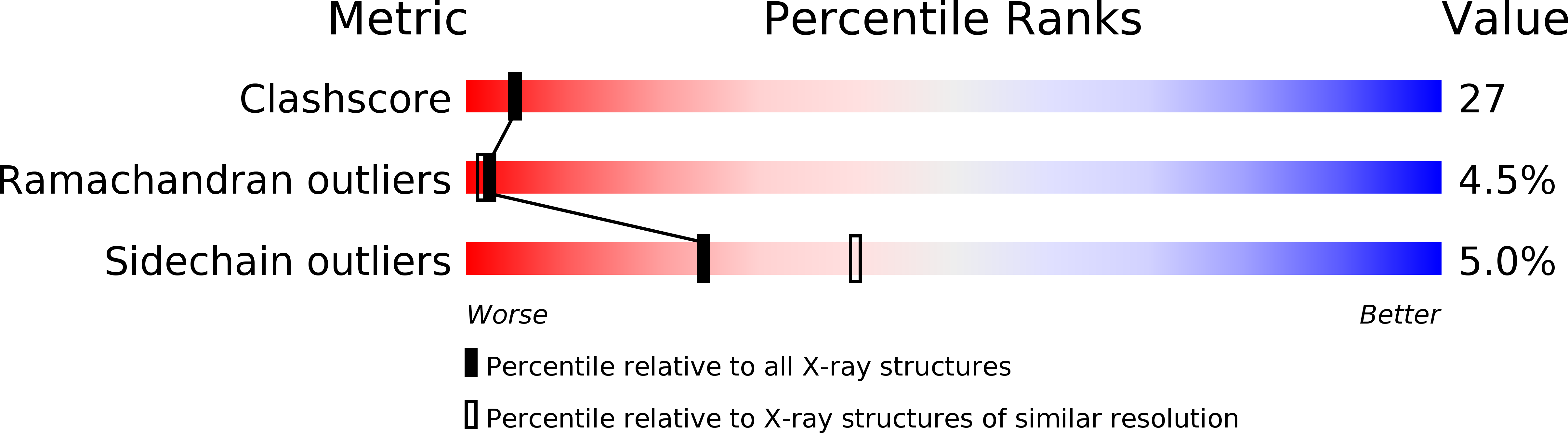
2.40 Å
R-Value Free:
0.27
R-Value Work:
0.22
R-Value Observed:
0.22
Space Group:
P 21 21 2
Macromolecular Entities
Structures with similar UniProt ID
Protein Blast
Polymer Type:polypeptide(L)
Molecule:PROTEIN (BACTERIOPHAGE T7 RNA POLYMERASE)
Gene (Uniprot):1
Chain IDs:C (auth: A)
Chain Length:883
Number of Molecules:1
Biological Source:Enterobacteria phage T7
Primary Citation
Structural basis for initiation of transcription from an RNA polymerase-promoter complex.
Nature 399 80 83 (1999)
PMID: 10331394 DOI: 10.1038/19999

Abstact

Although the single-polypeptide-chain RNA polymerase from bacteriophage T7 (T7RNAP), like other RNA polymerases, uses the same mechanism of polymerization as the DNA polymerases, it can also recognize a specific promoter sequence, initiate new RNA chains from a single nucleotide, abortively cycle the synthesis of short transcripts, be regulated by a transcription inhibitor, and terminate transcription. As T7RNAP is homologous to the Pol I family of DNA polymerases, the differences between the structure of T7RNAP complexed to substrates and that of the corresponding DNA polymerase complex provides a structural basis for understanding many of these functional differences. T7RNAP initiates RNA synthesis at promoter sequences that are conserved from positions -17 to +6 relative to the start site of transcription. The crystal structure at 2.4 A resolution of T7RNAP complexed with a 17-base-pair promoter shows that the four base pairs closest to the catalytic active site have melted to form a transcription bubble. The T7 promoter sequence is recognized by interactions in the major groove between an antiparallel beta-loop and bases. The amino-terminal domain is involved in promoter recognition and DNA melting. We have also used homology modelling of the priming and incoming nucleoside triphosphates from the T7 DNA-polymerase ternary complex structure to explain the specificity of T7RNAP for ribonucleotides, its ability to initiate from a single nucleotide, and the abortive cycling at the initiation of transcription.

Legend

Protein

Chemical

Disease

Primary Citation of related structures
Feedback Form
Name
Email
Institute
Feedback