1CDC image
Deposition Date 1995-05-23
Release Date 1995-09-15
Last Version Date 2024-02-07
Entry Detail
PDB ID:
1CDC
Title:
CD2, N-TERMINAL DOMAIN (1-99), TRUNCATED FORM
Biological Source:
Source Organism:
Host Organism:
Method Details:
Experimental Method:
Resolution:
2.00 Å
R-Value Work:
0.19
R-Value Observed:
0.19
Space Group:
P 21 21 21
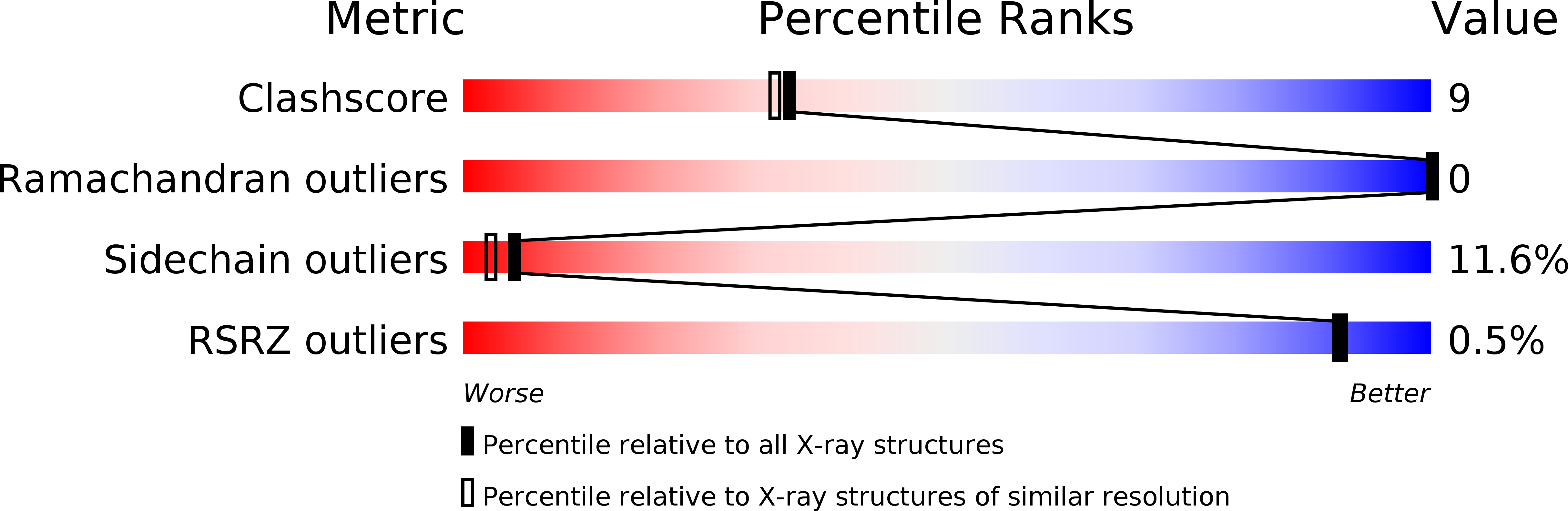
Macromolecular Entities
Structures with similar UniProt ID
Protein Blast
Polymer Type:polypeptide(L)
Molecule:CD2
Gene (Uniprot):Cd2
Chain IDs:A (auth: B), B (auth: A)
Chain Length:99
Number of Molecules:2
Biological Source:Rattus norvegicus
Primary Citation
One sequence, two folds: a metastable structure of CD2.
Proc.Natl.Acad.Sci.USA 92 7337 7341 (1995)
PMID: 7638192 DOI: 10.1073/pnas.92.16.7337

Abstact

When expressed as part of a glutathione S-transferase fusion protein the NH2-terminal domain of the lymphocyte cell adhesion molecule CD2 is shown to adopt two different folds. The immunoglobulin superfamily structure of the major (85%) monomeric component has previously been determined by both x-ray crystallography and NMR spectroscopy. We now describe the structure of a second, dimeric, form present in about 15% of recombinant CD2 molecules. After denaturation and refolding in the absence of the fusion partner, dimeric CD2 is converted to monomer, illustrating that the dimeric form represents a metastable folded state. The crystal structure of this dimeric form, refined to 2.0-A resolution, reveals two domains with overall similarity to the IgSF fold found in the monomer. However, in the dimer each domain is formed by the intercalation of two polypeptide chains. Hence each domain represents a distinct folding unit that can assemble in two different ways. In the dimer the two domains fold around a hydrophilic interface believed to mimic the cell adhesion interaction at the cell surface, and the formation of dimer can be regulated by mutating single residues at this interface. This unusual misfolded form of the protein, which appears to result from inter- rather than intramolecular interactions being favored by an intermediate structure formed during the folding process, illustrates that evolution of protein oligomers is possible from the sequence for a single protein domain.

Legend

Protein

Chemical

Disease

Primary Citation of related structures
Feedback Form
Name
Email
Institute
Feedback