1CCR image
Deposition Date 1983-03-14
Release Date 1983-04-21
Last Version Date 2025-03-26
Entry Detail
PDB ID:
1CCR
Title:
STRUCTURE OF RICE FERRICYTOCHROME C AT 2.0 ANGSTROMS RESOLUTION
Biological Source:
Source Organism(s):
Oryza sativa (Taxon ID: 4530)
Method Details:
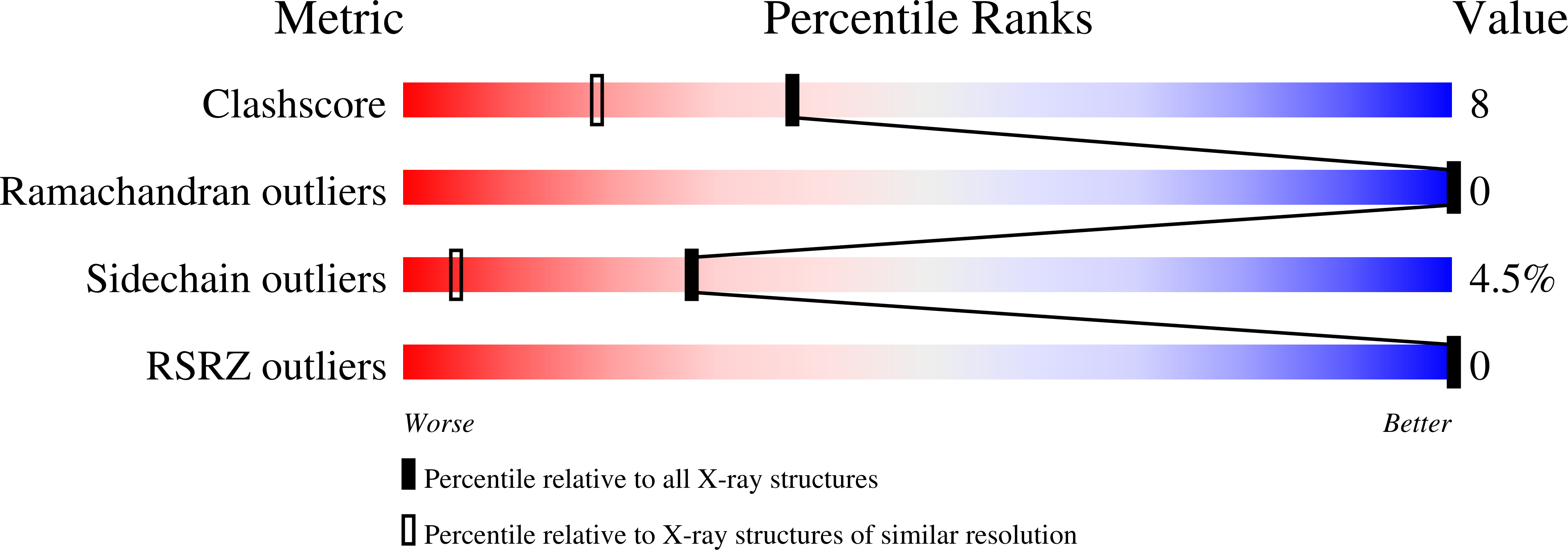
Experimental Method:
Resolution:
1.50 Å
R-Value Work:
0.19
Space Group:
P 61
Macromolecular Entities
Structures with similar UniProt ID
Protein Blast
Polymer Type:polypeptide(L)
Molecule:CYTOCHROME C
Chain IDs:A
Chain Length:112
Number of Molecules:1
Biological Source:Oryza sativa
Modified Residue
Compound ID Chain ID Parent Comp ID Details 2D Image
M3L A LYS N-TRIMETHYLLYSINE
Ligand Molecules
Primary Citation
Structure of rice ferricytochrome c at 2.0 A resolution.
J.Mol.Biol. 166 407 418 (1983)
PMID: 6304326 DOI: 10.1016/S0022-2836(83)80092-8

Abstact

The crystal structure of ferricytochrome c from rice embryos has been solved by X-ray diffraction to a resolution of 2.0 A, applying a single isomorphous replacement method with anomalous scattering effects. The initial molecular model was built on a graphics display system and was refined by the Hendrickson and Konnert method. The R factor was reduced to 0.25. Rice cytochrome c consists of III amino acid residues. In comparison with animal cytochromes c, the peptide chain extends for eight residues at the N-terminal end, which is characteristic for plant cytochromes c. These additional residues display a collagen-like conformation and an irregular reverse turn, and are located around the C-terminal alpha-helix on the surface or the rear side of the molecule. Two hydrogen bonds between the carbonyl oxygen of the N-terminal acetyl group and O eta of Tyr65, and between the peptide carbonyl oxygen of Pro-1 and O epsilon 1 of Gln89, are involved in holding these eight residues on the molecular surface, where Tyr65 and Gln89 are invariant in plant cytochromes c. Except for the extra eight residues, the main-chain conformations of both rice and tuna cytochromes c are essentially identical, though small local conformational differences are found at residues 24, 25, 56 and 57.

Legend

Protein

Chemical

Disease

Primary Citation of related structures
Feedback Form
Name
Email
Institute
Feedback