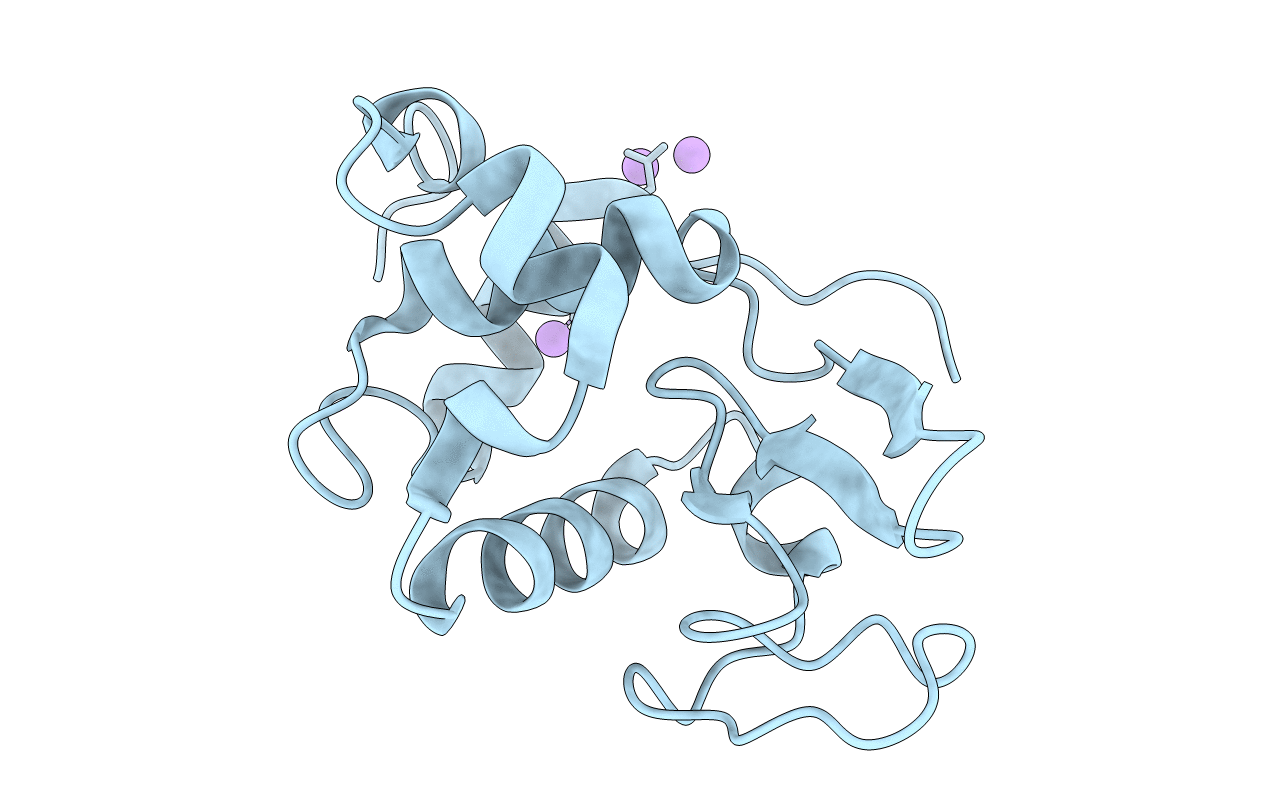
1C7P image
Deposition Date 2000-02-29
Release Date 2000-04-05
Last Version Date 2024-11-13
Entry Detail
PDB ID:
1C7P
Keywords:
Title:
CRYSTAL STRUCTURE OF MUTANT HUMAN LYSOZYME WITH FOUR EXTRA RESIDUES (EAEA) AT THE N-TERMINAL
Biological Source:
Source Organism:
Homo sapiens (Taxon ID: 9606)
Host Organism:
Method Details:
Experimental Method:
Resolution:
2.40 Å
R-Value Observed:
0.19
Space Group:
P 61 2 2

Macromolecular Entities
Structures with similar UniProt ID
Protein Blast
Polymer Type:polypeptide(L)
Molecule:LYSOZYME
Gene (Uniprot):LYZ
Mutagens:T15E, V16A, Q17E, G18A
Chain IDs:A
Chain Length:134
Number of Molecules:1
Biological Source:Homo sapiens
Ligand Molecules
Primary Citation
Effect of extra N-terminal residues on the stability and folding of human lysozyme expressed in Pichia pastoris.
Protein Eng. 13 299 307 (2000)
PMID: 10810162 DOI: 10.1093/protein/13.4.299

Abstact

A human lysozyme expression system by Pichia pastoris was constructed with the expression vector of pPIC9, which contains the alpha-factor signal peptide known for high secretion efficiency. P. pastoris expressed the human lysozyme at about 300 mg/l broth, but four extra residues (Glu(-4)-Ala(-3)-Glu(-2)-Ala(-1)-) were added at the N-terminus of the expressed protein (EAEA-lysozyme). To determine the effect of the four extra residues on the stability, structures and folding of the protein, calorimetry, X-ray crystal analysis and GuHCl denaturation experiments were performed. The calorimetric studies showed that the EAEA-lysozyme was destabilized by 9.6 kJ/mol at pH 2.7 compared with the wild-type protein, mainly caused by the substantial decrease in the enthalpy change (DeltaH). On the basis of structural information on the EAEA-lysozyme, thermodynamic analyses show that (1) the addition of the four residues slightly affected the conformation in other parts far from the N-terminus, (2) the large decrease in the enthalpy change due to the conformational changes would be almost compensated by the decrease in the entropy change and (3) the decrease in the Gibbs energy change between the EAEA and wild-type human lysozymes could be explained by the summation of each Gibbs energy change contributing to the stabilizing factors concerning the extra residues.

Legend

Protein

Chemical

Disease

Primary Citation of related structures
Feedback Form
Name
Email
Institute
Feedback