1C4W image
Deposition Date 1999-09-28
Release Date 2000-05-08
Last Version Date 2023-12-27
Entry Detail
PDB ID:
1C4W
Title:
1.9 A STRUCTURE OF A-THIOPHOSPHONATE MODIFIED CHEY D57C
Biological Source:
Source Organism:
Escherichia coli (Taxon ID: 562)
Host Organism:
Method Details:
Experimental Method:
Resolution:
1.84 Å
R-Value Work:
0.20
Space Group:
P 21 21 21
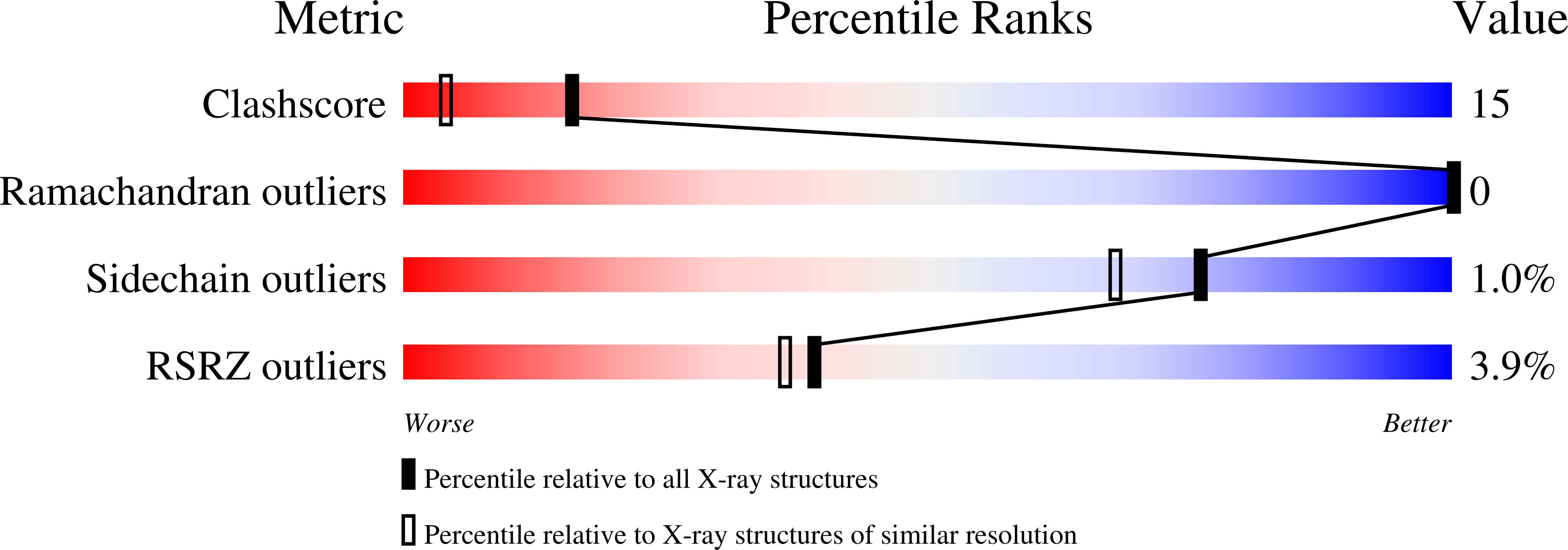
Macromolecular Entities
Structures with similar UniProt ID
Protein Blast
Polymer Type:polypeptide(L)
Molecule:CHEMOTAXIS PROTEIN CHEY
Mutagens:D57(CYQ)
Chain IDs:A
Chain Length:128
Number of Molecules:1
Biological Source:Escherichia coli
Modified Residue
Compound ID Chain ID Parent Comp ID Details 2D Image
CYQ A CYS ?
Primary Citation
The 1.9 A resolution crystal structure of phosphono-CheY, an analogue of the active form of the response regulator, CheY.
Biochemistry 39 5280 5286 (2000)
PMID: 10819997 DOI: 10.1021/bi9925524

Abstact

To structurally characterize the activated state of the transiently phosphorylated signal transduction protein CheY, we have constructed an alpha-thiophosphonate derivative of the CheY D57C point mutant and determined its three-dimensional structure at 1.85 A resolution. We have also characterized this analogue with high-resolution NMR and studied its binding to a peptide derived from FliM, CheY's target component of the flagellar motor. The chemically modified derivative, phosphono-CheY, exhibits many of the chemical properties of phosphorylated wild-type CheY, except that it is indefinitely stable. Electron density for the alpha-thiophosphonate substitution is clear and readily interpretable; omit refinement density at the phosphorus atom is greater than 10sigma. The molecule shows a number of localized conformational changes that are believed to constitute the postphosphorylation activation events. The most obvious of these changes include movement of the side chain of the active site base, Lys 109, and a predominately buried conformation of the side chain of Tyr 106. In addition, there are a number of more subtle changes more distant from the active site involving the alpha4 and alpha5 helices. These results are consistent with our previous structural interpretations of other CheY activation mutants, and with our earlier hypotheses concerning CheY activation through propagation of structural changes away from the active site.

Legend

Protein

Chemical

Disease

Primary Citation of related structures
Feedback Form
Name
Email
Institute
Feedback