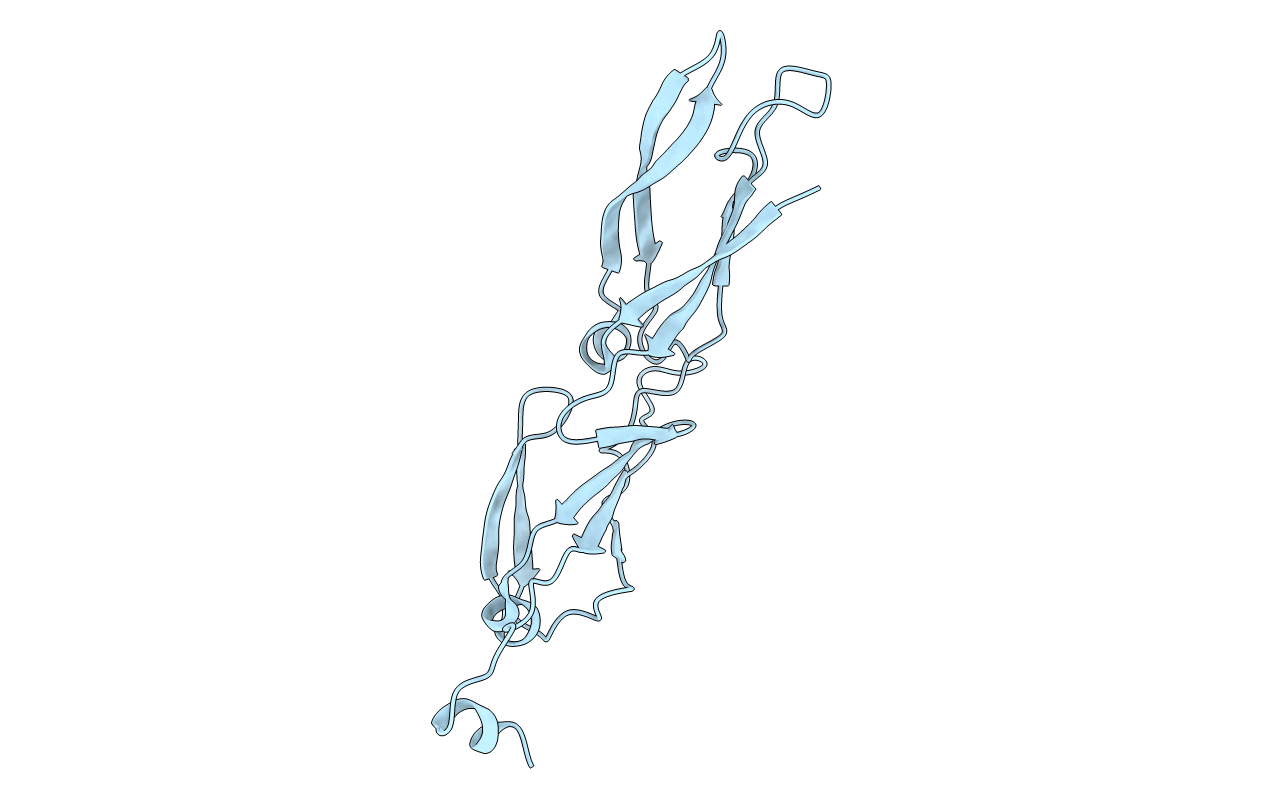
1C3G image
Deposition Date 1999-07-27
Release Date 2000-08-03
Last Version Date 2024-02-07
Entry Detail
PDB ID:
1C3G
Keywords:
Title:
S. CEREVISIAE HEAT SHOCK PROTEIN 40 SIS1
Biological Source:
Source Organism:
Host Organism:
Method Details:
Experimental Method:
Resolution:
2.70 Å
R-Value Free:
0.31
R-Value Work:
0.26
R-Value Observed:
0.26
Space Group:
P 41 21 2

Macromolecular Entities
Structures with similar UniProt ID
Protein Blast
Polymer Type:polypeptide(L)
Molecule:HEAT SHOCK PROTEIN 40
Gene (Uniprot):SIS1
Chain IDs:A
Chain Length:170
Number of Molecules:1
Biological Source:Saccharomyces cerevisiae
Primary Citation
The crystal structure of the peptide-binding fragment from the yeast Hsp40 protein Sis1.
Structure 8 799 807 (2000)
PMID: 10997899 DOI: 10.1107/S090744499900476X

Abstact

BACKGROUND: Molecular chaperone Hsp40 can bind non-native polypeptide and facilitate Hsp70 in protein refolding. How Hsp40 and other chaperones distinguish between the folded and unfolded states of proteins to bind nonnative polypeptides is a fundamental issue. RESULTS: To investigate this mechanism, we determined the crystal structure of the peptide-binding fragment of Sis1, an essential member of the Hsp40 family from Saccharomyces cerevisiae. The 2.7 A structure reveals that Sis1 forms a homodimer in the crystal by a crystallographic twofold axis. Sis1 monomers are elongated and consist of two domains with similar folds. Sis1 dimerizes through a short C-terminal stretch. The Sis1 dimer has a U-shaped architecture and a large cleft is formed between the two elongated monomers. Domain I in each monomer contains a hydrophobic depression that might be involved in binding the sidechains of hydrophobic amino acids. CONCLUSIONS: Sis1 (1-337), which lacks the dimerization motif, exhibited severe defects in chaperone activity, but could regulate Hsp70 ATPase activity. Thus, dimer formation is critical for Sis1 chaperone function. We propose that the Sis1 cleft functions as a docking site for the Hsp70 peptide-binding domain and that Sis1-Hsp70 interaction serves to facilitate the efficient transfer of peptides from Sis1 to Hsp70.

Legend

Protein

Chemical

Disease

Primary Citation of related structures
Feedback Form
Name
Email
Institute
Feedback